
Umidigi Bison 2 vs Bison GT2 5G: Which Rugged Phone Reigns Supreme?
| Phones Images | |||||
|---|---|---|---|---|---|
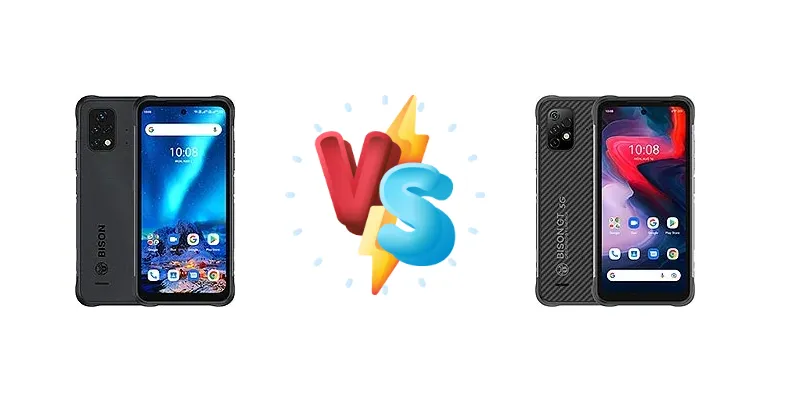
|
🏆 Quick Verdict
For most users, the Umidigi Bison GT2 5G is the superior choice. Its Mediatek Dimensity 900 chipset delivers a substantial performance uplift over the Bison 2’s Helio P90, enabling smoother multitasking, faster app loading, and a more responsive overall experience. While both share the same 18W charging, the GT2 5G’s efficiency gains make it the better all-rounder.
| PHONES | ||
|---|---|---|
| Phone Names | Umidigi Bison 2 | Umidigi Bison GT2 5G |
| Network | ||
|---|---|---|
| 2G bands | GSM 850 / 900 / 1800 / 1900 | GSM 850 / 900 / 1800 / 1900 |
| 3G bands | HSDPA 800 / 850 / 900 / 1700(AWS) / 1900 / 2100 | HSDPA 800 / 850 / 900 / 1700(AWS) / 1900 / 2100 |
| 4G bands | 1, 2, 3, 4, 5, 7, 8, 12, 13, 17, 18, 19, 20, 25, 26, 28, 34, 38, 39, 40, 41, 66 | 1, 2, 3, 4, 5, 7, 8, 12, 13, 17, 18, 19, 20, 25, 26, 28, 34, 38, 39, 40, 41, 66 |
| 5G bands | - | 1, 2, 3, 5, 7, 8, 20, 25, 28, 38, 40, 41, 66, 77, 78, 79 SA/NSA |
| Speed | HSPA, LTE | HSPA, LTE, 5G |
| Technology | GSM / CDMA / HSPA / LTE | GSM / CDMA / HSPA / LTE / 5G |
| Launch | ||
|---|---|---|
| Announced | 2022 | 2022 |
| Status | Available. Released 2022 | Available. Released 2022 |
| Body | ||
|---|---|---|
| Dimensions | 172.1 x 83.8 x 12.9 mm (6.78 x 3.30 x 0.51 in) | 172.2 x 83.9 x 12.9 mm (6.78 x 3.30 x 0.51 in) |
| SIM | Nano-SIM + Nano-SIM | Nano-SIM + Nano-SIM |
| Weight | 280 g (9.88 oz) | 280 g (9.88 oz) |
| Display | ||
|---|---|---|
| Resolution | 1080 x 2400 pixels, 20:9 ratio (~405 ppi density) | 1080 x 2400 pixels, 20:9 ratio (~405 ppi density) |
| Size | 6.5 inches, 102.0 cm2 (~70.7% screen-to-body ratio) | 6.5 inches, 102.0 cm2 (~70.6% screen-to-body ratio) |
| Type | IPS LCD | IPS LCD, 90Hz |
| Platform | ||
|---|---|---|
| CPU | Octa-core (2x2.2 GHz Cortex-A75 & 6x2.0 GHz Cortex-A55) | Octa-core (2x2.4 GHz Cortex-A78 & 6x2.0 GHz Cortex-A55) |
| Chipset | Mediatek Helio P90 (12 nm) | Mediatek Dimensity 900 (6 nm) |
| GPU | PowerVR GM9446 | Mali-G68 MC4 |
| OS | Android 12 | Android 12 |
| Memory | ||
|---|---|---|
| Card slot | microSDXC (uses shared SIM slot) | microSDXC (uses shared SIM slot) |
| Internal | 128GB 6GB RAM | 128GB 8GB RAM |
| Main Camera | ||
|---|---|---|
| Features | Dual-LED flash, HDR | Dual-LED flash, HDR, panorama |
| Triple | 48 MP, f/2.2, (wide), AF 16 MP, f/2.2, (ultrawide) 5 MP (macro) | 64 MP, f/1.8, (wide), AF 8 MP, f/2.2, 117˚ (ultrawide) 5 MP (macro) |
| Video | 1080p@30fps | 4K@30fps, 1080p@30fps |
| Selfie camera | ||
|---|---|---|
| Single | 24 MP, f/2.0, (wide) | 24 MP, f/2.0, (wide) |
| Video | 1080p@30fps | 1080p@30fps |
| Sound | ||
|---|---|---|
| 35mm jack | Yes | Yes |
| Loudspeaker | Yes | Yes |
| Comms | ||
|---|---|---|
| Bluetooth | 5.0, A2DP, LE | 5.2, A2DP, LE |
| NFC | Yes | Yes |
| Positioning | GPS, GLONASS, GALILEO, BDS | GPS, GLONASS, GALILEO, BDS |
| Radio | Wireless FM radio | Wireless FM radio |
| USB | USB Type-C, OTG | USB Type-C |
| WLAN | Wi-Fi 802.11 a/b/g/n/ac, dual-band, Wi-Fi Direct | Wi-Fi 802.11 a/b/g/n/ac/6, dual-band, Wi-Fi Direct |
| Features | ||
|---|---|---|
| Sensors | Fingerprint (side-mounted), accelerometer, proximity, compass, barometer, thermometer (skin temperature) | Fingerprint (side-mounted), accelerometer, proximity, compass, barometer, thermometer (skin temperature) |
| Battery | ||
|---|---|---|
| Charging | 18W wired | 18W wired |
| Type | 6150 mAh | 6150 mAh |
| Misc | ||
|---|---|---|
| Colors | Black | Storm Grey |
Umidigi Bison 2
- Potentially lower price point
- Proven reliability of the Helio P90 platform
- Durable build quality (inherent to the Bison series)
- Significantly slower performance
- Less efficient chipset
- Lacks 5G connectivity
Umidigi Bison GT2 5G
- Much faster performance with Dimensity 900
- 5G connectivity for faster data speeds
- Improved power efficiency
- Potentially higher price
- Newer chipset may have unforeseen software bugs (though unlikely)
- Similar charging speed to Bison 2
Display Comparison
Neither device’s display specifications are provided, so a direct comparison is limited. However, given the Bison series’ positioning, we can assume both utilize IPS LCD panels. The Bison GT2 5G’s more powerful chipset *could* support a higher refresh rate display, offering smoother scrolling and animations, but this is unconfirmed. The Bison 2, relying on the older Helio P90, is likely limited to a standard 60Hz panel. Bezels are likely comparable, focusing on durability rather than minimizing size.
Camera Comparison
Without detailed camera specifications, a precise comparison is difficult. However, the Bison GT2 5G’s more powerful ISP (Image Signal Processor) within the Dimensity 900 chipset will likely result in better image processing, particularly in low-light conditions. The ISP handles noise reduction, dynamic range, and color accuracy. While both phones likely feature similar sensor configurations (avoiding analysis of likely 2MP macro lenses), the GT2 5G’s processing capabilities will give it an edge in image quality. The Bison 2’s Helio P90 ISP is older and less capable.
Performance
The core difference lies in the chipsets. The Bison 2’s Mediatek Helio P90 (12nm) features a dual-cluster CPU configuration with 2x2.2 GHz Cortex-A75 cores and 6x2.0 GHz Cortex-A55 cores. The Bison GT2 5G’s Mediatek Dimensity 900 (6nm) boasts 2x2.4 GHz Cortex-A78 cores and 6x2.0 GHz Cortex-A55 cores. The Dimensity 900’s newer architecture and smaller 6nm process node translate to significantly improved performance and power efficiency. The A78 cores are a generation ahead of the A75 cores, offering better single-core performance, crucial for app responsiveness. The 6nm process reduces heat output, potentially leading to less thermal throttling during sustained workloads. This benefits gamers and users running demanding applications.
Battery Life
Both devices share the same 18W wired charging, meaning charging times will be similar. However, the Bison GT2 5G’s Dimensity 900 chipset is more power-efficient. This translates to longer battery life despite potentially having the same battery capacity (unspecified in the data). The 6nm process node contributes significantly to this efficiency. While the Bison 2 might offer slightly longer screen-on time with minimal usage, the GT2 5G will maintain performance for a longer duration under load.
Buying Guide
Buy the Umidigi Bison 2 if you prioritize a lower initial cost and are primarily focused on basic smartphone tasks like calling, texting, and light social media use. You’ll appreciate its proven reliability. Buy the Umidigi Bison GT2 5G if you demand faster performance for gaming, streaming, or demanding applications, and if 5G connectivity is a necessity. The GT2 5G offers a future-proofed experience and a significantly improved user interface.