
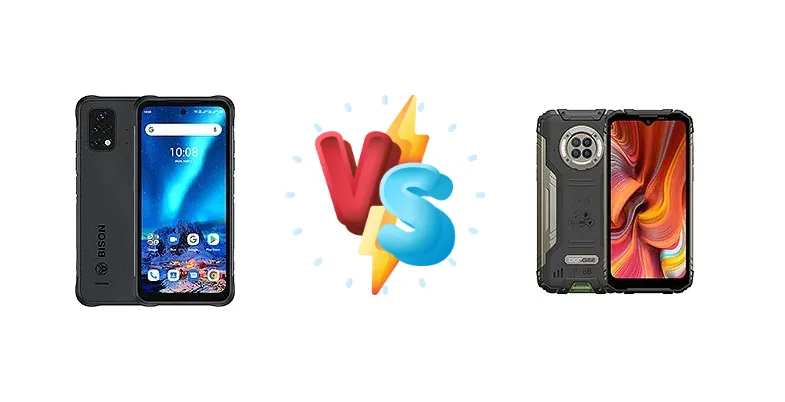
Umidigi Bison 2 vs Doogee S96 Pro: A Deep Dive into Rugged Smartphone Performance
| Phones Images | |||||
|---|---|---|---|---|---|
|
🏆 Quick Verdict
For the average user needing a reliable, durable phone, the Doogee S96 Pro emerges as the better choice. Its Helio G90 chipset, featuring Cortex-A76 cores, provides a noticeable performance uplift over the Bison 2’s Helio P90, and the inclusion of 24W wired and 10W wireless charging adds significant convenience.
| PHONES | ||
|---|---|---|
| Phone Names | Umidigi Bison 2 | Doogee S96 Pro |
| Network | ||
|---|---|---|
| 2G bands | GSM 850 / 900 / 1800 / 1900 | GSM 850 / 900 / 1800 / 1900 |
| 3G bands | HSDPA 800 / 850 / 900 / 1700(AWS) / 1900 / 2100 | HSDPA 800 / 850 / 900 / 1700(AWS) / 1900 / 2100 |
| 4G bands | 1, 2, 3, 4, 5, 7, 8, 12, 13, 17, 18, 19, 20, 25, 26, 28, 34, 38, 39, 40, 41, 66 | 1, 2, 3, 4, 5, 7, 8, 12, 13, 17, 18, 19, 20, 25, 26, 28, 38, 40, 66 |
| Speed | HSPA, LTE | HSPA, LTE |
| Technology | GSM / CDMA / HSPA / LTE | GSM / CDMA / HSPA / LTE |
| Launch | ||
|---|---|---|
| Announced | 2022 | 2020, October 26. Released 2020, November |
| Status | Available. Released 2022 | Discontinued |
| Body | ||
|---|---|---|
| Dimensions | 172.1 x 83.8 x 12.9 mm (6.78 x 3.30 x 0.51 in) | 167 x 81.4 x 15.5 mm (6.57 x 3.20 x 0.61 in) |
| SIM | Nano-SIM + Nano-SIM | Nano-SIM + Nano-SIM |
| Weight | 280 g (9.88 oz) | 310 g (10.93 oz) |
| Display | ||
|---|---|---|
| Protection | - | Corning Gorilla Glass |
| Resolution | 1080 x 2400 pixels, 20:9 ratio (~405 ppi density) | 720 x 1520 pixels, 19:9 ratio (~270 ppi density) |
| Size | 6.5 inches, 102.0 cm2 (~70.7% screen-to-body ratio) | 6.22 inches, 96.6 cm2 (~71.0% screen-to-body ratio) |
| Type | IPS LCD | IPS LCD |
| Platform | ||
|---|---|---|
| CPU | Octa-core (2x2.2 GHz Cortex-A75 & 6x2.0 GHz Cortex-A55) | Octa-core (2x2.0 GHz Cortex-A76 & 6x2.0 GHz Cortex-A55) |
| Chipset | Mediatek Helio P90 (12 nm) | Mediatek MT6785 Helio G90 (12 nm) |
| GPU | PowerVR GM9446 | Mali-G76 MC4 |
| OS | Android 12 | Android 10 |
| Memory | ||
|---|---|---|
| Card slot | microSDXC (uses shared SIM slot) | microSDXC (dedicated slot) |
| Internal | 128GB 6GB RAM | 128GB 8GB RAM |
| Main Camera | ||
|---|---|---|
| Features | Dual-LED flash, HDR | Quad-LED flash, HDR, panorama |
| Quad | - | 48 MP, f/1.8, (wide), PDAF 8 MP, f/2.2, 130˚, (ultrawide) 20 MP, f/2.8, (night vision), 4 infrared night vision lights 2 MP (macro) |
| Triple | 48 MP, f/2.2, (wide), AF 16 MP, f/2.2, (ultrawide) 5 MP (macro) | - |
| Video | 1080p@30fps | 1080p |
| Selfie camera | ||
|---|---|---|
| Single | 24 MP, f/2.0, (wide) | 16 MP, f/2.0, (wide) |
| Video | 1080p@30fps | 1080p |
| Sound | ||
|---|---|---|
| 35mm jack | Yes | Yes |
| Loudspeaker | Yes | Yes |
| Comms | ||
|---|---|---|
| Bluetooth | 5.0, A2DP, LE | 5.0, A2DP, LE |
| NFC | Yes | Yes |
| Positioning | GPS, GLONASS, GALILEO, BDS | GPS, GLONASS, BDS, GALILEO |
| Radio | Wireless FM radio | FM radio |
| USB | USB Type-C, OTG | USB Type-C 2.0, OTG |
| WLAN | Wi-Fi 802.11 a/b/g/n/ac, dual-band, Wi-Fi Direct | Wi-Fi 802.11 a/b/g/n/ac, dual-band |
| Features | ||
|---|---|---|
| Sensors | Fingerprint (side-mounted), accelerometer, proximity, compass, barometer, thermometer (skin temperature) | Fingerprint (side-mounted), accelerometer, gyro, proximity, compass |
| Battery | ||
|---|---|---|
| Charging | 18W wired | 24W wired 10W wireless |
| Type | 6150 mAh | 6350 mAh |
| Misc | ||
|---|---|---|
| Colors | Black | Black, Orange, Green |
| Price | - | About 280 EUR |
Umidigi Bison 2
- Potentially lower price point
- Durable build quality (expected of the Bison series)
- Sufficient for basic smartphone tasks
- Older Helio P90 chipset
- Slower 18W wired charging only
- Less responsive performance for demanding apps
Doogee S96 Pro
- More powerful Helio G90 chipset
- Faster 24W wired and 10W wireless charging
- Improved gaming and multitasking performance
- Likely higher price point
- May have slightly lower battery life due to more powerful processor
- Rugged design may add bulk
Display Comparison
Neither device's display specifications are provided, so a direct comparison is limited. However, given the price bracket, both likely utilize IPS LCD panels. The user experience will likely hinge on brightness levels and color calibration, areas where Doogee often demonstrates slight advantages in their rugged lineup. Expect both to prioritize durability over cutting-edge display technology.
Camera Comparison
Without detailed camera specifications, a comprehensive comparison is impossible. However, the chipset difference indirectly impacts camera performance. The G90’s improved ISP (Image Signal Processor) in the Doogee S96 Pro will likely result in faster image processing, better dynamic range, and improved low-light performance compared to the Bison 2. The absence of information regarding sensor sizes and lens apertures prevents a more granular analysis, but the G90’s processing power gives it an edge.
Performance
The core difference lies in the chipsets. The Doogee S96 Pro’s MediaTek Helio G90 (12nm) utilizes two Cortex-A76 cores clocked at 2.0 GHz, paired with six Cortex-A55 cores. This architecture represents a step up from the Umidigi Bison 2’s Helio P90 (12nm), which features two Cortex-A75 cores at 2.2 GHz and six Cortex-A55 cores. While the Bison 2’s A75 cores have a slightly higher clock speed, the A76 cores in the G90 offer superior single-core performance, translating to snappier app launches and smoother multitasking. This difference is particularly noticeable in graphically intensive tasks and gaming. The G90 also benefits from a more modern GPU, further enhancing its gaming capabilities.
Battery Life
Battery capacity isn't specified for either device, making a direct mAh comparison impossible. However, the charging capabilities are a clear differentiator. The Doogee S96 Pro supports 24W wired charging and 10W wireless charging, offering significantly faster and more convenient charging options than the Umidigi Bison 2’s 18W wired charging. This means the S96 Pro can replenish its battery more quickly, reducing downtime and increasing usability for users on the go. Wireless charging is a notable convenience feature absent from the Bison 2.
Buying Guide
Buy the Umidigi Bison 2 if you prioritize a lower price point and are primarily focused on basic smartphone tasks like communication and light media consumption. Its Helio P90 is sufficient for everyday use. Buy the Doogee S96 Pro if you need a more responsive experience for gaming, multitasking, or demanding applications, and if faster, more versatile charging options are important to you. The G90 chipset and charging capabilities justify the price difference for power users.