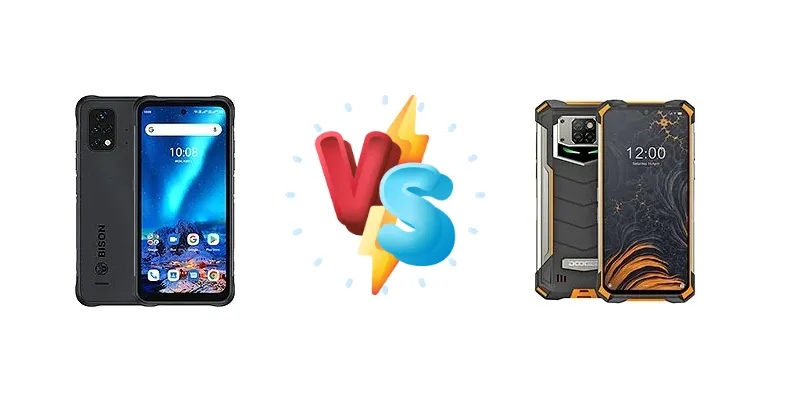
The Umidigi Bison 2 and Doogee S88 Pro both target the rugged smartphone market, offering durability and features for outdoor enthusiasts. However, they diverge in their core specifications, particularly in chipset and charging capabilities. This comparison dissects these differences to determine which device provides the best balance of performance, battery life, and value.
🏆 Quick Verdict
For most users, the Umidigi Bison 2 emerges as the stronger choice. Its Helio P90 chipset, featuring more powerful Cortex-A75 cores, provides a noticeable performance edge over the Doogee S88 Pro’s Helio P70. While the S88 Pro boasts faster charging and wireless capabilities, the Bison 2’s superior processing power makes it better suited for demanding tasks.
| Network |
|---|
| 2G bands | GSM 850 / 900 / 1800 / 1900 | GSM 850 / 900 / 1800 / 1900 |
| 3G bands | HSDPA 800 / 850 / 900 / 1700(AWS) / 1900 / 2100 | HSDPA 850 / 900 / 1700(AWS) / 1900 / 2100 |
| 4G bands | 1, 2, 3, 4, 5, 7, 8, 12, 13, 17, 18, 19, 20, 25, 26, 28, 34, 38, 39, 40, 41, 66 | 1, 3, 7, 8, 20 |
| Speed | HSPA, LTE | HSPA, LTE |
| Technology | GSM / CDMA / HSPA / LTE | GSM / HSPA / LTE |
| Launch |
|---|
| Announced | 2022 | 2020, June 06. Released 2020, June 06 |
| Status | Available. Released 2022 | Discontinued |
| Body |
|---|
| Build | - | Glass front (Gorilla Glass), aluminum back with rubber, aluminum frame |
| Dimensions | 172.1 x 83.8 x 12.9 mm (6.78 x 3.30 x 0.51 in) | 171.6 x 85.5 x 18.7 mm (6.76 x 3.37 x 0.74 in) |
| SIM | Nano-SIM + Nano-SIM | Nano-SIM + Nano-SIM |
| Weight | 280 g (9.88 oz) | 372 g (13.12 oz) |
| Display |
|---|
| Protection | - | Corning Gorilla Glass |
| Resolution | 1080 x 2400 pixels, 20:9 ratio (~405 ppi density) | 1080 x 2340 pixels, 19.5:9 ratio (~409 ppi density) |
| Size | 6.5 inches, 102.0 cm2 (~70.7% screen-to-body ratio) | 6.3 inches, 97.4 cm2 (~66.4% screen-to-body ratio) |
| Type | IPS LCD | IPS LCD |
| Platform |
|---|
| CPU | Octa-core (2x2.2 GHz Cortex-A75 & 6x2.0 GHz Cortex-A55) | Octa-core (4x2.1 GHz Cortex-A73 & 4x2.0 GHz Cortex-A53) |
| Chipset | Mediatek Helio P90 (12 nm) | Mediatek MT6771T Helio P70 (12 nm) |
| GPU | PowerVR GM9446 | Mali-G72 MP3 |
| OS | Android 12 | Android 10 |
| Memory |
|---|
| Card slot | microSDXC (uses shared SIM slot) | microSDXC (uses shared SIM slot) |
| Internal | 128GB 6GB RAM | 128GB 6GB RAM |
| Main Camera |
|---|
| Features | Dual-LED flash, HDR | Dual-LED dual-tone flash, HDR, panorama |
| Triple | 48 MP, f/2.2, (wide), AF
16 MP, f/2.2, (ultrawide)
5 MP (macro) | 21 MP, f/2.2, (wide), 1/2.4", 1.12µm, PDAF
8 MP, f/2.2, 130˚, (ultrawide), 1/4.0", 1.12µm
Auxiliary lens |
| Video | 1080p@30fps | 1080p@30fps |
| Selfie camera |
|---|
| Single | 24 MP, f/2.0, (wide) | 16 MP, f/2.2, 26mm (wide) |
| Video | 1080p@30fps | 1080p@30fps |
| Sound |
|---|
| 35mm jack | Yes | No |
| Loudspeaker | Yes | Yes |
| Comms |
|---|
| Bluetooth | 5.0, A2DP, LE | 4.2, A2DP |
| NFC | Yes | Yes |
| Positioning | GPS, GLONASS, GALILEO, BDS | GPS, GLONASS, BDS, GALILEO |
| Radio | Wireless FM radio | FM radio |
| USB | USB Type-C, OTG | USB Type-C 2.0, OTG |
| WLAN | Wi-Fi 802.11 a/b/g/n/ac, dual-band, Wi-Fi Direct | Wi-Fi 802.11 b/g/n |
| Features |
|---|
| Sensors | Fingerprint (side-mounted), accelerometer, proximity, compass, barometer, thermometer (skin temperature) | Fingerprint (side-mounted), accelerometer, gyro, proximity, compass |
| Battery |
|---|
| Charging | 18W wired | 24W wired
10W wireless
5W Reverse wireless |
| Type | 6150 mAh | 10000 mAh |
| Misc |
|---|
| Colors | Black | Fire Orange, Army Green, Mineral Black |
| Price | - | About 130 EUR |
Umidigi Bison 2
- More powerful Helio P90 chipset for better performance.
- Potentially smoother multitasking and gaming experience.
- Likely better CPU performance for demanding apps.
- Slower 18W wired charging.
- No wireless charging support.
Doogee S88 Pro
- Excellent 202-hour endurance rating for long battery life.
- Faster 24W wired charging.
- Convenient 10W wireless charging and 5W reverse wireless charging.
- Less powerful Helio P70 chipset.
- Potentially slower app loading and multitasking.
Display Comparison
The context data lacks detailed display specifications for both devices. However, given their price points, we can assume both utilize IPS LCD panels. The Doogee S88 Pro’s reported contrast ratio of 1641:1 suggests a reasonably good, though not exceptional, visual experience. Without knowing the resolution or brightness levels, it’s difficult to definitively declare a winner. Users prioritizing color accuracy and viewing angles should research independent display tests before purchasing.
Camera Comparison
The provided data doesn’t offer sufficient detail for a meaningful camera comparison. Both phones likely feature multi-camera setups, but without knowing sensor sizes, apertures, or image processing algorithms, it’s impossible to assess image quality. The presence of a 2MP macro camera on either device is unlikely to significantly impact the overall photographic experience; these sensors typically lack the resolution and dynamic range to produce high-quality macro shots. Users should focus on reviews that provide sample images and detailed camera analysis.
Performance
The Umidigi Bison 2’s Mediatek Helio P90 chipset represents a clear advantage over the Doogee S88 Pro’s Helio P70. The P90 utilizes two Cortex-A75 cores clocked at 2.2 GHz, compared to the P70’s four Cortex-A73 cores at 2.1 GHz. The A75 architecture is more efficient and delivers higher single-core performance, crucial for responsive app launches and smoother multitasking. While both chips are 12nm, the architectural improvements in the P90 translate to a more fluid user experience, particularly for gaming and resource-intensive applications. The Bison 2 will likely exhibit less stuttering and faster load times.
Battery Life
The Doogee S88 Pro’s 202-hour endurance rating is a significant highlight, suggesting excellent battery life under typical usage. However, the Umidigi Bison 2’s battery capacity is not provided, making a direct comparison difficult. The S88 Pro’s 24W wired charging, 10W wireless charging, and 5W reverse wireless charging offer considerable convenience. The Bison 2’s 18W wired charging is slower, and lacks wireless charging options. For users who frequently travel or are away from power outlets, the S88 Pro’s charging versatility is a major benefit. However, the Bison 2’s potentially larger battery capacity (if present) could offset the slower charging speed.
Buying Guide
Buy the Umidigi Bison 2 if you prioritize performance for gaming, multitasking, or running demanding applications. Its more modern CPU architecture will translate to a smoother user experience. Buy the Doogee S88 Pro if you absolutely need wireless charging and faster wired charging speeds, and your usage is primarily focused on basic tasks like calls, messaging, and light social media. The S88 Pro’s endurance rating suggests it can handle extended use between charges, even with moderate usage.
Frequently Asked Questions
❓ Does the Helio P70 in the Doogee S88 Pro struggle with graphically intensive games like PUBG or Call of Duty?
The Helio P70 is capable of running these games, but you’ll likely need to lower the graphics settings to medium or low to achieve a consistently smooth frame rate. The P70’s GPU is less powerful than those found in more recent chipsets, so expect some frame drops during intense action sequences. The Umidigi Bison 2’s Helio P90 will provide a noticeably better gaming experience.
❓ How long does it realistically take to fully charge the Doogee S88 Pro from 0% using the 24W charger?
While the S88 Pro supports 24W charging, real-world charging times can vary. Expect a full charge from 0% to take approximately 1 hour and 45 minutes to 2 hours, depending on background app activity and battery temperature. The 10W wireless charging will take considerably longer, likely exceeding 4 hours.
❓ Is the reverse wireless charging on the Doogee S88 Pro useful for topping up accessories like earbuds?
Yes, the 5W reverse wireless charging is convenient for slowly topping up small accessories like wireless earbuds or smartwatches. However, it’s not a fast charging solution and should be considered a supplementary feature rather than a primary charging method. It's best suited for emergency situations or when a power outlet isn't readily available.