
Umidigi Bison 2 vs Blackview BV9900E: A Deep Dive into Rugged Smartphone Performance
| Phones Images | |||||
|---|---|---|---|---|---|
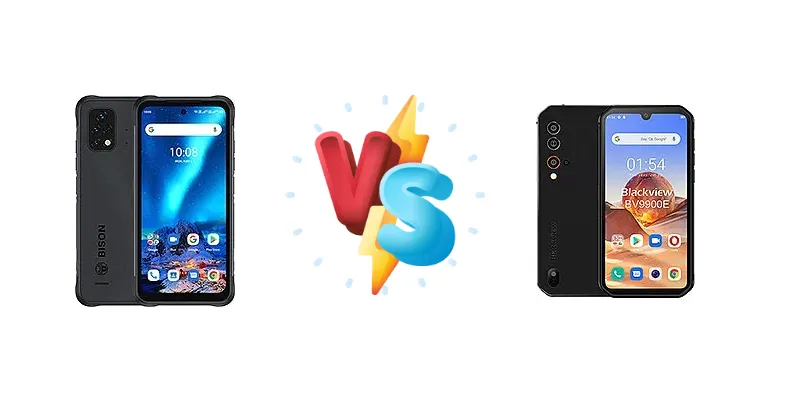
|
🏆 Quick Verdict
For the average user prioritizing a balance of affordability and reliable performance, the Umidigi Bison 2 emerges as the slightly stronger choice. While the Blackview BV9900E offers the convenience of wireless charging, the Bison 2’s lower price point and comparable performance make it a more compelling overall package.
| PHONES | ||
|---|---|---|
| Phone Names | Umidigi Bison 2 | Blackview BV9900E |
| Network | ||
|---|---|---|
| 2G bands | GSM 850 / 900 / 1800 / 1900 | GSM 850 / 900 / 1800 / 1900 |
| 3G bands | HSDPA 800 / 850 / 900 / 1700(AWS) / 1900 / 2100 | HSDPA 800 / 850 / 900 / 1700(AWS) / 1900 / 2100 |
| 4G bands | 1, 2, 3, 4, 5, 7, 8, 12, 13, 17, 18, 19, 20, 25, 26, 28, 34, 38, 39, 40, 41, 66 | 1, 2, 3, 4, 5, 7, 8, 12, 13, 17, 18, 19, 20, 25, 26, 28, 34, 38, 39, 40, 41, 66 |
| Speed | HSPA, LTE | HSPA, LTE |
| Technology | GSM / CDMA / HSPA / LTE | GSM / CDMA / HSPA / CDMA2000 / LTE |
| Launch | ||
|---|---|---|
| Announced | 2022 | 2020, September 10. Released 2020, September |
| Status | Available. Released 2022 | Discontinued |
| Body | ||
|---|---|---|
| Dimensions | 172.1 x 83.8 x 12.9 mm (6.78 x 3.30 x 0.51 in) | 156.5 x 78.3 x 14.2 mm (6.16 x 3.08 x 0.56 in) |
| SIM | Nano-SIM + Nano-SIM | Nano-SIM + Nano-SIM |
| Weight | 280 g (9.88 oz) | 273 g (9.63 oz) |
| Display | ||
|---|---|---|
| Protection | - | Corning Gorilla Glass 5 |
| Resolution | 1080 x 2400 pixels, 20:9 ratio (~405 ppi density) | 1080 x 2280 pixels, 19:9 ratio (~432 ppi density) |
| Size | 6.5 inches, 102.0 cm2 (~70.7% screen-to-body ratio) | 5.84 inches, 85.1 cm2 (~69.5% screen-to-body ratio) |
| Type | IPS LCD | IPS LCD |
| Platform | ||
|---|---|---|
| CPU | Octa-core (2x2.2 GHz Cortex-A75 & 6x2.0 GHz Cortex-A55) | Octa-core (2x2.2 GHz Cortex-A75 & 6x2.0 GHz Cortex-A55) |
| Chipset | Mediatek Helio P90 (12 nm) | Mediatek MT6779V/CE Helio P90 (12 nm) |
| GPU | PowerVR GM9446 | PowerVR GM9446 |
| OS | Android 12 | Android 10 |
| Memory | ||
|---|---|---|
| Card slot | microSDXC (uses shared SIM slot) | microSDXC |
| Internal | 128GB 6GB RAM | 128GB 6GB RAM |
| Main Camera | ||
|---|---|---|
| Features | Dual-LED flash, HDR | LED flash, HDR, panorama |
| Quad | - | 48 MP, f/1.8, (wide), PDAF 16 MP, 120˚ (ultrawide) 2 MP (macro) Auxiliary lens |
| Triple | 48 MP, f/2.2, (wide), AF 16 MP, f/2.2, (ultrawide) 5 MP (macro) | - |
| Video | 1080p@30fps | 4K@30fps, 1080p@60fps |
| Selfie camera | ||
|---|---|---|
| Single | 24 MP, f/2.0, (wide) | 16 MP, f/2.0, (wide) |
| Video | 1080p@30fps | 1080p@30fps |
| Sound | ||
|---|---|---|
| 35mm jack | Yes | No |
| Loudspeaker | Yes | Yes |
| Comms | ||
|---|---|---|
| Bluetooth | 5.0, A2DP, LE | 5.0, A2DP, LE |
| NFC | Yes | Yes |
| Positioning | GPS, GLONASS, GALILEO, BDS | GPS, GLONASS, GALILEO, BDS |
| Radio | Wireless FM radio | FM radio |
| USB | USB Type-C, OTG | USB Type-C 2.0, OTG |
| WLAN | Wi-Fi 802.11 a/b/g/n/ac, dual-band, Wi-Fi Direct | Wi-Fi 802.11 a/b/g/n/ac |
| Features | ||
|---|---|---|
| Sensors | Fingerprint (side-mounted), accelerometer, proximity, compass, barometer, thermometer (skin temperature) | Fingerprint (side-mounted), accelerometer, gyro, proximity, compass, barometer |
| Battery | ||
|---|---|---|
| Charging | 18W wired | 15W wired 18W wireless |
| Type | 6150 mAh | 4380 mAh |
| Misc | ||
|---|---|---|
| Colors | Black | Black, Silver |
| Price | - | About 260 EUR |
Umidigi Bison 2
- Potentially lower price point
- Comparable CPU and GPU performance to BV9900E
- Reliable 18W wired charging
- Lacks wireless charging
- Camera specifications are unknown
Blackview BV9900E
- Convenient 18W wireless charging
- Offers both wired and wireless charging options
- Potentially more refined software experience (brand reputation)
- Slightly higher price compared to Bison 2
- Wired charging is slower than Bison 2 (15W vs 18W)
Display Comparison
Both the Umidigi Bison 2 and Blackview BV9900E likely feature IPS LCD panels, typical for this price segment. Specific details like resolution and peak brightness are not provided, but rugged phones prioritize visibility in direct sunlight. The absence of high refresh rate panels is expected, focusing instead on power efficiency. Bezels are likely to be substantial on both devices, prioritizing structural integrity and drop protection over a modern, edge-to-edge aesthetic.
Camera Comparison
Camera specifications are not detailed enough to draw significant conclusions. Both phones likely feature multi-camera setups, but the quality will heavily depend on sensor size, lens aperture, and image processing algorithms – details not provided. The presence of a 2MP macro camera on either device is likely a marketing feature with limited practical utility. Image quality will likely be adequate for social media sharing but shouldn't be expected to compete with flagship smartphones.
Performance
Both devices are powered by the Mediatek Helio P90 (12 nm) chipset, featuring an octa-core CPU configuration with two Cortex-A75 cores clocked at 2.2 GHz and six Cortex-A55 cores at 2.0 GHz. This means CPU performance will be virtually identical between the two. The GPU performance will also be comparable. However, thermal management, which isn't specified, could differentiate real-world sustained performance. The lack of information on RAM type (LPDDR4X is likely) and speed prevents a deeper analysis, but the Helio P90 is capable of handling everyday tasks and moderate gaming.
Battery Life
Battery capacity isn't specified for either device, but rugged phones typically prioritize large batteries. The Blackview BV9900E gains an advantage with its 15W wired *and* 18W wireless charging capabilities. While the Umidigi Bison 2 offers 18W wired charging, the lack of wireless charging is a notable omission for users who value that convenience. The higher wireless charging wattage on the BV9900E suggests a potentially faster wireless charging experience, though real-world charging times will depend on the charger used.
Buying Guide
Buy the Umidigi Bison 2 if you need a highly durable phone for work or outdoor activities and prioritize value for money. Its 18W wired charging is sufficient for most users, and the lower price allows for accessories or extended warranties. Buy the Blackview BV9900E if you frequently utilize wireless charging and value the convenience it provides, even at a slightly higher cost. The BV9900E is also a better fit for users who prefer a more versatile charging solution.