
Umidigi Bison 2 vs Blackview BV6600 Pro: A Deep Dive into Rugged Smartphone Performance
| Phones Images | |||||
|---|---|---|---|---|---|
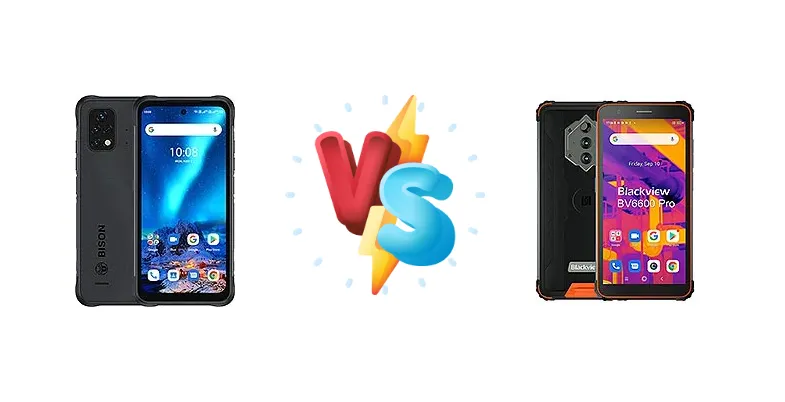
|
🏆 Quick Verdict
For the average user prioritizing responsiveness and smoother multitasking, the Umidigi Bison 2 emerges as the better choice. Its Helio P90 chipset offers a substantial performance advantage over the Blackview BV6600 Pro’s Helio P35, making it more suitable for demanding applications and a more future-proof investment.
| PHONES | ||
|---|---|---|
| Phone Names | Umidigi Bison 2 | Blackview BV6600 Pro |
| Network | ||
|---|---|---|
| 2G bands | GSM 850 / 900 / 1800 / 1900 | GSM 850 / 900 / 1800 / 1900 |
| 3G bands | HSDPA 800 / 850 / 900 / 1700(AWS) / 1900 / 2100 | HSDPA 850 / 900 / 1700(AWS) / 1900 / 2100 |
| 4G bands | 1, 2, 3, 4, 5, 7, 8, 12, 13, 17, 18, 19, 20, 25, 26, 28, 34, 38, 39, 40, 41, 66 | 1, 2, 3, 4, 5, 7, 8, 12, 13, 17, 19, 18, 20, 28, 25, 26, 38, 40, 41, 66 |
| Speed | HSPA, LTE | HSPA, LTE |
| Technology | GSM / CDMA / HSPA / LTE | GSM / CDMA / HSPA / CDMA2000 / LTE |
| - | CDMA2000 1x | |
| Launch | ||
|---|---|---|
| Announced | 2022 | 2021, September 28 |
| Status | Available. Released 2022 | Available. Released 2021, October |
| Body | ||
|---|---|---|
| Dimensions | 172.1 x 83.8 x 12.9 mm (6.78 x 3.30 x 0.51 in) | 159 x 79.4 x 18 mm (6.26 x 3.13 x 0.71 in) |
| SIM | Nano-SIM + Nano-SIM | Nano-SIM + Nano-SIM |
| Weight | 280 g (9.88 oz) | 325 g (11.46 oz) |
| - | IP68/IP69K dust/water resistant (up to 1.5m for 30 min) Drop-to-concrete resistance from up to 1.5m MIL-STD-810G compliant | |
| Display | ||
|---|---|---|
| Protection | - | Dragontrail Glass |
| Resolution | 1080 x 2400 pixels, 20:9 ratio (~405 ppi density) | 720 x 1440 pixels, 18:9 ratio (~282 ppi density) |
| Size | 6.5 inches, 102.0 cm2 (~70.7% screen-to-body ratio) | 5.7 inches, 83.8 cm2 (~66.4% screen-to-body ratio) |
| Type | IPS LCD | IPS LCD |
| Platform | ||
|---|---|---|
| CPU | Octa-core (2x2.2 GHz Cortex-A75 & 6x2.0 GHz Cortex-A55) | Octa-core (4x2.35 GHz Cortex-A53 & 4x1.8 GHz Cortex-A53) |
| Chipset | Mediatek Helio P90 (12 nm) | Mediatek MT6765V/CA Helio P35 (12 nm) |
| GPU | PowerVR GM9446 | PowerVR GE8320 |
| OS | Android 12 | Android 11 |
| Memory | ||
|---|---|---|
| Card slot | microSDXC (uses shared SIM slot) | microSDXC |
| Internal | 128GB 6GB RAM | 64GB 4GB RAM |
| - | eMMC | |
| Main Camera | ||
|---|---|---|
| Features | Dual-LED flash, HDR | Thermal imaging, LED flash |
| Single | - | 8 MP, f/2.0, (wide) |
| Triple | 48 MP, f/2.2, (wide), AF 16 MP, f/2.2, (ultrawide) 5 MP (macro) | 16 MP, f/2.0, (wide), PDAF 5 MP, thermal assisted camera FLIR thermal camera (Lepton module) |
| Video | 1080p@30fps | 1080p@30fps |
| Selfie camera | ||
|---|---|---|
| Single | 24 MP, f/2.0, (wide) | 8 MP, f/2.0, (wide) |
| Video | 1080p@30fps | 1080p@30fps |
| Sound | ||
|---|---|---|
| 3.5mm jack | - | No |
| 35mm jack | Yes | No |
| Loudspeaker | Yes | Yes |
| Comms | ||
|---|---|---|
| Bluetooth | 5.0, A2DP, LE | 5.0, A2DP, LE |
| NFC | Yes | Yes |
| Positioning | GPS, GLONASS, GALILEO, BDS | GPS, GLONASS, GALILEO, BDS |
| Radio | Wireless FM radio | FM radio |
| USB | USB Type-C, OTG | USB Type-C 2.0, OTG |
| WLAN | Wi-Fi 802.11 a/b/g/n/ac, dual-band, Wi-Fi Direct | Wi-Fi 802.11 a/b/g/n/ac |
| Features | ||
|---|---|---|
| Sensors | Fingerprint (side-mounted), accelerometer, proximity, compass, barometer, thermometer (skin temperature) | Fingerprint (side-mounted), accelerometer, gyro, proximity, compass |
| Battery | ||
|---|---|---|
| Charging | 18W wired | 18W wired |
| Type | 6150 mAh | 8580 mAh |
| Misc | ||
|---|---|---|
| Colors | Black | Black, Orange, Green |
| Price | - | About 260 EUR |
Umidigi Bison 2
- Significantly faster processor for smoother performance
- More capable GPU for better graphics rendering
- Potentially faster image processing
- More future-proof chipset
- May consume slightly more power during heavy usage
- Potentially higher price point
Blackview BV6600 Pro
- Lower price point
- Potentially longer battery life during light usage
- Rugged design for durability
- Sufficient for basic smartphone tasks
- Slower processor and GPU
- Struggles with demanding applications
- Less responsive user experience
- Limited future-proofing
Display Comparison
Neither device's display specifications are provided, so a direct comparison is limited. However, given the price points, both likely utilize IPS LCD panels. The focus here will be on performance differences impacting display responsiveness. The Bison 2's more powerful GPU, stemming from the Helio P90, will likely translate to smoother scrolling and faster rendering of graphics-intensive content on the display, even if the panels themselves are similar.
Camera Comparison
Without detailed camera specifications, a comprehensive comparison is difficult. However, the chipset plays a role in image processing speed. The Bison 2’s Helio P90 will process images faster, potentially leading to quicker shot-to-shot times and improved image stabilization. The BV6600 Pro’s P35 will likely exhibit slower processing, potentially resulting in more noticeable shutter lag and less effective noise reduction. It's reasonable to assume both phones will include a primary camera and potentially auxiliary lenses, but the P90's ISP will likely offer more advanced features.
Performance
The core difference lies in the chipsets. The Umidigi Bison 2’s Mediatek Helio P90, built on a 12nm process, features an octa-core configuration with two Cortex-A75 cores clocked at 2.2 GHz and six Cortex-A55 cores at 2.0 GHz. This architecture prioritizes performance. Conversely, the Blackview BV6600 Pro utilizes the Helio P35 (also 12nm) with four Cortex-A53 cores at 2.35 GHz and another four at 1.8 GHz. While the P35’s higher clock speed *appears* advantageous, the older Cortex-A53 architecture is significantly less efficient than the A75 cores in the P90. This means the Bison 2 will handle complex tasks and multitasking with greater ease, while the BV6600 Pro will likely struggle with demanding applications. The P90 also boasts a more capable GPU, further widening the performance gap.
Battery Life
Both devices feature 18W wired charging. While charging speed is identical, the efficiency of the chipset impacts overall battery life. The Helio P90, despite being more powerful, is optimized for power efficiency. The BV6600 Pro’s Helio P35, while less powerful, may offer slightly longer battery life during *light* usage due to its lower power draw. However, under moderate to heavy load, the Bison 2’s more efficient architecture will likely result in comparable, or even better, battery performance.
Buying Guide
Buy the Umidigi Bison 2 if you need a rugged phone capable of handling moderate gaming, streaming, and multitasking without significant slowdowns. It’s ideal for users who frequently use resource-intensive apps or want a phone that will remain responsive for longer. Buy the Blackview BV6600 Pro if your primary needs are basic communication, light app usage, and extended battery life, and you’re on a very tight budget. It’s a solid option for those prioritizing durability over raw performance.