
Umidigi Active T1 vs Bison 2 Pro: Which Rugged Phone Reigns Supreme?
| Phones Images | |||||
|---|---|---|---|---|---|
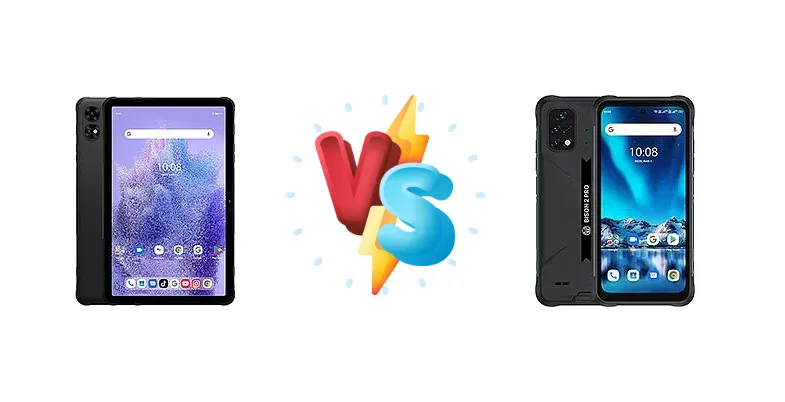
|
🏆 Quick Verdict
For most users prioritizing raw performance and responsiveness, the Umidigi Bison 2 Pro is the better choice, thanks to its Mediatek Helio P90 chipset. However, the Active T1’s 20W charging offers a significant convenience advantage, making it ideal for users who frequently need to top up their battery quickly.
| PHONES | ||
|---|---|---|
| Phone Names | Umidigi Active T1 | Umidigi Bison 2 Pro |
| Network | ||
|---|---|---|
| 2G bands | GSM 850 / 900 / 1800 / 1900 | GSM 850 / 900 / 1800 / 1900 |
| 3G bands | HSDPA 850 / 900 / 1700(AWS) / 1900 / 2100 | HSDPA 800 / 850 / 900 / 1700(AWS) / 1900 / 2100 |
| 4G bands | 1, 2, 3, 4, 5, 7, 8, 12, 13, 17, 20, 28, 38, 40, 41, 66 | 1, 2, 3, 4, 5, 7, 8, 12, 13, 17, 18, 19, 20, 25, 26, 28, 34, 38, 39, 40, 41, 66 |
| Speed | HSPA, LTE | HSPA, LTE |
| Technology | GSM / HSPA / LTE | GSM / CDMA / HSPA / LTE |
| Launch | ||
|---|---|---|
| Announced | 2023 | 2022 |
| Status | Available. Released 2023 | Available. Released 2022 |
| Body | ||
|---|---|---|
| Dimensions | 263.6 x 168.2 x 11.8 mm (10.38 x 6.62 x 0.46 in) | 172.1 x 83.8 x 12.9 mm (6.78 x 3.30 x 0.51 in) |
| SIM | Nano-SIM + Nano-SIM | Nano-SIM + Nano-SIM |
| Weight | 756 g (1.67 lb) | 280 g (9.88 oz) |
| Display | ||
|---|---|---|
| Resolution | 1200 x 2000 pixels, 5:3 ratio (~212 ppi density) | 1080 x 2400 pixels, 20:9 ratio (~405 ppi density) |
| Size | 11.0 inches, 344.4 cm2 (~77.7% screen-to-body ratio) | 6.5 inches, 102.0 cm2 (~70.7% screen-to-body ratio) |
| Type | IPS LCD, 420 nits | IPS LCD |
| Platform | ||
|---|---|---|
| CPU | Octa-core (2x2.0 GHz Cortex-A75 & 6x1.8 GHz Cortex-A55) | Octa-core (2x2.2 GHz Cortex-A75 & 6x2.0 GHz Cortex-A55) |
| Chipset | Unisoc Tiger T616 (12 nm) | Mediatek Helio P90 (12 nm) |
| GPU | Mali-G57 MP1 | PowerVR GM9446 |
| OS | Android 13 | Android 12 |
| Memory | ||
|---|---|---|
| Card slot | microSDXC (uses shared SIM slot) | microSDXC (uses shared SIM slot) |
| Internal | 128GB 8GB RAM | 256GB 8GB RAM |
| Main Camera | ||
|---|---|---|
| Dual | 16 MP, f/2.2, (wide) 8 MP, f/2.2, 120˚ (ultrawide) | - |
| Features | LED flash | Dual-LED flash, HDR |
| Triple | - | 48 MP, f/2.2, (wide), AF 16 MP, f/2.2, (ultrawide) 5 MP (macro) |
| Video | 1080p@30fps | 1080p@30fps |
| Selfie camera | ||
|---|---|---|
| Single | 16 MP, f/2.2, (wide) | 24 MP, f/2.0, (wide) |
| Video | 1080p@30fps | 1080p@30fps |
| Sound | ||
|---|---|---|
| 35mm jack | Yes | Yes |
| Loudspeaker | Yes, with stereo speakers (4 speakers) | Yes |
| Comms | ||
|---|---|---|
| Bluetooth | 5.0, A2DP, LE | 5.0, A2DP, LE |
| NFC | No | Yes |
| Positioning | GPS, GLONASS, GALILEO | GPS, GLONASS, GALILEO, BDS |
| Radio | FM radio | Wireless FM radio |
| USB | USB Type-C, accessory connector pins | USB Type-C, OTG |
| WLAN | Wi-Fi 802.11 a/b/g/n/ac | Wi-Fi 802.11 a/b/g/n/ac, dual-band, Wi-Fi Direct |
| Features | ||
|---|---|---|
| Sensors | Accelerometer, gyro, proximity, compass | Fingerprint (side-mounted), accelerometer, proximity, compass, barometer, thermometer (skin temperature) |
| Battery | ||
|---|---|---|
| Charging | 20W wired | 18W wired |
| Type | 10000 mAh | 6150 mAh |
| Misc | ||
|---|---|---|
| Colors | Black | Black |
Umidigi Active T1
- Faster 20W charging for quicker top-ups
- More modern Unisoc Tiger T616 chipset architecture
- Potentially better software support due to newer chipset
- Slightly lower CPU performance compared to the Bison 2 Pro
- Likely less capable GPU for gaming
Umidigi Bison 2 Pro
- More powerful Mediatek Helio P90 chipset for smoother performance
- Superior GPU for gaming and graphics-intensive tasks
- More advanced ISP for potentially better image quality
- Slower 18W charging
- Older chipset architecture
Display Comparison
Neither Umidigi provides detailed display specifications beyond size and resolution. However, given the price point, both likely utilize IPS LCD panels. The real difference lies in the processing power driving them. The Bison 2 Pro’s Helio P90 has a more capable GPU, potentially leading to smoother animations and better graphics rendering, even if the panels themselves are similar. Bezels are likely comparable, typical of rugged designs prioritizing protection over slimness.
Camera Comparison
Detailed camera specifications are absent. However, given Umidigi’s typical approach, both phones likely feature a multi-camera setup with a primary sensor, an ultrawide, and potentially a macro lens. The image signal processor (ISP) within the Helio P90 is more advanced, offering better noise reduction and dynamic range. While megapixel counts are unknown, the P90’s superior ISP will likely result in better image quality, particularly in challenging lighting conditions. The Active T1’s newer chipset *could* offer some software-based image processing improvements, but the hardware advantage lies with the Bison 2 Pro.
Performance
The core difference between these phones is the chipset. The Bison 2 Pro’s Mediatek Helio P90 features a CPU clocked at 2.2 GHz Cortex-A75 cores, compared to the Active T1’s Unisoc Tiger T616 with 2.0 GHz Cortex-A75 cores. While both are octa-core designs with the same Cortex-A55 efficiency cores, the higher clock speed and slightly more mature architecture of the P90 translate to a noticeable performance advantage in CPU-intensive tasks and gaming. The Unisoc T616 benefits from being built on a 12nm process, but the P90’s overall architecture provides a performance edge. RAM configurations are not specified, but the P90’s GPU will be the limiting factor for graphically intensive applications.
Battery Life
Battery capacity is not specified for either device. However, the Active T1’s 20W wired charging is a clear advantage over the Bison 2 Pro’s 18W charging. This means the Active T1 will reach a full charge significantly faster, a crucial benefit for users who need to quickly replenish their battery. Without knowing the battery capacities, it’s difficult to definitively say which phone offers better battery life, but the faster charging of the Active T1 provides a tangible usability benefit.
Buying Guide
Buy the Umidigi Active T1 if you need a phone that charges quickly and benefits from a more modern chipset architecture, even if it means slightly lower peak performance. This phone is ideal for everyday tasks, social media, and light gaming. Buy the Umidigi Bison 2 Pro if you prioritize smoother multitasking, more demanding games, and a generally more responsive user experience, and are willing to accept slower 18W charging.