
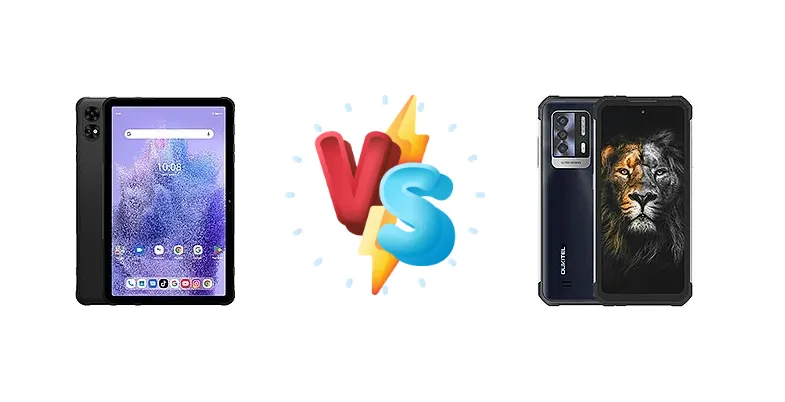
Umidigi Active T1 vs Oukitel WP17: Which Rugged Phone Reigns Supreme?
| Phones Images | |||||
|---|---|---|---|---|---|
|
🏆 Quick Verdict
For the average user prioritizing overall performance and smoother multitasking, the Oukitel WP17 is the better choice. Its MediaTek Helio G95 chipset provides a noticeable performance uplift over the Umidigi Active T1’s Unisoc Tiger T616. However, the Active T1 remains a viable option for users on a tighter budget who prioritize basic functionality.
| PHONES | ||
|---|---|---|
| Phone Names | Umidigi Active T1 | Oukitel WP17 |
| Network | ||
|---|---|---|
| 2G bands | GSM 850 / 900 / 1800 / 1900 | GSM 850 / 900 / 1800 / 1900 |
| 3G bands | HSDPA 850 / 900 / 1700(AWS) / 1900 / 2100 | HSDPA 850 / 900 / 1700(AWS) / 1900 / 2100 |
| 4G bands | 1, 2, 3, 4, 5, 7, 8, 12, 13, 17, 20, 28, 38, 40, 41, 66 | 1, 2, 3, 4, 5, 7, 8, 12, 13, 17, 18, 19, 20, 25, 26, 28, 66 |
| Speed | HSPA, LTE | HSPA, LTE |
| Technology | GSM / HSPA / LTE | GSM / HSPA / LTE |
| Launch | ||
|---|---|---|
| Announced | 2023 | 2021, October |
| Status | Available. Released 2023 | Available. Released 2021, October |
| Body | ||
|---|---|---|
| Dimensions | 263.6 x 168.2 x 11.8 mm (10.38 x 6.62 x 0.46 in) | - |
| SIM | Nano-SIM + Nano-SIM | Nano-SIM + Nano-SIM |
| Weight | 756 g (1.67 lb) | - |
| Display | ||
|---|---|---|
| Resolution | 1200 x 2000 pixels, 5:3 ratio (~212 ppi density) | 1080 x 2400 pixels, 20:9 ratio (~388 ppi density) |
| Size | 11.0 inches, 344.4 cm2 (~77.7% screen-to-body ratio) | 6.78 inches, 111.0 cm2 |
| Type | IPS LCD, 420 nits | IPS LCD, 90Hz |
| Platform | ||
|---|---|---|
| CPU | Octa-core (2x2.0 GHz Cortex-A75 & 6x1.8 GHz Cortex-A55) | Octa-core (2x2.05 GHz Cortex-A76 & 6x2.0 GHz Cortex-A55) |
| Chipset | Unisoc Tiger T616 (12 nm) | Mediatek MT6785V/CD Helio G95 (12 nm) |
| GPU | Mali-G57 MP1 | Mali-G76 MC4 |
| OS | Android 13 | Android 11 |
| Memory | ||
|---|---|---|
| Card slot | microSDXC (uses shared SIM slot) | microSDXC |
| Internal | 128GB 8GB RAM | 128GB 8GB RAM |
| Main Camera | ||
|---|---|---|
| Dual | 16 MP, f/2.2, (wide) 8 MP, f/2.2, 120˚ (ultrawide) | - |
| Features | LED flash | LED flash, panorama |
| Triple | - | 64 MP, f/1.8, (wide), PDAF 20 MP, f/2.0, (night vision), 4 infrared night vision lights 2 MP (macro) |
| Video | 1080p@30fps | 4K@30fps, 1080p@30fps |
| Selfie camera | ||
|---|---|---|
| Single | 16 MP, f/2.2, (wide) | 16 MP |
| Video | 1080p@30fps | Yes |
| Sound | ||
|---|---|---|
| 35mm jack | Yes | Unspecified |
| Loudspeaker | Yes, with stereo speakers (4 speakers) | Yes |
| Comms | ||
|---|---|---|
| Bluetooth | 5.0, A2DP, LE | Yes |
| NFC | No | Yes |
| Positioning | GPS, GLONASS, GALILEO | GPS, GLONASS, GALILEO, BDS |
| Radio | FM radio | Unspecified |
| USB | USB Type-C, accessory connector pins | USB Type-C 2.0, OTG |
| WLAN | Wi-Fi 802.11 a/b/g/n/ac | Yes |
| Features | ||
|---|---|---|
| Sensors | Accelerometer, gyro, proximity, compass | Unspecified |
| Battery | ||
|---|---|---|
| Charging | 20W wired | - |
| Type | 10000 mAh | Li-Po 8300 mAh |
| Misc | ||
|---|---|---|
| Colors | Black | Blue, Camo, Camouflage |
| Price | - | About 240 EUR |
Umidigi Active T1
- More affordable price point
- Rugged design for durability
- Decent for basic smartphone tasks
- Unisoc Tiger T616 chipset is less powerful
- Likely limited gaming performance
- May struggle with demanding apps
Oukitel WP17
- MediaTek Helio G95 offers superior performance
- Better for gaming and multitasking
- 20W fast charging
- Generally more expensive than the Active T1
- Rugged design may add bulk
- Battery life could be impacted by the more powerful processor
Display Comparison
Neither device boasts a standout display. Both likely utilize IPS LCD panels, common in this price bracket. The focus here isn't on visual fidelity, but durability. While specific display specs (resolution, brightness) are missing, the ruggedized nature suggests a focus on scratch resistance and visibility in direct sunlight. Bezels are likely substantial on both to contribute to structural integrity.
Camera Comparison
Without detailed camera specifications, a direct comparison is difficult. However, it’s safe to assume both phones feature basic camera setups geared towards functional photography rather than high-end image quality. The presence of a 2MP macro camera on either device is likely more for marketing than practical use. The larger sensor size (if any) will be the determining factor, but without that data, the WP17’s more powerful ISP (integrated signal processor) within the Helio G95 chipset *may* offer slightly better image processing capabilities.
Performance
The core difference lies in the chipsets. The Oukitel WP17’s MediaTek Helio G95 (12nm) is a clear upgrade over the Umidigi Active T1’s Unisoc Tiger T616 (12nm). The G95 features Cortex-A76 cores clocked at 2.05 GHz, offering superior single-core performance compared to the T616’s Cortex-A75 cores at 2.0 GHz. This translates to snappier app launches and smoother multitasking. While both are 12nm chips, the architectural improvements in the G95 provide a tangible advantage. The G95’s Mali-G76 MC4 GPU also outperforms the T616’s integrated GPU, making the WP17 the better choice for mobile gaming.
Battery Life
Battery capacity is not provided for either device. However, the Oukitel WP17’s 20W charging, matching the Umidigi Active T1, is a key consideration. Faster charging is crucial for rugged phones used in the field. While a larger battery capacity would be ideal, the WP17’s more efficient chipset could potentially offset a slightly smaller battery, resulting in comparable real-world battery life. The 20W charging will allow both devices to reach a usable charge level relatively quickly.
Buying Guide
Buy the Umidigi Active T1 if you need a highly affordable, basic rugged phone for essential communication and light tasks like calls, texts, and occasional navigation. It’s ideal for users who prioritize cost savings over raw processing power. Buy the Oukitel WP17 if you prefer a more responsive experience for gaming, streaming, and running multiple apps simultaneously. Its Helio G95 chipset delivers a significant performance boost, making it suitable for users who demand more from their smartphone.