
Umidigi Active T1 vs Cubot KingKong 5 Pro: Which Rugged Phone Reigns Supreme?
| Phones Images | |||||
|---|---|---|---|---|---|
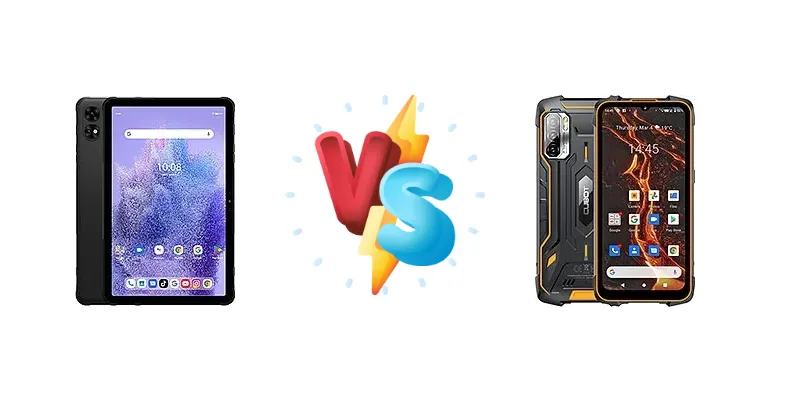
|
🏆 Quick Verdict
For the average user seeking a balance of performance and ruggedness, the Umidigi Active T1 emerges as the better choice. Its Unisoc Tiger T616 chipset, utilizing newer Cortex-A75 cores, provides a noticeable performance advantage over the Cubot KingKong 5 Pro’s older Helio P22, making it more suitable for everyday tasks and light gaming.
| PHONES | ||
|---|---|---|
| Phone Names | Umidigi Active T1 | Cubot KingKong 5 Pro |
| Network | ||
|---|---|---|
| 2G bands | GSM 850 / 900 / 1800 / 1900 | GSM 850 / 900 / 1800 / 1900 |
| 3G bands | HSDPA 850 / 900 / 1700(AWS) / 1900 / 2100 | HSDPA 850 / 900 / 1700(AWS) / 1900 / 2100 |
| 4G bands | 1, 2, 3, 4, 5, 7, 8, 12, 13, 17, 20, 28, 38, 40, 41, 66 | 1, 2, 3, 4, 5, 7, 8, 12, 13, 17, 18, 19, 20, 25, 26, 28, 38, 40, 41, 66 |
| Speed | HSPA, LTE | HSPA, LTE |
| Technology | GSM / HSPA / LTE | GSM / HSPA / LTE |
| Launch | ||
|---|---|---|
| Announced | 2023 | 2021 |
| Status | Available. Released 2023 | Available. Released 2021 |
| Body | ||
|---|---|---|
| Dimensions | 263.6 x 168.2 x 11.8 mm (10.38 x 6.62 x 0.46 in) | 165.8 x 81.4 x 18.8 mm (6.53 x 3.20 x 0.74 in) |
| SIM | Nano-SIM + Nano-SIM | Nano-SIM + Nano-SIM |
| Weight | 756 g (1.67 lb) | 319 g (11.25 oz) |
| Display | ||
|---|---|---|
| Resolution | 1200 x 2000 pixels, 5:3 ratio (~212 ppi density) | 720 x 1560 pixels, 19.5:9 ratio (~286 ppi density) |
| Size | 11.0 inches, 344.4 cm2 (~77.7% screen-to-body ratio) | 6.01 inches, 88.7 cm2 (~65.7% screen-to-body ratio) |
| Type | IPS LCD, 420 nits | IPS LCD |
| Platform | ||
|---|---|---|
| CPU | Octa-core (2x2.0 GHz Cortex-A75 & 6x1.8 GHz Cortex-A55) | Octa-core (4x2.0 GHz Cortex-A53 & 4x1.5 GHz Cortex-A53) |
| Chipset | Unisoc Tiger T616 (12 nm) | Mediatek MT6762D Helio P22 (12 nm) |
| GPU | Mali-G57 MP1 | PowerVR GE8320 |
| OS | Android 13 | Android 11 |
| Memory | ||
|---|---|---|
| Card slot | microSDXC (uses shared SIM slot) | microSDXC (uses shared SIM slot) |
| Internal | 128GB 8GB RAM | 64GB 4GB RAM |
| Main Camera | ||
|---|---|---|
| Dual | 16 MP, f/2.2, (wide) 8 MP, f/2.2, 120˚ (ultrawide) | - |
| Features | LED flash | LED flash |
| Triple | - | 48 MP, (wide), AF 5 MP (macro), AF Auxiliary lens |
| Video | 1080p@30fps | Yes |
| Selfie camera | ||
|---|---|---|
| Single | 16 MP, f/2.2, (wide) | 25 MP |
| Video | 1080p@30fps | Yes |
| Sound | ||
|---|---|---|
| 35mm jack | Yes | Unspecified |
| Loudspeaker | Yes, with stereo speakers (4 speakers) | Yes, with stereo speakers |
| Comms | ||
|---|---|---|
| Bluetooth | 5.0, A2DP, LE | 5.0, A2DP, LE |
| NFC | No | Yes |
| Positioning | GPS, GLONASS, GALILEO | GPS, GLONASS, BDS |
| Radio | FM radio | Unspecified |
| USB | USB Type-C, accessory connector pins | USB Type-C, OTG |
| WLAN | Wi-Fi 802.11 a/b/g/n/ac | Wi-Fi 802.11 a/b/g/n/ac, dual-band |
| Features | ||
|---|---|---|
| Sensors | Accelerometer, gyro, proximity, compass | Fingerprint (rear-mounted), accelerometer, gyro, proximity, compass |
| Battery | ||
|---|---|---|
| Charging | 20W wired | - |
| Type | 10000 mAh | 8000 mAh |
| Misc | ||
|---|---|---|
| Colors | Black | Black |
Umidigi Active T1
- More powerful Unisoc Tiger T616 chipset
- Faster 20W wired charging
- Potentially smoother multitasking experience
- Rugged phone brands often have limited software support
- Camera quality likely dependent on sensor, not chipset
Cubot KingKong 5 Pro
- Likely lower price point
- Rugged design for durability
- Acceptable for basic smartphone tasks
- Older and less powerful MediaTek Helio P22 chipset
- Slower performance for demanding apps
- Charging speed likely slower
Display Comparison
Neither device’s display specifications are provided, so a direct comparison is limited. However, given the price bracket, both likely utilize IPS LCD panels. The focus here will be on performance. The chipset’s ability to drive the display smoothly will be more impacted by the CPU and GPU, favoring the Umidigi Active T1.
Camera Comparison
Without detailed camera specifications, a comprehensive comparison is impossible. However, it’s common in this price range for both phones to feature a primary camera alongside auxiliary sensors of limited utility. The image signal processor (ISP) within the Unisoc T616 may offer slightly better image processing capabilities, but the actual image quality will heavily depend on the sensor used. The absence of OIS on either device suggests reliance on software stabilization.
Performance
The core difference lies in the chipsets. The Umidigi Active T1’s Unisoc Tiger T616, built on a 12nm process, features a heterogeneous core configuration with 2x 2.0 GHz Cortex-A75 cores and 6x 1.8 GHz Cortex-A55 cores. This architecture provides a significant uplift in single-core and multi-core performance compared to the Cubot KingKong 5 Pro’s MediaTek Helio P22. The Helio P22 utilizes four 2.0 GHz Cortex-A53 cores and four 1.5 GHz Cortex-A53 cores. The A75 cores in the T616 are substantially more powerful than the A53 cores in the P22, resulting in faster app loading times and smoother multitasking. This translates to a more responsive user experience for the Umidigi Active T1.
Battery Life
The Umidigi Active T1 supports 20W wired charging, a feature not explicitly mentioned for the Cubot KingKong 5 Pro. While battery capacity isn’t specified for either, the faster charging speed of the Umidigi Active T1 provides a tangible benefit, allowing for quicker top-ups. The efficiency of the Unisoc T616, while not groundbreaking, is likely comparable to the Helio P22, meaning battery life will be more influenced by usage patterns than chipset alone. The 20W charging will reduce downtime significantly.
Buying Guide
Buy the Umidigi Active T1 if you need a phone capable of handling more demanding applications, such as social media, streaming, and occasional gaming, alongside the expected rugged durability. Buy the Cubot KingKong 5 Pro if your primary concern is absolute budget-friendliness and you only require basic smartphone functionality – calls, texts, and light app usage – and are willing to accept a slower overall experience.