
Umidigi Active T1 vs Blackview BV8800: A Deep Dive into Rugged Smartphone Performance
| Phones Images | |||||
|---|---|---|---|---|---|
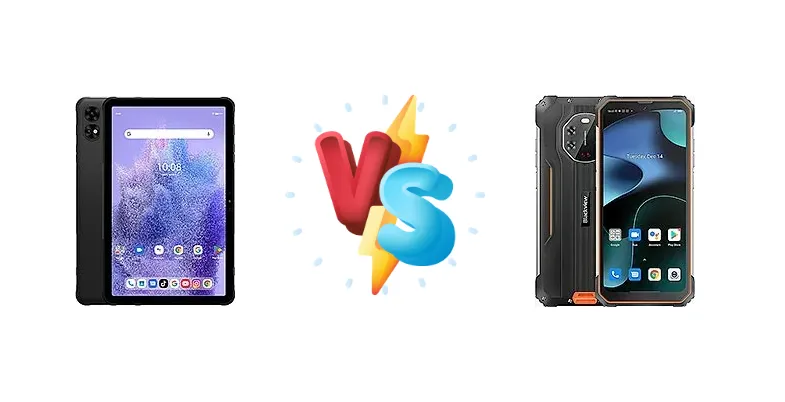
|
🏆 Quick Verdict
For the average user prioritizing a balance of efficiency and affordability, the Umidigi Active T1 is the better choice. However, the Blackview BV8800’s significantly faster charging and more powerful Helio G96 chipset make it ideal for users who demand peak performance and minimal downtime.
| PHONES | ||
|---|---|---|
| Phone Names | Umidigi Active T1 | Blackview BV8800 |
| Network | ||
|---|---|---|
| 2G bands | GSM 850 / 900 / 1800 / 1900 | GSM 850 / 900 / 1800 / 1900 |
| 3G bands | HSDPA 850 / 900 / 1700(AWS) / 1900 / 2100 | HSDPA 800 / 850 / 900 / 1700(AWS) / 1900 / 2100 |
| 4G bands | 1, 2, 3, 4, 5, 7, 8, 12, 13, 17, 20, 28, 38, 40, 41, 66 | 1, 2, 3, 4, 5, 7, 8, 12, 13, 17, 18, 19, 20, 25, 26, 28, 30, 34, 38, 39, 40, 41, 66 |
| Speed | HSPA, LTE | HSPA, LTE |
| Technology | GSM / HSPA / LTE | GSM / CDMA / HSPA / CDMA2000 / LTE |
| - | CDMA2000 1x | |
| Launch | ||
|---|---|---|
| Announced | 2023 | 2021, December 24 |
| Status | Available. Released 2023 | Available. Released 2022, January 10 |
| Body | ||
|---|---|---|
| Dimensions | 263.6 x 168.2 x 11.8 mm (10.38 x 6.62 x 0.46 in) | 176.2 x 83.5 x 17.7 mm (6.94 x 3.29 x 0.70 in) |
| SIM | Nano-SIM + Nano-SIM | Nano-SIM + Nano-SIM |
| Weight | 756 g (1.67 lb) | 367 g (12.95 oz) |
| - | IP68/IP69K dust/water resistant (up to 1.5m for 30 min) Drop-to-concrete resistance from up to 1.5m MIL-STD-810H compliant | |
| Display | ||
|---|---|---|
| Resolution | 1200 x 2000 pixels, 5:3 ratio (~212 ppi density) | 1080 x 2408 pixels, 20:9 ratio (~401 ppi density) |
| Size | 11.0 inches, 344.4 cm2 (~77.7% screen-to-body ratio) | 6.58 inches, 104.3 cm2 (~70.9% screen-to-body ratio) |
| Type | IPS LCD, 420 nits | IPS LCD, 90Hz, 480 nits |
| Platform | ||
|---|---|---|
| CPU | Octa-core (2x2.0 GHz Cortex-A75 & 6x1.8 GHz Cortex-A55) | Octa-core (2x2.05 GHz Cortex-A76 & 6x2.0 GHz Cortex-A55) |
| Chipset | Unisoc Tiger T616 (12 nm) | Mediatek MT6781 Helio G96 (12 nm) |
| GPU | Mali-G57 MP1 | Mali-G57 MC2 |
| OS | Android 13 | Android 11, Doke-OS 3.0 |
| Memory | ||
|---|---|---|
| Card slot | microSDXC (uses shared SIM slot) | No |
| Internal | 128GB 8GB RAM | 128GB 8GB RAM |
| - | UFS 2.1 | |
| Main Camera | ||
|---|---|---|
| Dual | 16 MP, f/2.2, (wide) 8 MP, f/2.2, 120˚ (ultrawide) | - |
| Features | LED flash | Dual-LED flash, HDR, panorama |
| Quad | - | 50 MP, f/1.8, (wide), PDAF 8 MP, f/2.2, 117˚ (ultrawide) 20 MP, f/1.8, (IR camera), 2 IR emitters Auxiliary lens |
| Single | - | 16 MP, f/2.0, (wide) |
| Video | 1080p@30fps | 1440p@30fps |
| Selfie camera | ||
|---|---|---|
| Single | 16 MP, f/2.2, (wide) | 16 MP, f/2.0, (wide) |
| Video | 1080p@30fps | 1080p@30fps |
| Sound | ||
|---|---|---|
| 3.5mm jack | - | No |
| 35mm jack | Yes | No |
| Loudspeaker | Yes, with stereo speakers (4 speakers) | Yes |
| Comms | ||
|---|---|---|
| Bluetooth | 5.0, A2DP, LE | 5.2, A2DP, LE |
| NFC | No | Yes |
| Positioning | GPS, GLONASS, GALILEO | GPS, GLONASS, GALILEO, BDS |
| Radio | FM radio | FM radio |
| USB | USB Type-C, accessory connector pins | USB Type-C 2.0, OTG |
| WLAN | Wi-Fi 802.11 a/b/g/n/ac | Wi-Fi 802.11 a/b/g/n/ac |
| Features | ||
|---|---|---|
| Sensors | Accelerometer, gyro, proximity, compass | Fingerprint (side-mounted), accelerometer, gyro, proximity, compass, barometer |
| Battery | ||
|---|---|---|
| Charging | 20W wired | 33W wired, 31% in 30 min, 100% in 90 min Reverse wired |
| Type | 10000 mAh | 8380 mAh |
| Misc | ||
|---|---|---|
| Colors | Black | Black, Orange, Green |
| Price | - | About 350 EUR |
| Tests | ||
|---|---|---|
| Battery life | - | Endurance rating 199h |
| Camera | - | Photo / Video |
| Display | - | Contrast ratio: 1348:1 (nominal) |
| Loudspeaker | - | -29.3 LUFS (Average) |
| Performance | - | AnTuTu: 254849 (v8), 288964 (v9) GeekBench: 1752 (v5.1) GFXBench: 10fps (ES 3.1 onscreen) |
Umidigi Active T1
- More power-efficient chipset (Unisoc T616)
- Potentially lower price point
- Comparable battery endurance
- Significantly less powerful processor
- Slower charging speeds (20W)
- Limited performance for demanding tasks
Blackview BV8800
- Faster and more powerful processor (Helio G96)
- Significantly faster charging (33W)
- Reverse wired charging capability
- Less power-efficient chipset
- Potentially higher price point
- May run warmer under heavy load
Display Comparison
Both the Umidigi Active T1 and Blackview BV8800 share a contrast ratio of 1348:1, suggesting similar color reproduction capabilities. However, the Blackview BV8800 boasts a measured peak brightness of 501 nits, which will provide better visibility in direct sunlight compared to the Umidigi Active T1 (brightness data unavailable). While both are adequate for outdoor use, the BV8800 has a clear advantage in challenging lighting conditions. The lack of information on panel technology (IPS, AMOLED) for the Umidigi Active T1 makes a definitive comparison of color accuracy and viewing angles difficult.
Camera Comparison
Both devices list 'Photo / Video' capabilities, but lack specific details regarding sensor size, aperture, or image stabilization. This makes a direct comparison challenging. However, the market positioning of Blackview often includes a focus on camera features, suggesting a potentially more refined camera experience. Without further data, it’s difficult to assess the quality of images produced by either device, and the presence of a 2MP macro lens on either (likely) offers minimal practical benefit. The G96’s ISP (Image Signal Processor) is also more capable than the T616’s, potentially leading to better image processing.
Performance
The Blackview BV8800’s MediaTek Helio G96 chipset represents a significant performance leap over the Umidigi Active T1’s Unisoc Tiger T616. The G96 utilizes two Cortex-A76 cores clocked at 2.05 GHz, compared to the T616’s Cortex-A75 cores at 2.0 GHz. This architectural difference, combined with the G96’s higher clock speed, translates to noticeably faster application loading times and smoother multitasking. While both are 12nm chips, the G96’s more advanced core design provides superior single-core and multi-core performance. The T616 prioritizes efficiency, making it suitable for less demanding tasks, but will struggle with graphically intensive games.
Battery Life
Both phones achieve an endurance rating of 199 hours, indicating comparable battery life under similar usage scenarios. However, the Blackview BV8800’s 33W wired charging significantly outperforms the Umidigi Active T1’s 20W charging. The BV8800 can reach 31% charge in 30 minutes and 100% in 90 minutes, while the T1’s charging time is not specified. This faster charging capability is a major advantage for users who need to quickly top up their battery. The BV8800 also offers reverse wired charging, a feature absent on the T1, allowing it to act as a power bank for other devices.
Buying Guide
Buy the Umidigi Active T1 if you need a reliable, long-lasting device for everyday tasks and moderate outdoor use, and value power efficiency. Buy the Blackview BV8800 if you prioritize gaming, demanding applications, and require the fastest possible charging speeds, even if it means sacrificing some battery efficiency.