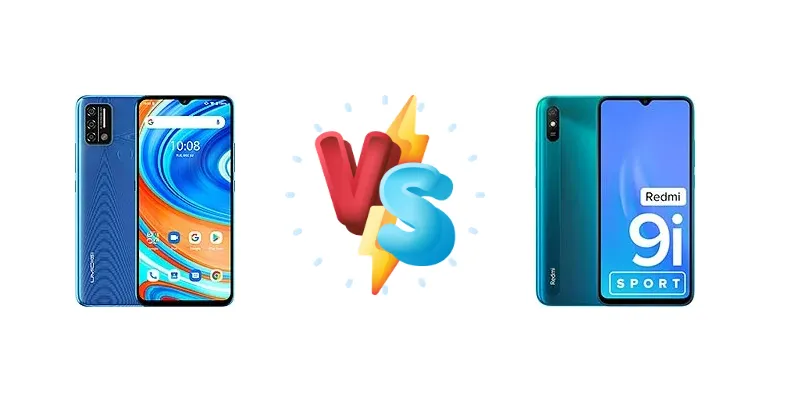
The sub-$150 smartphone market is fiercely competitive. Both the Umidigi A9 and Xiaomi Redmi 9i Sport target this segment, offering a baseline Android experience for essential tasks. While their core specifications appear nearly identical on paper, a closer look reveals nuances in brand positioning and potential long-term usability that differentiate these devices.
🏆 Quick Verdict
For the average user prioritizing brand reliability and potential software updates, the Xiaomi Redmi 9i Sport is the slightly better choice. While both phones share the same Mediatek Helio G25 chipset and 10W charging, Xiaomi’s established ecosystem and track record offer a degree of confidence Umidigi currently lacks.
| Network |
|---|
| 2G bands | GSM 850 / 900 / 1800 / 1900 | GSM 850 / 900 / 1800 / 1900 |
| 3G bands | HSDPA 800 / 850 / 900 / 1700(AWS) / 1900 / 2100 | HSDPA 850 / 900 / 2100 |
| 4G bands | 1, 2, 3, 4, 5, 7, 8, 12, 13, 17, 18, 19, 20, 26, 28, 34, 38, 39, 40, 41, 66 | 1, 3, 5, 8, 40, 41 |
| Speed | HSPA, LTE | HSPA, LTE |
| Technology | GSM / HSPA / LTE | GSM / HSPA / LTE |
| Launch |
|---|
| Announced | 2021. Released 2021 | 2021, September 28 |
| Status | Discontinued | Available. Released 2021, September 28 |
| Body |
|---|
| Dimensions | 164 x 77.1 x 9.5 mm (6.46 x 3.04 x 0.37 in) | 164.9 x 77.1 x 9 mm (6.49 x 3.04 x 0.35 in) |
| SIM | Nano-SIM + Nano-SIM | Nano-SIM + Nano-SIM |
| Weight | 204 g (7.20 oz) | 194 g (6.84 oz) |
| | - | Water-repellent coating |
| Display |
|---|
| Resolution | 720 x 1600 pixels, 20:9 ratio (~269 ppi density) | 720 x 1600 pixels, 20:9 ratio (~269 ppi density) |
| Size | 6.53 inches, 102.9 cm2 (~81.4% screen-to-body ratio) | 6.53 inches, 102.9 cm2 (~81.0% screen-to-body ratio) |
| Type | IPS LCD | IPS LCD, 400 nits (typ) |
| Platform |
|---|
| CPU | Octa-core (4x2.0 GHz Cortex-A53 & 4x1.5 GHz Cortex-A53) | Octa-core (4x2.0 GHz Cortex-A53 & 4x1.5 GHz Cortex-A53) |
| Chipset | Mediatek Helio G25 (12 nm) | Mediatek MT6762G Helio G25 (12 nm) |
| GPU | PowerVR GE8320 | PowerVR GE8320 |
| OS | Android 11 | Android 10, MIUI 12 |
| Memory |
|---|
| Card slot | microSDXC (dedicated slot) | microSDXC (dedicated slot) |
| Internal | 64GB 3GB RAM | 64GB 4GB RAM, 128GB 4GB RAM |
| | - | eMMC 5.1 |
| Main Camera |
|---|
| Features | Dual-LED flash, HDR, panorama | LED flash, HDR |
| Single | - | 13 MP, f/2.2, 28mm (wide), 1.0µm, PDAF |
| Triple | 13 MP, f/1.8, (wide), AF
8 MP, 120˚ (ultrawide)
Auxiliary lens | - |
| Video | 1080p@30fps | 1080p@30fps |
| Selfie camera |
|---|
| Features | - | HDR |
| Single | 8 MP, f/1.8, (wide) | 5 MP, f/2.2, (wide), 1.12µm |
| Video | 1080p@30fps | 1080p@30fps |
| Sound |
|---|
| 3.5mm jack | - | Yes |
| 35mm jack | Yes | Yes |
| Loudspeaker | Yes | Yes |
| Comms |
|---|
| Bluetooth | 5.0, A2DP, LE | 5.0, A2DP, LE |
| NFC | No | No |
| Positioning | GPS, GLONASS, GALILEO | GPS, GLONASS, BDS |
| Radio | No | FM radio |
| USB | USB Type-C, OTG | microUSB 2.0, OTG |
| WLAN | Wi-Fi 802.11 a/b/g/n/ac, dual-band, Wi-Fi Direct | Wi-Fi 802.11 а/b/g/n, Wi-Fi Direct |
| Features |
|---|
| Sensors | Fingerprint (rear-mounted), accelerometer, proximity, compass, thermometer (skin temperature) | Accelerometer, proximity, compass |
| Battery |
|---|
| Charging | 10W wired | 10W wired |
| Type | 5150 mAh | Li-Po 5000 mAh |
| Misc |
|---|
| Colors | Granite Grey, Sky Blue, Peacock Green | Carbon Black, Coral Green, Metallic Blue |
| Price | - | About 100 EUR |
Umidigi A9
- Potentially lower price point
- Functional for basic smartphone tasks
- May offer unique color options
- Less established brand reputation
- Potentially limited software support
- Likely slower software updates
Xiaomi Redmi 9i Sport
- More established brand with better support
- Potential for more frequent software updates
- Xiaomi’s ecosystem integration
- May be slightly more expensive
- Similar hardware to the Umidigi A9
- 10W charging is slow
Display Comparison
Both the Umidigi A9 and Xiaomi Redmi 9i Sport likely feature similar LCD panels, given their price point. Neither manufacturer specifies screen brightness in nits, but we can expect both to struggle in direct sunlight. The resolution is also likely 720p+, adequate for the screen size but not exceptionally sharp. The absence of features like higher PWM dimming rates or color calibration data suggests a focus on cost reduction over display quality. Bezels are expected to be noticeable on both devices, typical for this price bracket.
Camera Comparison
Camera performance is expected to be similar on both devices, with the primary sensor likely being an 8MP or 13MP unit. Both manufacturers often include lower-resolution auxiliary cameras (2MP macro, depth sensors) which offer limited practical benefit. Image processing will likely prioritize contrast and saturation over accuracy. Low-light performance will be a significant weakness due to the small sensor size and lack of optical image stabilization (OIS). The Redmi 9i Sport may benefit from Xiaomi’s more mature camera software algorithms, potentially resulting in slightly better image quality.
Performance
The heart of both devices is the Mediatek Helio G25 (MT6762G in the Redmi 9i Sport), a 12nm chipset featuring an octa-core CPU configuration with 4x2.0 GHz Cortex-A53 and 4x1.5 GHz Cortex-A53 cores. This means performance will be virtually identical for everyday tasks like browsing, social media, and light app usage. The GPU, an IMG GE8320, is sufficient for basic gaming, but demanding titles will require significant graphical settings reductions. RAM configurations are not specified, but both likely offer options around 3-4GB, which is sufficient for the chipset but can lead to app reloading. Thermal management will likely be passive, relying on the phone’s chassis to dissipate heat, potentially leading to throttling during sustained workloads.
Battery Life
Both phones feature 10W wired charging, which is slow by modern standards. A full charge from 0-100% will likely take over 3 hours. Battery capacity is not specified for either device, but we can estimate around 4000-5000mAh, sufficient for a full day of light to moderate use. The efficiency of the Helio G25 chipset contributes to reasonable battery life, but power users will likely need to top up the battery during the day. The slow charging speed is a significant drawback for both devices.
Buying Guide
Buy the Umidigi A9 if you need a functional smartphone at the absolute lowest possible price and are comfortable with potentially limited software support. It’s a viable option for a secondary device or for users who prioritize cost above all else. Buy the Xiaomi Redmi 9i Sport if you prefer a more established brand with a better chance of receiving security updates and a slightly more refined user experience, even if it means paying a small premium.
Frequently Asked Questions
❓ Will the Redmi 9i Sport receive Android updates beyond its initial release version?
Xiaomi typically provides at least one major Android update and several security patches for its Redmi series. While not guaranteed, the Redmi 9i Sport has a higher probability of receiving updates compared to the Umidigi A9, given Xiaomi’s established software support track record.
❓ Is the Helio G25 chipset capable of running popular games like PUBG Mobile?
The Helio G25 can run PUBG Mobile, but you’ll need to significantly lower the graphical settings to achieve playable frame rates. Expect to use the lowest settings and potentially experience occasional stuttering, especially during intense firefights. It’s not ideal for demanding gaming.
❓ How reliable is Umidigi's customer support compared to Xiaomi?
Xiaomi has a much larger and more established customer support network globally. Umidigi’s support is often limited to online forums and may have longer response times. This is a key consideration for users who value readily available assistance.
❓ What type of charging port do both phones use?
Both the Umidigi A9 and Xiaomi Redmi 9i Sport utilize a micro-USB port for charging and data transfer. This is a standard for phones in this price range, but it's slower and less convenient than the more modern USB-C port.