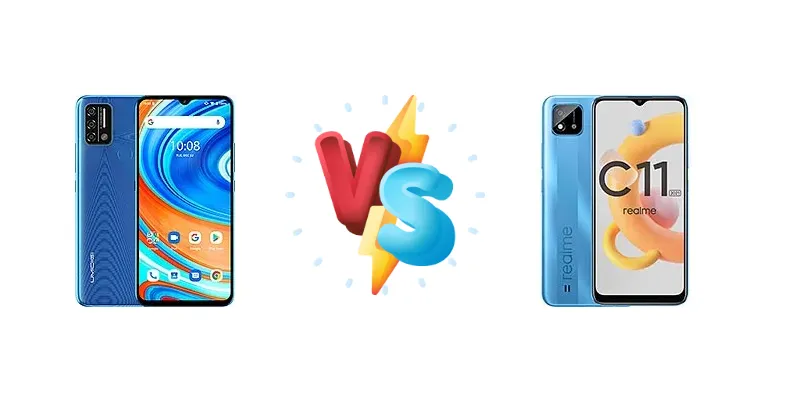
The sub-$150 smartphone market is fiercely competitive. Both the Umidigi A9 and the Realme C11 (2021) aim to deliver essential smartphone functionality at an incredibly affordable price. However, they take different approaches to achieving this, primarily through contrasting chipset choices. This comparison will dissect those differences and determine which device offers the best value for your money.
🏆 Quick Verdict
For the average user prioritizing responsiveness and future-proofing, the Umidigi A9 is the better choice. Its Mediatek Helio G25, built on a 12nm process, offers a more modern CPU architecture than the Realme C11 (2021)'s older 28nm Unisoc SC9863A, resulting in a smoother user experience despite similar core counts.
| Network |
|---|
| 2G bands | GSM 850 / 900 / 1800 / 1900 | GSM 850 / 900 / 1800 / 1900 |
| 3G bands | HSDPA 800 / 850 / 900 / 1700(AWS) / 1900 / 2100 | HSDPA 850 / 900 / 1900 / 2100 |
| 4G bands | 1, 2, 3, 4, 5, 7, 8, 12, 13, 17, 18, 19, 20, 26, 28, 34, 38, 39, 40, 41, 66 | 1, 3, 5, 8, 38, 40, 41 |
| Speed | HSPA, LTE | HSPA, LTE |
| Technology | GSM / HSPA / LTE | GSM / HSPA / LTE |
| Launch |
|---|
| Announced | 2021. Released 2021 | 2021, June 28 |
| Status | Discontinued | Available. Released 2021, June 28 |
| Body |
|---|
| Build | - | Glass front, plastic frame, plastic back |
| Dimensions | 164 x 77.1 x 9.5 mm (6.46 x 3.04 x 0.37 in) | 165.2 x 76.4 x 8.9 mm (6.50 x 3.01 x 0.35 in) |
| SIM | Nano-SIM + Nano-SIM | Nano-SIM + Nano-SIM |
| Weight | 204 g (7.20 oz) | 190 g (6.70 oz) |
| | - | Splash resistant design |
| Display |
|---|
| Resolution | 720 x 1600 pixels, 20:9 ratio (~269 ppi density) | 720 x 1600 pixels, 20:9 ratio (~269 ppi density) |
| Size | 6.53 inches, 102.9 cm2 (~81.4% screen-to-body ratio) | 6.52 inches, 102.6 cm2 (~81.3% screen-to-body ratio) |
| Type | IPS LCD | IPS LCD, 400 nits (typ) |
| Platform |
|---|
| CPU | Octa-core (4x2.0 GHz Cortex-A53 & 4x1.5 GHz Cortex-A53) | Octa-core (4x1.6 GHz Cortex-A55 & 4x1.2 GHz Cortex-A55) |
| Chipset | Mediatek Helio G25 (12 nm) | Unisoc SC9863A (28 nm) |
| GPU | PowerVR GE8320 | IMG8322 |
| OS | Android 11 | Android 11, Realme Go UI |
| Memory |
|---|
| Card slot | microSDXC (dedicated slot) | microSDXC (dedicated slot) |
| Internal | 64GB 3GB RAM | 32GB 2GB RAM, 64GB 4GB RAM |
| | - | eMMC 5.1 |
| Main Camera |
|---|
| Features | Dual-LED flash, HDR, panorama | LED flash, HDR, panorama |
| Single | - | 8 MP, f/2.0, (wide), AF |
| Triple | 13 MP, f/1.8, (wide), AF
8 MP, 120˚ (ultrawide)
Auxiliary lens | - |
| Video | 1080p@30fps | 1080p@30fps |
| Selfie camera |
|---|
| Features | - | HDR, panorama |
| Single | 8 MP, f/1.8, (wide) | 5 MP, f/2.2, (wide) |
| Video | 1080p@30fps | 1080p@30fps |
| Sound |
|---|
| 3.5mm jack | - | Yes |
| 35mm jack | Yes | Yes |
| Loudspeaker | Yes | Yes |
| Comms |
|---|
| Bluetooth | 5.0, A2DP, LE | 4.2, A2DP |
| NFC | No | No |
| Positioning | GPS, GLONASS, GALILEO | GPS, GLONASS, GALILEO, BDS |
| Radio | No | Unspecified |
| USB | USB Type-C, OTG | microUSB 2.0, OTG |
| WLAN | Wi-Fi 802.11 a/b/g/n/ac, dual-band, Wi-Fi Direct | Wi-Fi 802.11 b/g/n |
| Features |
|---|
| Sensors | Fingerprint (rear-mounted), accelerometer, proximity, compass, thermometer (skin temperature) | Accelerometer, gyro, proximity, compass |
| Battery |
|---|
| Charging | 10W wired | 10W wired
Reverse wired |
| Type | 5150 mAh | 5000 mAh |
| Misc |
|---|
| Colors | Granite Grey, Sky Blue, Peacock Green | Cool Blue, Cool Grey |
| Models | - | RMX3231 |
| Price | - | About 80 EUR |
Umidigi A9
- More efficient chipset (Helio G25)
- More modern CPU architecture (Cortex-A53)
- Slightly better front camera resolution (8MP)
- Potentially longer battery life due to chipset efficiency
- Lacks reverse wired charging
- Basic display specifications
Realme C11 (2021)
- Reverse wired charging capability
- Slightly newer Cortex-A55 CPU cores
- Affordable price point
- Simple and easy-to-use interface
- Less efficient chipset (Unisoc SC9863A)
- Older 28nm manufacturing process
- Potentially shorter battery life
Display Comparison
Neither device boasts a standout display. Both likely feature basic IPS LCD panels with resolutions around 720x1600. However, details like peak brightness and color gamut coverage are unavailable. The Realme C11 (2021) doesn't offer any display features beyond the basics, while Umidigi doesn't specify any enhancements for the A9 either. Expect similar viewing experiences in both cases, adequate for indoor use but potentially washed out in direct sunlight.
Camera Comparison
Both phones are expected to feature basic camera setups. Details are sparse, but both likely include a primary camera and potentially a depth sensor. The Realme C11 (2021) includes a 5MP front camera, while the Umidigi A9 has an 8MP front camera. Image quality will be heavily reliant on software processing and lighting conditions. Don't expect exceptional results from either device, and avoid relying on any included 2MP macro lenses, as their image quality is typically poor. The A9's slightly higher resolution front camera may offer marginally better selfies.
Performance
This is where the key difference lies. The Umidigi A9’s Mediatek Helio G25, fabricated on a 12nm process, features an octa-core CPU with a split configuration of 4x2.0 GHz Cortex-A53 and 4x1.5 GHz Cortex-A53 cores. The Realme C11 (2021) utilizes the Unisoc SC9863A, an older chipset built on a less efficient 28nm process, with an octa-core CPU of 4x1.6 GHz Cortex-A55 and 4x1.2 GHz Cortex-A55 cores. While both have eight cores, the Cortex-A55 architecture in the Realme is a slight improvement over the A53, the 12nm process of the Helio G25 provides a significant advantage in power efficiency and sustained performance. This translates to less throttling under load and a more consistent user experience. The A9 will likely handle multitasking and moderately demanding apps more smoothly.
Battery Life
Both devices are equipped with 5000mAh batteries and 10W wired charging. The Realme C11 (2021) adds reverse wired charging, allowing it to act as a power bank for other devices. However, the Unisoc SC9863A’s less efficient architecture will likely result in shorter battery life compared to the Umidigi A9, despite the identical capacity. The A9’s Helio G25 will extract more usage from each charge. While both offer similar charging speeds, the A9’s efficiency advantage will mean it spends less time plugged in.
Buying Guide
Buy the Umidigi A9 if you need a phone that feels more responsive for everyday tasks like browsing and social media, and if you anticipate keeping the device for more than a year. Buy the Realme C11 (2021) if you prioritize reverse wired charging for topping up accessories, and if your usage is extremely light, consisting primarily of calls and basic messaging. The C11's older chipset will show its age more quickly with demanding apps.
Frequently Asked Questions
❓ Will the Unisoc SC9863A in the Realme C11 (2021) struggle with popular apps like Facebook or WhatsApp after a few months of use?
The Unisoc SC9863A, being an older and less powerful chipset, is likely to show its limitations over time. While it will handle basic apps initially, performance degradation is expected as the phone fills up with data and apps. Facebook and WhatsApp, with their increasingly demanding features, may become noticeably slower and less responsive after prolonged use.
❓ Does the Umidigi A9 support fast charging, or is it limited to the 10W charging speed?
The Umidigi A9 is limited to 10W wired charging. While not a particularly fast charging speed, the Helio G25's efficiency means it won't require as much charging time to reach a full charge compared to the Realme C11 (2021), despite having the same battery capacity.
❓ Is the reverse wired charging feature on the Realme C11 (2021) useful for charging accessories like Bluetooth headphones?
Yes, the reverse wired charging feature can be useful for topping up small accessories like Bluetooth headphones or a smartwatch. However, the 10W charging speed is relatively slow, so it will take a significant amount of time to fully charge larger devices. It's best suited for emergency situations or providing a small boost to accessories.