
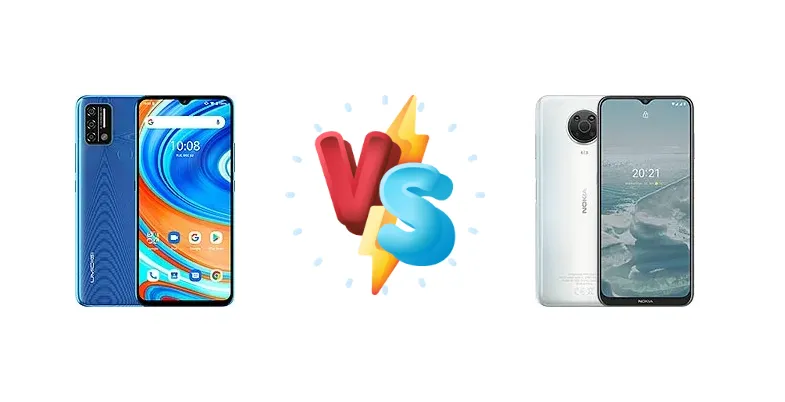
Umidigi A9 vs Nokia G20: A Detailed Comparison of Two Budget Champions
| Phones Images | |||||
|---|---|---|---|---|---|
|
🏆 Quick Verdict
For most users, the Nokia G20 edges out the Umidigi A9. While both share a 10W charging rate, the Nokia G20’s Helio G35 chipset, with its higher clocked Cortex-A53 cores, provides a noticeable performance boost in everyday tasks and light gaming, justifying the potential price difference.
| PHONES | ||
|---|---|---|
| Phone Names | Umidigi A9 | Nokia G20 |
| Network | ||
|---|---|---|
| 2G bands | GSM 850 / 900 / 1800 / 1900 | GSM 850 / 900 / 1800 / 1900 |
| 3G bands | HSDPA 800 / 850 / 900 / 1700(AWS) / 1900 / 2100 | HSDPA 850 / 900 / 1900 / 2100 - International |
| 4G bands | 1, 2, 3, 4, 5, 7, 8, 12, 13, 17, 18, 19, 20, 26, 28, 34, 38, 39, 40, 41, 66 | 1, 3, 5, 7, 8, 20, 28, 38, 40, 41 - International |
| Speed | HSPA, LTE | HSPA 42.2/5.76 Mbps, LTE Cat4 150/50 Mbps |
| Technology | GSM / HSPA / LTE | GSM / HSPA / LTE |
| - | 1, 2, 3, 4, 5, 7, 8, 12, 17, 28, 66 - LATAM | |
| Launch | ||
|---|---|---|
| Announced | 2021. Released 2021 | 2021, April 08 |
| Status | Discontinued | Available. Released 2021, May 17 |
| Body | ||
|---|---|---|
| Dimensions | 164 x 77.1 x 9.5 mm (6.46 x 3.04 x 0.37 in) | 164.9 x 76 x 9.2 mm (6.49 x 2.99 x 0.36 in) |
| SIM | Nano-SIM + Nano-SIM | · Nano-SIM· Nano-SIM + Nano-SIM |
| Weight | 204 g (7.20 oz) | 197 g (6.95 oz) |
| - | Splash protection | |
| Display | ||
|---|---|---|
| Resolution | 720 x 1600 pixels, 20:9 ratio (~269 ppi density) | 720 x 1600 pixels, 20:9 ratio (~269 ppi density) |
| Size | 6.53 inches, 102.9 cm2 (~81.4% screen-to-body ratio) | 6.52 inches, 102.6 cm2 (~81.9% screen-to-body ratio) |
| Type | IPS LCD | IPS LCD |
| Platform | ||
|---|---|---|
| CPU | Octa-core (4x2.0 GHz Cortex-A53 & 4x1.5 GHz Cortex-A53) | Octa-core (4x2.3 GHz Cortex-A53 & 4x1.8 GHz Cortex-A53) |
| Chipset | Mediatek Helio G25 (12 nm) | Mediatek MT6765G Helio G35 (12 nm) |
| GPU | PowerVR GE8320 | PowerVR GE8320 |
| OS | Android 11 | Android 11, upgradable to Android 13 |
| Memory | ||
|---|---|---|
| Card slot | microSDXC (dedicated slot) | microSDXC (dedicated slot) |
| Internal | 64GB 3GB RAM | 64GB 4GB RAM, 128GB 4GB RAM |
| Main Camera | ||
|---|---|---|
| Features | Dual-LED flash, HDR, panorama | LED flash, HDR, panorama |
| Quad | - | 48 MP, f/1.8, (wide), PDAF 5 MP, (ultrawide) 2 MP (macro) Auxiliary lens |
| Single | - | 8 MP, (wide) |
| Triple | 13 MP, f/1.8, (wide), AF 8 MP, 120˚ (ultrawide) Auxiliary lens | - |
| Video | 1080p@30fps | 1080p@30fps |
| Selfie camera | ||
|---|---|---|
| Single | 8 MP, f/1.8, (wide) | 8 MP, (wide) |
| Video | 1080p@30fps | 1080p@30fps |
| Sound | ||
|---|---|---|
| 3.5mm jack | - | Yes |
| 35mm jack | Yes | Yes |
| Loudspeaker | Yes | Yes |
| Comms | ||
|---|---|---|
| Bluetooth | 5.0, A2DP, LE | 5.0, A2DP, LE |
| NFC | No | Yes (market/region dependent) |
| Positioning | GPS, GLONASS, GALILEO | GPS, GLONASS, BDS |
| Radio | No | FM radio |
| USB | USB Type-C, OTG | USB Type-C 2.0, OTG |
| WLAN | Wi-Fi 802.11 a/b/g/n/ac, dual-band, Wi-Fi Direct | Wi-Fi 802.11 b/g/n |
| Features | ||
|---|---|---|
| Sensors | Fingerprint (rear-mounted), accelerometer, proximity, compass, thermometer (skin temperature) | Fingerprint (side-mounted), accelerometer, gyro, proximity |
| Battery | ||
|---|---|---|
| Charging | 10W wired | 10W wired |
| Type | 5150 mAh | Li-Po 5050 mAh |
| Misc | ||
|---|---|---|
| Colors | Granite Grey, Sky Blue, Peacock Green | Glacier, Night |
| Models | - | TA-1336, TA-1343, TA-1347, TA-1372, TA-1365 |
| Price | - | About 90 EUR |
| SAR | - | 1.01 W/kg (head) 1.02 W/kg (body) |
| SAR EU | - | 0.49 W/kg (head) 1.13 W/kg (body) |
Umidigi A9
- Potentially lower price point
- Simple and straightforward user experience
- Adequate for basic smartphone tasks
- Slower processor compared to the Nokia G20
- May receive fewer software updates
- Less responsive user interface
Nokia G20
- Faster processor for smoother performance
- Potentially better software support from Nokia
- Slightly more responsive user experience
- May be slightly more expensive
- Still limited by 10W charging
- Camera performance likely similar to Umidigi A9
Display Comparison
Neither device boasts a standout display. Both likely utilize LCD panels, common in this price bracket. Without specific brightness or color gamut data, it’s safe to assume both offer adequate, but not exceptional, viewing experiences. The focus here is on functionality over fidelity. Bezels are likely to be substantial on both, maximizing screen real estate within a budget.
Camera Comparison
Camera performance is likely to be similar, relying heavily on software processing. Both phones will likely feature a primary camera alongside basic auxiliary lenses (often 2MP macro or depth sensors). Without sensor size information, it’s difficult to make a definitive judgment. However, the image signal processor (ISP) within the Helio G35 *may* offer slightly better noise reduction and dynamic range compared to the G25, but this is a subtle difference. Users shouldn't expect flagship-level image quality from either device.
Performance
The core difference lies in the chipsets. The Nokia G20’s Mediatek Helio G35 features a CPU clocked up to 2.3 GHz, utilizing 4x Cortex-A53 cores at this speed, alongside 4x cores at 1.8 GHz. This contrasts with the Umidigi A9’s Helio G25, which peaks at 2.0 GHz (4x cores) and 1.5 GHz (4x cores). This higher clock speed on the G35 translates to faster app loading times and a more fluid multitasking experience. While both are based on the 12nm process, the G35’s architecture provides a tangible performance advantage, particularly for users who occasionally engage in light gaming or demanding applications. The impact of RAM speed isn't specified, but both likely utilize LPDDR4X, a standard for this segment.
Battery Life
Both devices are equipped with 10W wired charging, indicating a similar charging experience – expect over 3 hours for a full charge. Battery capacity isn't specified, but given the target price point, both likely house batteries in the 4000-5000 mAh range. The slightly more efficient Helio G35 in the Nokia G20 *could* translate to marginally longer battery life, but real-world usage patterns will be the dominant factor.
Buying Guide
Buy the Umidigi A9 if you prioritize absolute affordability and are primarily focused on basic smartphone functions like calls, messaging, and light social media use. Buy the Nokia G20 if you value a slightly smoother user experience, a bit more responsiveness in apps, and potentially longer software support, as Nokia generally provides more consistent updates than Umidigi.