
Umidigi A9 vs Motorola Moto G Power (2021): A Deep Dive into Budget Smartphone Performance
| Phones Images | |||||
|---|---|---|---|---|---|
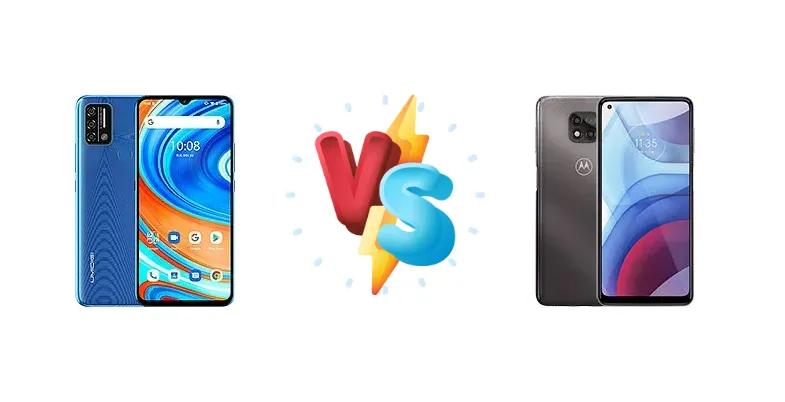
|
🏆 Quick Verdict
For most users, the Motorola Moto G Power (2021) is the better choice. Its Snapdragon 662 chipset, built on an 11nm process, provides a noticeable performance advantage over the Umidigi A9’s Helio G25, and the 15W charging is a welcome improvement over the A9’s 10W. While the A9 is cheaper, the G Power’s superior efficiency and usability justify the price difference.
| PHONES | ||
|---|---|---|
| Phone Names | Umidigi A9 | Motorola Moto G Power (2021) |
| Network | ||
|---|---|---|
| 2G bands | GSM 850 / 900 / 1800 / 1900 | GSM 850 / 900 / 1800 / 1900 |
| 3G bands | HSDPA 800 / 850 / 900 / 1700(AWS) / 1900 / 2100 | HSDPA 850 / 900 / 1700(AWS) / 1900 / 2100 |
| 4G bands | 1, 2, 3, 4, 5, 7, 8, 12, 13, 17, 18, 19, 20, 26, 28, 34, 38, 39, 40, 41, 66 | 1, 2, 3, 4, 5, 7, 8, 12, 13, 14, 17, 25, 26, 29, 30, 38, 41, 66, 71 |
| Speed | HSPA, LTE | HSPA, LTE |
| Technology | GSM / HSPA / LTE | GSM / CDMA / HSPA / EVDO / LTE |
| - | CDMA2000 1xEV-DO | |
| Launch | ||
|---|---|---|
| Announced | 2021. Released 2021 | 2021, January 08 |
| Status | Discontinued | Available. Released 2021, January 14 |
| Body | ||
|---|---|---|
| Build | - | Glass front, plastic back, plastic frame |
| Dimensions | 164 x 77.1 x 9.5 mm (6.46 x 3.04 x 0.37 in) | 165.3 x 75.9 x 9.5 mm (6.51 x 2.99 x 0.37 in) |
| SIM | Nano-SIM + Nano-SIM | Nano-SIM |
| Weight | 204 g (7.20 oz) | 206.5 g (7.30 oz) |
| - | Water-repellent coating | |
| Display | ||
|---|---|---|
| Resolution | 720 x 1600 pixels, 20:9 ratio (~269 ppi density) | 720 x 1600 pixels, 20:9 ratio (~266 ppi density) |
| Size | 6.53 inches, 102.9 cm2 (~81.4% screen-to-body ratio) | 6.6 inches, 105.2 cm2 (~83.8% screen-to-body ratio) |
| Type | IPS LCD | IPS LCD |
| Platform | ||
|---|---|---|
| CPU | Octa-core (4x2.0 GHz Cortex-A53 & 4x1.5 GHz Cortex-A53) | Octa-core (4x2.0 GHz Kryo 260 Gold & 4x1.8 GHz Kryo 260 Silver) |
| Chipset | Mediatek Helio G25 (12 nm) | Qualcomm SM6115 Snapdragon 662 (11 nm) |
| GPU | PowerVR GE8320 | Adreno 610 |
| OS | Android 11 | Android 10 |
| Memory | ||
|---|---|---|
| Card slot | microSDXC (dedicated slot) | microSDXC (dedicated slot) |
| Internal | 64GB 3GB RAM | 32GB 3GB RAM, 64GB 4GB RAM |
| - | eMMC 5.1 | |
| Main Camera | ||
|---|---|---|
| Features | Dual-LED flash, HDR, panorama | LED flash, HDR, panorama |
| Triple | 13 MP, f/1.8, (wide), AF 8 MP, 120˚ (ultrawide) Auxiliary lens | 48 MP, f/1.7, (wide), 1/2.0", 0.8µm, PDAF 2 MP (macro) Auxiliary lens |
| Video | 1080p@30fps | 1080p@30/60fps, gyro-EIS |
| Selfie camera | ||
|---|---|---|
| Features | - | HDR |
| Single | 8 MP, f/1.8, (wide) | 8 MP, f/2.0, 1.12µm |
| Video | 1080p@30fps | 1080p@30fps, gyro-EIS |
| Sound | ||
|---|---|---|
| 3.5mm jack | - | Yes |
| 35mm jack | Yes | Yes |
| Loudspeaker | Yes | Yes |
| Comms | ||
|---|---|---|
| Bluetooth | 5.0, A2DP, LE | 5.0, A2DP, LE |
| NFC | No | No |
| Positioning | GPS, GLONASS, GALILEO | GPS, GLONASS, GALILEO |
| Radio | No | FM radio |
| USB | USB Type-C, OTG | USB Type-C 2.0 |
| WLAN | Wi-Fi 802.11 a/b/g/n/ac, dual-band, Wi-Fi Direct | Wi-Fi 802.11 a/b/g/n/ac, dual-band, Wi-Fi Direct |
| Features | ||
|---|---|---|
| Sensors | Fingerprint (rear-mounted), accelerometer, proximity, compass, thermometer (skin temperature) | Fingerprint (side-mounted), accelerometer, gyro, proximity, compass, barometer |
| Battery | ||
|---|---|---|
| Charging | 10W wired | 15W wired |
| Type | 5150 mAh | Li-Po 5000 mAh |
| Misc | ||
|---|---|---|
| Colors | Granite Grey, Sky Blue, Peacock Green | Flash Gray, Polar Silver |
| Price | - | About 60 EUR |
Umidigi A9
- Lowest possible price point
- Potentially longer standby time due to simpler chipset
- Acceptable for basic smartphone tasks
- Noticeably slower performance than the Moto G Power
- Slower 10W charging
- Older chipset architecture
Motorola Moto G Power (2021)
- More powerful Snapdragon 662 chipset
- Faster 15W charging
- Better power efficiency for longer battery life
- Smoother multitasking experience
- Slightly higher price than the Umidigi A9
- May not be significantly better in camera performance
Display Comparison
Neither device is expected to boast a high-end display. Details are missing, but given the price point, both likely utilize LCD panels. The focus here isn't on visual fidelity, but durability and power efficiency. The absence of high refresh rates is expected. The real difference will likely be in color calibration and peak brightness, which are currently unknown. However, the Moto G Power’s brand reputation suggests slightly better quality control in this area.
Camera Comparison
Camera performance is likely to be similar, with both phones targeting the entry-level segment. Details on sensor sizes and apertures are unavailable, but it’s safe to assume both will feature a primary sensor paired with basic auxiliary lenses (likely a depth or macro sensor). Image processing will be a key differentiator. Motorola’s software typically prioritizes natural-looking images, while Umidigi may lean towards more saturated colors. Without specific sensor details, it’s difficult to declare a clear winner, but the Snapdragon 662’s ISP (Image Signal Processor) generally offers better image processing capabilities.
Performance
The core difference lies in the chipsets. The Motorola Moto G Power (2021) utilizes the Qualcomm Snapdragon 662 (11nm), featuring Kryo 260 Gold and Silver cores clocked up to 2.0 GHz and 1.8 GHz respectively. This 11nm process offers better power efficiency than the Umidigi A9’s MediaTek Helio G25 (12nm). While both are octa-core CPUs, the Snapdragon 662’s architecture is more modern and optimized for sustained performance. The G25’s Cortex-A53 cores, while capable, are older designs. This translates to a smoother experience with the Moto G Power, especially when multitasking or running more demanding applications. Gamers will find the Snapdragon 662 more capable of handling titles like PUBG Mobile at medium settings.
Battery Life
The Motorola Moto G Power (2021) boasts a significant advantage in charging speed with 15W wired charging, compared to the Umidigi A9’s 10W. While both phones likely have large batteries (Moto G Power is known for its large battery capacity), the faster charging will reduce downtime. The Snapdragon 662’s superior power efficiency also contributes to longer battery life during typical usage. The 11nm process allows the Moto G Power to extract more usage from its battery compared to the 12nm Helio G25 in the Umidigi A9.
Buying Guide
Buy the Umidigi A9 if your absolute priority is the lowest possible price and you primarily need a phone for basic tasks like calls, texts, and light social media. Buy the Motorola Moto G Power (2021) if you value smoother performance for multitasking, occasional gaming, and appreciate the peace of mind that comes with a more efficient chipset and faster charging, even if it means spending a bit more.