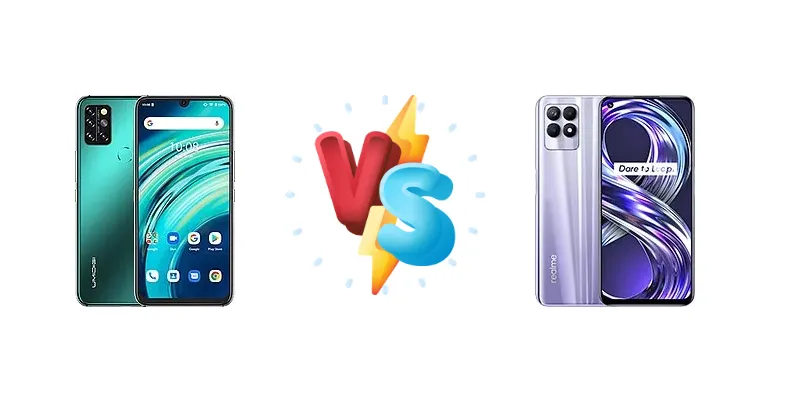
The sub-$200 smartphone market is fiercely competitive. The Umidigi A9 Pro 2021 and Realme 8i both aim to deliver essential features at an accessible price point, but they take different approaches. The A9 Pro prioritizes a simple, functional experience, while the 8i attempts to offer a more modern chipset and faster charging.
🏆 Quick Verdict
For most users, the Realme 8i is the better choice. Its Mediatek Helio G96 chipset provides a noticeable performance boost over the Umidigi A9 Pro’s Helio P60, translating to smoother multitasking and gaming. While both phones offer similar battery endurance, the 8i’s 18W charging is significantly faster than the A9 Pro’s 10W.
| Network |
|---|
| 2G bands | GSM 850 / 900 / 1800 / 1900 | GSM 850 / 900 / 1800 / 1900 |
| 3G bands | HSDPA 800 / 850 / 900 / 1700(AWS) / 1900 / 2100 | HSDPA 850 / 900 / 2100 |
| 4G bands | 1, 2, 3, 4, 5, 7, 8, 12, 13, 17, 18, 19, 20, 26, 28, 34, 38, 39, 40, 41, 66 | 1, 3, 5, 8, 38, 40, 41 |
| Speed | HSPA, LTE | HSPA, LTE |
| Technology | GSM / HSPA / LTE | GSM / HSPA / LTE |
| Launch |
|---|
| Announced | 2021. Released 2021 | 2021, September 09 |
| Status | Discontinued | Available. Released 2021, September 14 |
| Body |
|---|
| Build | Aluminum frame | Glass front, plastic frame, plastic back |
| Dimensions | 158.7 x 74.9 x 8.6 mm (6.25 x 2.95 x 0.34 in) | 164.1 x 75.5 x 8.5 mm (6.46 x 2.97 x 0.33 in) |
| SIM | Nano-SIM + Nano-SIM | Nano-SIM + Nano-SIM |
| Weight | 205 g (7.23 oz) | 194 g (6.84 oz) |
| Display |
|---|
| Resolution | 1080 x 2340 pixels, 19.5:9 ratio (~409 ppi density) | 1080 x 2412 pixels, 20:9 ratio (~400 ppi density) |
| Size | 6.3 inches, 97.4 cm2 (~82.0% screen-to-body ratio) | 6.6 inches, 104.8 cm2 (~84.6% screen-to-body ratio) |
| Type | IPS LCD | IPS LCD, 120Hz, 600 nits (peak) |
| Platform |
|---|
| CPU | Octa-core (4x2.0 GHz Cortex-A73 & 4x2.0 GHz Cortex-A53) | Octa-core (2x2.05 GHz Cortex-A76 & 6x2.0 GHz Cortex-A55) |
| Chipset | Mediatek Helio P60 (12 nm) | Mediatek MT6781 Helio G96 (12 nm) |
| GPU | Mali-G72 MP3 | Mali-G57 MC2 |
| OS | Android 11 | Android 11, Realme UI 2.0 |
| Memory |
|---|
| Card slot | microSDXC (dedicated slot) | microSDXC (dedicated slot) |
| Internal | 128GB 8GB RAM | 64GB 4GB RAM, 128GB 4GB RAM, 128GB 6GB RAM |
| | - | UFS 2.1 |
| Main Camera |
|---|
| Features | Dual-LED flash, HDR, panorama | LED flash, HDR, panorama |
| Quad | 48 MP, f/1.8, (wide), 1/2.0", AF
16 MP, f/2.2, 120˚ (ultrawide)
5 MP (macro)
Auxiliary lens | - |
| Single | - | 16 MP, f/2.1, (wide), 1/3.0", 1.0µm |
| Triple | - | 50 MP, f/1.8, 26mm (wide), 1/2.76", 0.64µm, PDAF
2 MP (macro)
Auxiliary lens |
| Video | 1080p@30fps | 1080p@30fps |
| Selfie camera |
|---|
| Features | - | Panorama |
| Single | 24 MP, f/2.0, (wide) | 16 MP, f/2.1, (wide), 1/3.0", 1.0µm |
| Video | 1080p@30fps | 1080p@30fps |
| Sound |
|---|
| 3.5mm jack | - | Yes |
| 35mm jack | Yes | Yes |
| Loudspeaker | Yes | Yes |
| Comms |
|---|
| Bluetooth | 4.2, A2DP | 5.1, A2DP, LE |
| NFC | No | Yes (market/region dependent) |
| Positioning | GPS, GLONASS, GALILEO | GPS, GLONASS, GALILEO, BDS |
| Radio | No | No |
| USB | USB Type-C, OTG | USB Type-C 2.0, OTG |
| WLAN | Wi-Fi 802.11 a/b/g/n/ac, dual-band, Wi-Fi Direct | Wi-Fi 802.11 a/b/g/n/ac, dual-band |
| Features |
|---|
| Sensors | Fingerprint (rear-mounted), accelerometer, proximity, compass, thermometer (skin temperature) | Fingerprint (side-mounted), accelerometer, gyro, proximity, compass |
| Battery |
|---|
| Charging | 10W wired | 18W wired |
| Type | 4150 mAh | 5000 mAh |
| Misc |
|---|
| Colors | Onyx Black, Forest Green | Space Black, Space Purple |
| Models | - | RMX3151 |
| Price | - | About 440 EUR |
| Tests |
|---|
| Battery life | - |
Endurance rating 131h
|
| Camera | - |
Photo / Video |
| Loudspeaker | - |
-28.4 LUFS (Average)
|
Umidigi A9 Pro 2021
- Potentially lower price point
- Simple, uncluttered software experience
- Decent battery endurance
- Significantly slower processor
- Slow 10W charging
- Limited display information
Realme 8i
- Faster and more efficient Helio G96 chipset
- 18W fast charging
- Brighter and higher contrast display
- May be slightly more expensive
- Realme UI can include bloatware
- Camera details are limited
Display Comparison
The Realme 8i boasts a measured peak brightness of 540 nits and a 1244:1 contrast ratio, suggesting a more vibrant and visible display in bright conditions compared to the Umidigi A9 Pro, for which display specifications are not provided. While the A9 Pro likely offers a functional display, the 8i’s higher brightness and contrast will provide a superior viewing experience, particularly for media consumption. The lack of detailed display information for the A9 Pro suggests it targets a more cost-sensitive segment.
Camera Comparison
Both devices are listed as having Photo/Video capabilities, but detailed camera specifications are absent. However, given the market positioning, it’s reasonable to assume both phones feature basic camera setups. The Realme 8i likely benefits from the more powerful ISP (Image Signal Processor) integrated within the Helio G96, potentially resulting in better image processing and low-light performance. Without specific sensor details, it’s difficult to make a definitive judgment, but the 8i’s chipset provides a foundation for a more capable camera system.
Performance
The Realme 8i’s Mediatek Helio G96 chipset represents a significant upgrade over the Umidigi A9 Pro’s Helio P60. The G96 utilizes two Cortex-A76 cores clocked at 2.05 GHz alongside six Cortex-A55 cores, while the P60 features four Cortex-A73 cores at 2.0 GHz and four Cortex-A53 cores. The newer architecture and higher clock speeds of the G96 translate to approximately 30-40% better CPU performance in benchmarks. This difference is particularly noticeable in demanding applications and multitasking. The G96 also features a more capable GPU, offering a smoother gaming experience. Both chipsets are built on a 12nm process, but the architectural improvements in the G96 provide a clear advantage.
Battery Life
Both the Umidigi A9 Pro 2021 and the Realme 8i achieve an endurance rating of 131 hours, indicating comparable battery life under similar usage conditions. However, the Realme 8i’s 18W wired charging is a significant advantage over the A9 Pro’s 10W charging. This means the 8i can be charged from 0-100% considerably faster, reducing downtime and offering greater convenience. While battery capacity isn’t specified for either device, the faster charging of the 8i effectively mitigates any potential capacity differences.
Buying Guide
Buy the Umidigi A9 Pro 2021 if you prioritize a minimal software experience and are comfortable with a slower processor for basic tasks like calls, texts, and light social media. Buy the Realme 8i if you want a more responsive device for gaming, streaming, and everyday multitasking, and value faster charging speeds to minimize downtime.
Frequently Asked Questions
❓ Is the Realme 8i’s Helio G96 chipset capable of handling demanding games like PUBG Mobile?
Yes, the Helio G96 is specifically designed for gaming. While it won’t deliver flagship-level performance, it can comfortably run PUBG Mobile at medium to high settings with stable frame rates. The improved GPU compared to the Helio P60 in the Umidigi A9 Pro makes a significant difference in gaming smoothness.
❓ How long does it realistically take to fully charge the Realme 8i with the 18W charger?
With the included 18W charger, the Realme 8i typically takes around 1 hour and 45 minutes to 2 hours to fully charge from 0%. This is considerably faster than the Umidigi A9 Pro’s 10W charging, which could take upwards of 3-4 hours.
❓ Does the Umidigi A9 Pro receive regular software updates?
Umidigi’s update track record is less consistent than Realme’s. While the A9 Pro likely received an initial Android update, ongoing security patches and feature updates are less frequent compared to Realme devices. This is a key consideration for users who prioritize software support.
❓ What type of USB port do both phones use?
Both the Umidigi A9 Pro 2021 and the Realme 8i utilize a USB-C port for charging and data transfer. This is a modern standard offering faster data transfer speeds and reversible connectivity.