
Umidigi A9 Pro 2021 vs. Motorola Moto G Power (2021): Which Budget Champion Reigns Supreme?
| Phones Images | |||||
|---|---|---|---|---|---|
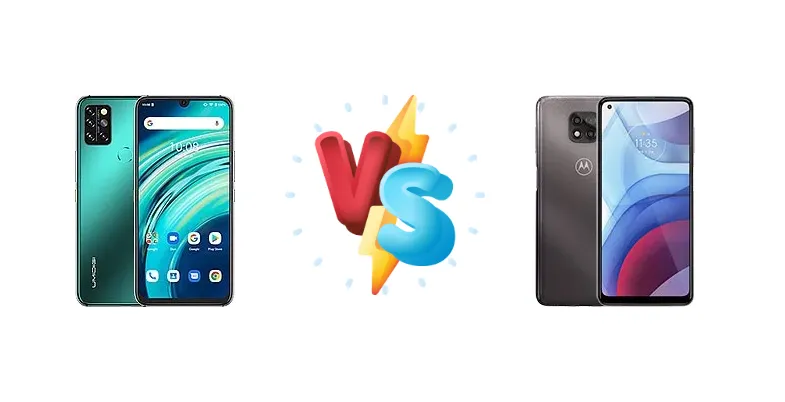
|
🏆 Quick Verdict
For the average user prioritizing consistent performance and slightly faster charging, the Motorola Moto G Power (2021) is the better choice. Its Snapdragon 662, built on an 11nm process, offers a more efficient and capable experience than the Umidigi A9 Pro’s Helio P60, despite the latter’s slightly higher CPU clock speeds on some cores.
| PHONES | ||
|---|---|---|
| Phone Names | Umidigi A9 Pro 2021 | Motorola Moto G Power (2021) |
| Network | ||
|---|---|---|
| 2G bands | GSM 850 / 900 / 1800 / 1900 | GSM 850 / 900 / 1800 / 1900 |
| 3G bands | HSDPA 800 / 850 / 900 / 1700(AWS) / 1900 / 2100 | HSDPA 850 / 900 / 1700(AWS) / 1900 / 2100 |
| 4G bands | 1, 2, 3, 4, 5, 7, 8, 12, 13, 17, 18, 19, 20, 26, 28, 34, 38, 39, 40, 41, 66 | 1, 2, 3, 4, 5, 7, 8, 12, 13, 14, 17, 25, 26, 29, 30, 38, 41, 66, 71 |
| Speed | HSPA, LTE | HSPA, LTE |
| Technology | GSM / HSPA / LTE | GSM / CDMA / HSPA / EVDO / LTE |
| - | CDMA2000 1xEV-DO | |
| Launch | ||
|---|---|---|
| Announced | 2021. Released 2021 | 2021, January 08 |
| Status | Discontinued | Available. Released 2021, January 14 |
| Body | ||
|---|---|---|
| Build | Aluminum frame | Glass front, plastic back, plastic frame |
| Dimensions | 158.7 x 74.9 x 8.6 mm (6.25 x 2.95 x 0.34 in) | 165.3 x 75.9 x 9.5 mm (6.51 x 2.99 x 0.37 in) |
| SIM | Nano-SIM + Nano-SIM | Nano-SIM |
| Weight | 205 g (7.23 oz) | 206.5 g (7.30 oz) |
| - | Water-repellent coating | |
| Display | ||
|---|---|---|
| Resolution | 1080 x 2340 pixels, 19.5:9 ratio (~409 ppi density) | 720 x 1600 pixels, 20:9 ratio (~266 ppi density) |
| Size | 6.3 inches, 97.4 cm2 (~82.0% screen-to-body ratio) | 6.6 inches, 105.2 cm2 (~83.8% screen-to-body ratio) |
| Type | IPS LCD | IPS LCD |
| Platform | ||
|---|---|---|
| CPU | Octa-core (4x2.0 GHz Cortex-A73 & 4x2.0 GHz Cortex-A53) | Octa-core (4x2.0 GHz Kryo 260 Gold & 4x1.8 GHz Kryo 260 Silver) |
| Chipset | Mediatek Helio P60 (12 nm) | Qualcomm SM6115 Snapdragon 662 (11 nm) |
| GPU | Mali-G72 MP3 | Adreno 610 |
| OS | Android 11 | Android 10 |
| Memory | ||
|---|---|---|
| Card slot | microSDXC (dedicated slot) | microSDXC (dedicated slot) |
| Internal | 128GB 8GB RAM | 32GB 3GB RAM, 64GB 4GB RAM |
| - | eMMC 5.1 | |
| Main Camera | ||
|---|---|---|
| Features | Dual-LED flash, HDR, panorama | LED flash, HDR, panorama |
| Quad | 48 MP, f/1.8, (wide), 1/2.0", AF 16 MP, f/2.2, 120˚ (ultrawide) 5 MP (macro) Auxiliary lens | - |
| Triple | - | 48 MP, f/1.7, (wide), 1/2.0", 0.8µm, PDAF 2 MP (macro) Auxiliary lens |
| Video | 1080p@30fps | 1080p@30/60fps, gyro-EIS |
| Selfie camera | ||
|---|---|---|
| Features | - | HDR |
| Single | 24 MP, f/2.0, (wide) | 8 MP, f/2.0, 1.12µm |
| Video | 1080p@30fps | 1080p@30fps, gyro-EIS |
| Sound | ||
|---|---|---|
| 3.5mm jack | - | Yes |
| 35mm jack | Yes | Yes |
| Loudspeaker | Yes | Yes |
| Comms | ||
|---|---|---|
| Bluetooth | 4.2, A2DP | 5.0, A2DP, LE |
| NFC | No | No |
| Positioning | GPS, GLONASS, GALILEO | GPS, GLONASS, GALILEO |
| Radio | No | FM radio |
| USB | USB Type-C, OTG | USB Type-C 2.0 |
| WLAN | Wi-Fi 802.11 a/b/g/n/ac, dual-band, Wi-Fi Direct | Wi-Fi 802.11 a/b/g/n/ac, dual-band, Wi-Fi Direct |
| Features | ||
|---|---|---|
| Sensors | Fingerprint (rear-mounted), accelerometer, proximity, compass, thermometer (skin temperature) | Fingerprint (side-mounted), accelerometer, gyro, proximity, compass, barometer |
| Battery | ||
|---|---|---|
| Charging | 10W wired | 15W wired |
| Type | 4150 mAh | Li-Po 5000 mAh |
| Misc | ||
|---|---|---|
| Colors | Onyx Black, Forest Green | Flash Gray, Polar Silver |
| Price | - | About 60 EUR |
Umidigi A9 Pro 2021
- Potentially lower purchase price.
- Slightly higher CPU clock speeds on some cores (theoretical benefit).
- May offer more RAM/storage configurations at a given price point.
- Less efficient Helio P60 chipset.
- Slower 10W charging.
- Likely inferior image processing.
Motorola Moto G Power (2021)
- More efficient Snapdragon 662 chipset.
- Faster 15W charging.
- Superior image processing capabilities.
- Better sustained performance.
- Potentially higher purchase price.
- May have less RAM/storage for the same price.
- Motorola’s software update track record is not always the fastest.
Display Comparison
Neither device boasts a standout display. Both likely utilize IPS LCD panels, common in this price bracket. The key difference lies under the hood: processing power impacts UI responsiveness. While neither spec sheet details peak brightness or color accuracy, the Moto G Power’s more capable chipset will contribute to smoother animations and faster app loading, indirectly improving the perceived display experience. Bezels are expected to be substantial on both devices, reflecting their budget positioning.
Camera Comparison
Both phones likely feature a multi-camera setup, but details are scarce. Focusing on the primary sensors is crucial. Without specific sensor size information, it’s difficult to declare a clear winner. However, Qualcomm’s image signal processor (ISP) within the Snapdragon 662 generally offers superior image processing capabilities, resulting in better dynamic range and noise reduction compared to the ISP found in the Helio P60. The prevalence of low-resolution auxiliary cameras (often 2MP) on budget phones suggests these are largely marketing features and should be disregarded when evaluating camera quality.
Performance
The core battleground is the chipset. The Motorola Moto G Power (2021) features the Qualcomm Snapdragon 662 (11nm), while the Umidigi A9 Pro 2021 uses the MediaTek Helio P60 (12nm). While the Helio P60’s Cortex-A73 cores reach 2.0 GHz, the Snapdragon 662’s Kryo 260 Gold cores, coupled with the more efficient 11nm process, provide a more sustained and balanced performance. The Snapdragon 662’s architecture is better suited for handling modern apps and multitasking. The 12nm process of the Helio P60 will likely result in more heat generation under load, potentially leading to thermal throttling. This impacts gaming and prolonged app usage.
Battery Life
The Motorola Moto G Power (2021) supports 15W wired charging, while the Umidigi A9 Pro 2021 is limited to 10W. While battery capacity isn’t specified, Motorola’s ‘Power’ branding emphasizes battery life. The Snapdragon 662’s power efficiency further contributes to longer runtimes. The 15W charging, while not fast by modern standards, will replenish the battery significantly quicker than the A9 Pro’s 10W charging, reducing downtime. The efficiency gains of the Snapdragon 662 will likely offset any potential capacity differences.
Buying Guide
Buy the Umidigi A9 Pro 2021 if you prioritize a lower initial cost and are willing to accept some performance compromises for basic tasks like calling, texting, and light social media use. Buy the Motorola Moto G Power (2021) if you value smoother multitasking, a more responsive user experience, and the benefit of Qualcomm’s optimized power efficiency, even if it means spending a bit more upfront.