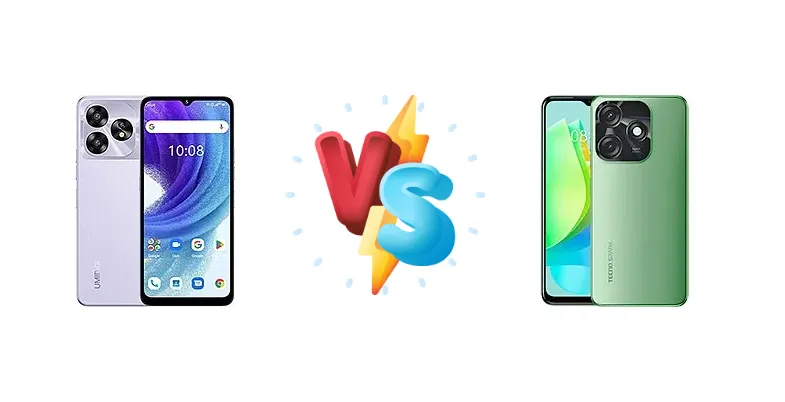
The sub-$150 smartphone market is fiercely competitive. Both the Umidigi A15T and Tecno Spark 10C aim to deliver a functional smartphone experience without breaking the bank. However, they take different approaches to achieving this, primarily through their chipset choices – the Mediatek Helio G95 in the A15T and the Unisoc T606 in the Spark 10C. This comparison dives deep into the architectural differences and real-world implications of these processors to determine which phone offers the best value.
🏆 Quick Verdict
For users prioritizing gaming and demanding applications, the Umidigi A15T is the clear winner. Its Mediatek Helio G95 chipset, featuring Cortex-A76 cores, provides a significant performance advantage over the Tecno Spark 10C’s Unisoc T606. While both offer 18W charging, the A15T’s superior processing power makes it the better choice for those seeking a more responsive and capable device.
| Network |
|---|
| 2G bands | GSM 850 / 900 / 1800 / 1900 | GSM 850 / 900 / 1800 / 1900 |
| 3G bands | HSDPA 850 / 900 / 1700(AWS) / 1900 / 2100 | HSDPA 850 / 900 / 2100 |
| 4G bands | 1, 2, 3, 4, 5, 7, 8, 12, 13, 17, 18, 19, 20, 25, 26, 28, 34, 38, 39, 40, 41, 66 | LTE |
| Speed | HSPA, LTE | HSPA, LTE |
| Technology | GSM / HSPA / LTE | GSM / HSPA / LTE |
| Launch |
|---|
| Announced | 2024 | 2023, March 23 |
| Status | Available. Released 2024 | Available. Released 2023, March 29 |
| Body |
|---|
| Build | - | Glass front, plastic frame, plastic back |
| Dimensions | 167.6 x 75.3 x 8.6 mm (6.60 x 2.96 x 0.34 in) | 163.9 x 75.5 x 8.5 mm (6.45 x 2.97 x 0.33 in) |
| SIM | Nano-SIM + Nano-SIM | Nano-SIM + Nano-SIM |
| Weight | 195 g (6.88 oz) | - |
| Display |
|---|
| Resolution | 720 x 1650 pixels (~269 ppi density) | 720 x 1612 pixels, 20:9 ratio (~267 ppi density) |
| Size | 6.7 inches, 106.2 cm2 (~84.1% screen-to-body ratio) | 6.6 inches, 104.6 cm2 (~84.6% screen-to-body ratio) |
| Type | IPS LCD, 500 nits | IPS LCD, 90Hz |
| Platform |
|---|
| CPU | Octa-core (2x2.05 GHz Cortex-A76 & 6x2.0 GHz Cortex-A55) | Octa-core (2x1.6 GHz Cortex-A75 & 6x1.6 GHz Cortex-A55) |
| Chipset | Mediatek Helio G95 (12 nm) | Unisoc T606 (12 nm) |
| GPU | Mali-G76 MC4 | Mali-G57 MP1 |
| OS | Android 13 | Android 12, HIOS 8.6 |
| Memory |
|---|
| Card slot | microSDXC (uses shared SIM slot) | microSDXC (dedicated slot) |
| Internal | 128GB 8GB RAM | 64GB 4GB RAM, 128GB 4GB RAM, 128GB 8GB RAM |
| Main Camera |
|---|
| Dual | - | 16 MP, (wide), PDAF
0.08 MP, (depth) |
| Features | LED flash | Dual-LED flash, HDR, panorama |
| Single | - | 16 MP, (wide), PDAF
Auxiliary lens |
| Triple | 64 MP, f/1.8, (wide), AF
8 MP, f/2.2, 118˚ (ultrawide)
2 MP (macro) | - |
| Video | 4K@30fps, 1080p@30fps | 1080p@30fps |
| Selfie camera |
|---|
| Features | - | Dual-LED flash |
| Single | 16 MP, f/2.2, (wide) | 8 MP, (wide) |
| Video | 720p@30fps | 1080p@30fps |
| Sound |
|---|
| 3.5mm jack | - | Yes |
| 35mm jack | Yes | Yes |
| Loudspeaker | Yes | Yes |
| Comms |
|---|
| Bluetooth | 5.0, A2DP, LE | Yes |
| NFC | Yes | No |
| Positioning | GPS, GLONASS, GALILEO, BDS | GPS |
| Radio | FM radio | FM radio |
| USB | USB Type-C | USB Type-C 2.0 |
| WLAN | Wi-Fi 802.11 a/b/g/n/ac | Wi-Fi 802.11 a/b/g/n/ac, dual-band |
| Features |
|---|
| Sensors | Fingerprint (side-mounted), accelerometer, gyro, proximity, compass | Fingerprint (side-mounted), accelerometer, proximity, compass |
| Battery |
|---|
| Charging | 18W wired | 18W wired |
| Type | 5000 mAh | 5000 mAh |
| Misc |
|---|
| Colors | Space Black, Nebula Purple, Glacier Blue | Black, Blue, Green |
| Models | - | KI5k, KI5m |
| Price | About 180 EUR | ₹ 9,990 |
Umidigi A15T
- Superior processing power with the Helio G95 chipset.
- More capable for gaming and multitasking.
- Potentially better image processing due to the more powerful ISP.
- Likely higher power consumption leading to potentially shorter battery life.
- May be slightly more expensive than the Tecno Spark 10C.
Tecno Spark 10C
- Lower price point, making it more accessible.
- Potentially better battery life with light usage due to the less demanding processor.
- Sufficient for basic smartphone tasks.
- Significantly weaker performance compared to the Umidigi A15T.
- Struggles with demanding games and multitasking.
- Less responsive user experience.
Display Comparison
Neither device’s display specifications are provided, so a direct comparison is limited. However, given the price bracket, both likely utilize IPS LCD panels. The focus here will be on performance impact. A more powerful chipset, like the Helio G95 in the A15T, can better drive higher refresh rate displays (if present) without significant battery drain, offering a smoother visual experience. The absence of detailed display specs suggests both prioritize cost-effectiveness over premium display features.
Camera Comparison
Without detailed camera specifications, a direct comparison is difficult. However, it’s safe to assume both phones feature basic camera setups geared towards casual photography. The processing capabilities of the Helio G95 in the A15T *could* offer slightly better image processing, potentially resulting in more detailed and vibrant photos, but this is heavily dependent on software optimization. The presence of a more powerful ISP (Image Signal Processor) within the G95 chipset is a potential advantage, but without sensor details, it’s speculative.
Performance
The core difference lies in the chipsets. The Umidigi A15T’s Mediatek Helio G95 (12nm) boasts a CPU configuration of 2x2.05 GHz Cortex-A76 and 6x2.0 GHz Cortex-A55 cores. This architecture, particularly the inclusion of the Cortex-A76, provides a substantial performance uplift compared to the Tecno Spark 10C’s Unisoc T606 (12nm) with its 2x1.6 GHz Cortex-A75 and 6x1.6 GHz Cortex-A55 cores. The Cortex-A76 offers significantly higher IPC (Instructions Per Clock) than the A75, translating to faster application loading times and smoother multitasking. While both are 12nm chips, the architectural advantage of the G95 is crucial. This difference will be most noticeable in gaming and resource-intensive tasks.
Battery Life
Both devices feature 18W wired charging, suggesting similar charging speeds. The actual 0-100% charge time will depend on battery capacity (not provided) and charging efficiency. However, the more powerful processor in the Umidigi A15T will likely consume more power during intensive tasks. Therefore, while charging speeds are equal, the A15T might require more frequent charging with heavy use. Battery life will ultimately depend on user habits and screen-on time.
Buying Guide
Buy the Umidigi A15T if you need a phone capable of handling moderate gaming, multitasking, and demanding apps without significant slowdown. It’s ideal for users who want the most processing power possible within a tight budget. Buy the Tecno Spark 10C if you prioritize basic smartphone functionality – calls, texts, social media – and are looking for the absolute lowest price point. It’s a suitable option for first-time smartphone users or those with very light usage patterns.
Frequently Asked Questions
❓ Will the Umidigi A15T run PUBG Mobile smoothly?
The Helio G95 chipset in the A15T is capable of running PUBG Mobile, but likely at medium settings to maintain a stable frame rate. Expect some frame drops during intense firefights. The Tecno Spark 10C’s Unisoc T606 will struggle to provide a playable experience, even on the lowest settings.
❓ Is the Unisoc T606 chipset suitable for everyday social media and browsing?
Yes, the Unisoc T606 is perfectly adequate for basic tasks like browsing social media, checking emails, and making calls. It won’t offer a particularly snappy experience, but it will handle these tasks without major issues. However, opening multiple apps or switching between them quickly will likely result in noticeable lag.
❓ Does the Umidigi A15T get noticeably warmer during gaming?
The Helio G95 is known to generate more heat under load than the Unisoc T606. While the A15T likely has basic thermal management, expect some warming during extended gaming sessions. This may lead to slight performance throttling to prevent overheating.
❓ Which phone is better for someone upgrading from a feature phone?
The Tecno Spark 10C is likely the better choice for a first-time smartphone user. Its lower price point makes it a less risky investment, and the Unisoc T606 is sufficient for basic smartphone functions. The Umidigi A15T’s extra power is unlikely to be fully utilized by someone new to smartphones.