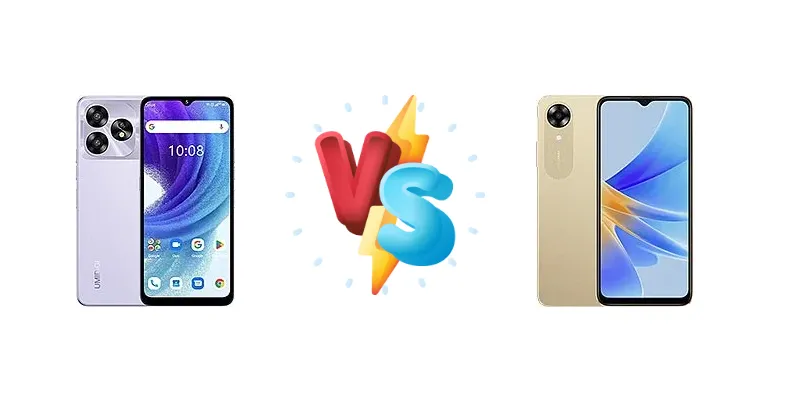
The sub-$150 smartphone market is fiercely competitive. Both the Umidigi A15T and Oppo A17k aim to deliver essential smartphone functionality at an accessible price point. However, significant differences in their core chipsets dictate vastly different performance profiles, making this comparison crucial for budget-conscious buyers.
🏆 Quick Verdict
For users prioritizing performance and responsiveness, the Umidigi A15T is the clear winner. Its Mediatek Helio G95 chipset offers a substantial upgrade over the Oppo A17k’s Helio G35, making it better suited for gaming and multitasking. While the A17k may offer a slightly more polished software experience, the A15T’s raw power provides a more future-proof experience.
| Network |
|---|
| 2G bands | GSM 850 / 900 / 1800 / 1900 | GSM 850 / 900 / 1800 / 1900 |
| 3G bands | HSDPA 850 / 900 / 1700(AWS) / 1900 / 2100 | HSDPA 850 / 900 / 2100 |
| 4G bands | 1, 2, 3, 4, 5, 7, 8, 12, 13, 17, 18, 19, 20, 25, 26, 28, 34, 38, 39, 40, 41, 66 | 1, 3, 5, 8, 38, 40, 41 |
| Speed | HSPA, LTE | HSPA, LTE |
| Technology | GSM / HSPA / LTE | GSM / HSPA / LTE |
| Launch |
|---|
| Announced | 2024 | 2022, October 13 |
| Status | Available. Released 2024 | Available. Released 2022, October 18 |
| Body |
|---|
| Dimensions | 167.6 x 75.3 x 8.6 mm (6.60 x 2.96 x 0.34 in) | 164.2 x 75.6 x 8.3 mm (6.46 x 2.98 x 0.33 in) |
| SIM | Nano-SIM + Nano-SIM | Nano-SIM + Nano-SIM |
| Weight | 195 g (6.88 oz) | 189 g (6.67 oz) |
| | - | IPX4 water resistance |
| Display |
|---|
| Protection | - | Panda Glass |
| Resolution | 720 x 1650 pixels (~269 ppi density) | 720 x 1612 pixels, 20:9 ratio (~269 ppi density) |
| Size | 6.7 inches, 106.2 cm2 (~84.1% screen-to-body ratio) | 6.56 inches, 103.4 cm2 (~83.3% screen-to-body ratio) |
| Type | IPS LCD, 500 nits | IPS LCD, 480 nits (typ), 600 nits (HBM) |
| Platform |
|---|
| CPU | Octa-core (2x2.05 GHz Cortex-A76 & 6x2.0 GHz Cortex-A55) | Octa-core (4x2.3 GHz Cortex-A53 & 4x1.8 GHz Cortex-A53) |
| Chipset | Mediatek Helio G95 (12 nm) | Mediatek MT6765 Helio G35 (12 nm) |
| GPU | Mali-G76 MC4 | PowerVR GE8320 |
| OS | Android 13 | Android 12, ColorOS 12.1 |
| Memory |
|---|
| Card slot | microSDXC (uses shared SIM slot) | microSDXC |
| Internal | 128GB 8GB RAM | 64GB 3GB RAM |
| | - | eMMC 5.1 |
| Main Camera |
|---|
| Features | LED flash | LED flash, panorama |
| Single | - | 8 MP, f/2.0, (wide), AF |
| Triple | 64 MP, f/1.8, (wide), AF
8 MP, f/2.2, 118˚ (ultrawide)
2 MP (macro) | - |
| Video | 4K@30fps, 1080p@30fps | 1080p@30fps |
| Selfie camera |
|---|
| Single | 16 MP, f/2.2, (wide) | 5 MP, f/2.2, (wide) |
| Video | 720p@30fps | 1080p@30fps |
| Sound |
|---|
| 3.5mm jack | - | Yes |
| 35mm jack | Yes | Yes |
| Loudspeaker | Yes | Yes |
| Comms |
|---|
| Bluetooth | 5.0, A2DP, LE | 5.3, A2DP, LE, aptX HD |
| NFC | Yes | No |
| Positioning | GPS, GLONASS, GALILEO, BDS | GPS, GLONASS, BDS, GALILEO |
| Radio | FM radio | Unspecified |
| USB | USB Type-C | microUSB 2.0, OTG |
| WLAN | Wi-Fi 802.11 a/b/g/n/ac | Wi-Fi 802.11 a/b/g/n/ac, dual-band |
| Features |
|---|
| Sensors | Fingerprint (side-mounted), accelerometer, gyro, proximity, compass | Fingerprint (side-mounted), accelerometer, proximity, compass |
| Battery |
|---|
| Charging | 18W wired | - |
| Type | 5000 mAh | Li-Po 5000 mAh |
| Misc |
|---|
| Colors | Space Black, Nebula Purple, Glacier Blue | Navy Blue, Gold |
| Models | - | CPH2471 |
| Price | About 180 EUR | About 130 EUR |
Umidigi A15T
- Significantly more powerful processor (Helio G95)
- Better suited for gaming and multitasking
- Potentially superior camera image processing
- Software experience may be less polished than Oppo
- May have slightly lower standby time due to more powerful processor
Oppo A17k
- Potentially more refined software experience (Oppo's ColorOS)
- Lower power consumption for potentially longer standby
- Generally reliable brand reputation
- Significantly weaker processor (Helio G35)
- Struggles with demanding apps and games
- Slower overall performance
Display Comparison
Neither device boasts a standout display. Both utilize 12nm chipsets, suggesting similar power constraints impacting display capabilities. While specific display specs (resolution, brightness) are missing, the focus here is on performance, not visual fidelity. Expect basic LCD panels suitable for everyday use, but not ideal for outdoor visibility or color-critical work. Bezels are likely comparable given the price bracket.
Camera Comparison
Without detailed camera specifications, a direct comparison is limited. However, the chipset difference indirectly impacts camera performance. The G95’s superior image signal processor (ISP) within the Helio G95 allows for faster image processing and potentially better noise reduction compared to the G35. While both phones likely feature basic camera setups, the A15T will likely deliver sharper, more detailed photos and videos, especially in challenging lighting conditions. The prevalence of 2MP macro lenses on both devices suggests limited utility; focusing on the main sensor performance is more relevant.
Performance
The core difference lies in the chipsets. The Umidigi A15T’s Mediatek Helio G95, with its 2x2.05 GHz Cortex-A76 and 6x2.0 GHz Cortex-A55 cores, represents a significant architectural leap over the Oppo A17k’s Helio G35. The G95’s Cortex-A76 cores provide substantially higher single-core performance, crucial for app launch speeds and responsiveness. The G35, utilizing 4x2.3 GHz Cortex-A53 and 4x1.8 GHz Cortex-A53 cores, relies on older, less efficient architecture. This translates to noticeable lag and slower processing times in demanding applications. The G95 is better equipped for sustained workloads, benefiting users who multitask or play mobile games.
Battery Life
Both devices feature 18W wired charging, suggesting comparable charging speeds. While battery capacity isn't specified, the Helio G95’s greater efficiency could offset a potentially smaller battery in the A15T, resulting in similar real-world battery life. However, the G35’s lower power draw might provide slightly longer standby times. The 18W charging is adequate for topping up overnight, but doesn’t offer rapid charging capabilities.
Buying Guide
Buy the Umidigi A15T if you need a phone capable of handling moderate gaming, smoother app switching, and generally faster performance. This is the choice for users who want the most processing power for their money. Buy the Oppo A17k if you prioritize a potentially more refined user experience and are primarily focused on basic tasks like calling, texting, and light social media use. It’s a good option for first-time smartphone users or those with minimal demands.
Frequently Asked Questions
❓ Will the Umidigi A15T handle popular games like PUBG Mobile or Call of Duty Mobile?
The Helio G95 in the Umidigi A15T is capable of running PUBG Mobile and Call of Duty Mobile, but likely at medium settings to maintain a stable frame rate. Expect some frame drops during intense action. The Oppo A17k’s Helio G35 will struggle with these titles, offering a significantly less enjoyable gaming experience.
❓ Is the software on the Oppo A17k more user-friendly than on the Umidigi A15T?
Oppo’s ColorOS is generally known for its user-friendly interface and added features. Umidigi’s software is typically closer to stock Android, which some users prefer for its simplicity, but may lack the polish and optimizations found in ColorOS. However, software updates and long-term support are often more consistent with established brands like Oppo.
❓ How much of a performance difference will I actually notice between the Helio G95 and Helio G35 in everyday tasks?
The difference will be quite noticeable. The Helio G95 will result in faster app launch times, smoother scrolling, and quicker response when switching between apps. The Helio G35 will feel sluggish in comparison, especially when running multiple apps simultaneously or opening heavier applications like web browsers with many tabs.