
Umidigi A15C vs Samsung Galaxy A14 5G: A Deep Dive into Budget 5G
| Phones Images | |||||
|---|---|---|---|---|---|
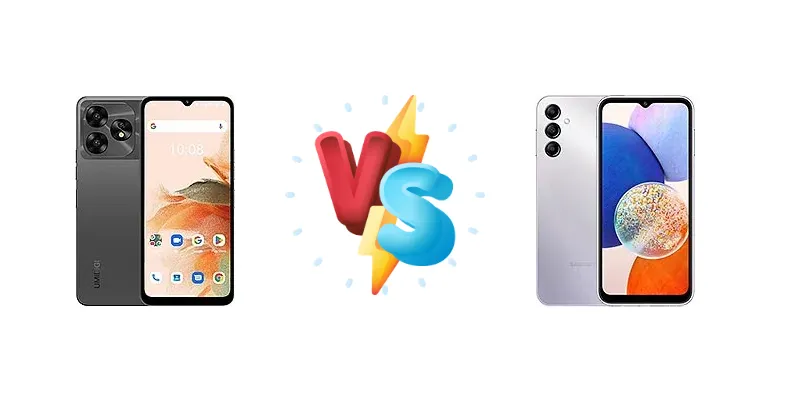
|
🏆 Quick Verdict
For most users, the Samsung Galaxy A14 5G is the better choice. Its Exynos 1330 (or Dimensity 700) chipset offers significantly improved performance over the Umidigi A15C’s Unisoc T606, translating to a smoother user experience and better app responsiveness. While the A15C is cheaper, the A14 5G’s performance advantage justifies the price difference.
| PHONES | ||
|---|---|---|
| Phone Names | Umidigi A15C | Samsung Galaxy A14 5G |
| Network | ||
|---|---|---|
| 2G bands | GSM 850 / 900 / 1800 / 1900 | GSM 850 / 900 / 1800 / 1900 |
| 3G bands | HSDPA 850 / 900 / 1700(AWS) / 1900 / 2100 | HSDPA 850 / 900 / 1700(AWS) / 1900 / 2100 |
| 4G bands | 1, 2, 3, 4, 5, 7, 8, 12, 13, 17, 18, 19, 20, 25, 26, 28, 34, 38, 39, 40, 41, 66 | 1, 2, 3, 4, 5, 7, 8, 12, 17, 20, 26, 28, 38, 40, 41, 66 - International |
| 5G bands | - | 2, 5, 66, 77 Sub6/mmWave - USA |
| Speed | HSPA, LTE | HSPA, LTE, 5G |
| Technology | GSM / HSPA / LTE | GSM / HSPA / LTE / 5G |
| - | 1, 3, 5, 7, 8, 20, 28, 40, 41, 78 SA/NSA/Sub6 - India | |
| Launch | ||
|---|---|---|
| Announced | 2023 | 2023, January 04 |
| Status | Available. Released 2023 | Available. Released 2023, January 12 |
| Body | ||
|---|---|---|
| Build | - | Glass front, plastic back, plastic frame |
| Dimensions | 167.6 x 75.3 x 8.6 mm (6.60 x 2.96 x 0.34 in) | 167.7 x 78 x 9.1 mm (6.60 x 3.07 x 0.36 in) |
| SIM | Nano-SIM + Nano-SIM | · Nano-SIM· Nano-SIM + Nano-SIM |
| Weight | 195 g (6.88 oz) | 202 g (7.13 oz) |
| Display | ||
|---|---|---|
| Resolution | 720 x 1650 pixels (~269 ppi density) | 1080 x 2408 pixels, 20:9 ratio (~400 ppi density) |
| Size | 6.7 inches, 106.2 cm2 (~84.1% screen-to-body ratio) | 6.6 inches, 104.9 cm2 (~80.2% screen-to-body ratio) |
| Type | IPS LCD, 500 nits | PLS LCD, 90Hz |
| Platform | ||
|---|---|---|
| CPU | Octa-core (2x1.6 GHz Cortex-A75 & 6x1.6 GHz Cortex-A55) | Octa-core (2x2.4 GHz Cortex-A78 & 6x2.0 GHz Cortex-A55) - SM-A146BOcta-core (2x2.2 GHz Cortex-A76 & 6x2.0 GHz Cortex-A55) - SM-A146P |
| Chipset | Unisoc T606 (12 nm) | Exynos 1330 (5 nm) - SM-A146BMediatek Dimensity 700 (7 nm) - SM-A146P |
| GPU | Mali-G57 MP1 | Mali-G68 MP2 - SM-A146BMali-G57 MC2 - SM-A146P |
| OS | Android 13 | Android 13, upgradable to Android 15, One UI Core 7 |
| Memory | ||
|---|---|---|
| Card slot | microSDXC (uses shared SIM slot) | microSDXC (uses shared SIM slot) - USA onlymicroSDXC (dedicated slot) - International |
| Internal | 128GB 8GB RAM | 64GB 4GB RAM, 128GB 4GB RAM, 128GB 6GB RAM, 128GB 8GB RAM |
| Main Camera | ||
|---|---|---|
| Features | LED flash | LED flash, panorama, HDR |
| Single | - | 13 MP, f/2.0, (wide) |
| Triple | 48 MP, f/1.8, (wide), AF 8 MP, f/2.2, 118˚ (ultrawide) 5 MP (macro) | 50 MP, f/1.8, 26mm (wide), 1/2.76", 0.64µm, PDAF 2 MP (macro) Auxiliary lens |
| Video | 1080p@30fps | 1080p@30fps |
| Selfie camera | ||
|---|---|---|
| Single | 8 MP, f/2.2, (wide) | 13 MP, f/2.0, 26mm (wide), 1.12µm |
| Video | 1080p@30fps | 1080p@30fps |
| Sound | ||
|---|---|---|
| 3.5mm jack | - | Yes |
| 35mm jack | Yes | Yes |
| Loudspeaker | Yes | Yes |
| Comms | ||
|---|---|---|
| Bluetooth | 5.0, A2DP, LE | 5.2, A2DP, LE |
| NFC | Yes | Yes |
| Positioning | GPS, GLONASS, GALILEO, BDS | GPS, GLONASS, GALILEO |
| Radio | FM radio | FM radio (Exynos 1330 chipset only), recording |
| USB | USB Type-C | USB Type-C 2.0 |
| WLAN | Wi-Fi 802.11 a/b/g/n/ac | Wi-Fi 802.11 a/b/g/n/ac, dual-band, Wi-Fi Direct |
| Features | ||
|---|---|---|
| Sensors | Fingerprint (side-mounted), accelerometer, proximity, compass | Fingerprint (side-mounted), accelerometer, gyro, proximity, compass, barometer (USA only) |
| Battery | ||
|---|---|---|
| Charging | 10W wired | 15W wired |
| Type | 5000 mAh | Li-Po 5000 mAh |
| Misc | ||
|---|---|---|
| Colors | Graphite Black, Jade Green, Lavender Purple, Pearl White, Space Gray | Black, Light Green, Dark Red, Silver |
| Models | - | SM-A146B, SM-A146B/DS, SM-A146P, SM-A146P/DS, SM-A146U, SM-A146U1, SM-A146U1/DS, SM-A146W, SM-A146P/N, SM-A146P/DSN, SM-S146VL, SM-A146M |
| Price | - | $ 77.63 / C$ 151.00 / £ 97.00 / € 159.79 / ₹ 14,990 |
| SAR | - | 1.00 W/kg (head) 1.00 W/kg (body) |
| SAR EU | - | 0.56 W/kg (head) 1.28 W/kg (body) |
| Tests | ||
|---|---|---|
| Battery life | - | Endurance rating 130h |
| Camera | - | Photo / Video |
| Display | - | Contrast ratio: 1334:1 (nominal) |
| Loudspeaker | - | -26.8 LUFS (Good) |
| Performance | - | AnTuTu: 307886 (v9) GeekBench: 1727 (v5.1) GFXBench: 12fps (ES 3.1 onscreen) |
Umidigi A15C
- Significantly lower price point
- 5G connectivity for budget users
- Acceptable battery life
- Substantially weaker processor
- Limited charging speed (10W)
- Display specs are less impressive
Samsung Galaxy A14 5G
- More powerful processor (Exynos 1330 or Dimensity 700)
- Faster charging (15W)
- Brighter display for outdoor visibility
- Higher price compared to Umidigi A15C
- Potential regional chipset variation (Exynos vs Dimensity)
- 2MP macro camera is largely unnecessary
Display Comparison
Both phones feature similar contrast ratios at 1334:1, suggesting comparable image quality in terms of black levels. However, the Samsung Galaxy A14 5G boasts a significantly brighter display at 519 nits, compared to an unlisted value for the Umidigi A15C, implying better visibility outdoors. The lack of detailed display specs for the A15C raises concerns about color accuracy and viewing angles, areas where Samsung typically excels. The A14 5G’s larger screen size (unspecified, but generally larger in this class) also contributes to a more immersive viewing experience.
Camera Comparison
Both phones offer 'Photo / Video' capabilities, but detailed camera specifications are limited. Without sensor size or aperture information for either device, a direct comparison is difficult. However, Samsung’s image processing algorithms are generally more refined, potentially leading to better image quality in various lighting conditions. The inclusion of a 2MP macro camera on both devices is largely a marketing tactic, offering limited practical benefit due to the small sensor size and lack of optical image stabilization (OIS).
Performance
The performance gap is the most significant differentiator. The Samsung Galaxy A14 5G, equipped with either the Exynos 1330 (SM-A146B) or Dimensity 700 (SM-A146P), utilizes a more advanced fabrication process (5nm or 7nm respectively) compared to the Umidigi A15C’s 12nm Unisoc T606. The Exynos 1330’s Cortex-A78 cores, clocked at 2.4 GHz, provide a substantial performance uplift over the A15C’s Cortex-A75 cores at 1.6 GHz. This translates to faster app loading times, smoother multitasking, and improved gaming performance on the A14 5G. The A15C’s Unisoc T606 is adequate for basic tasks, but will struggle with demanding applications.
Battery Life
Both devices achieve an endurance rating of 130 hours, suggesting similar overall battery life. However, the Samsung Galaxy A14 5G supports 15W wired charging, while the Umidigi A15C is limited to 10W. This means the A14 5G will recharge faster, reducing downtime. While battery capacity isn’t specified for either device, the faster charging speed of the A14 5G provides a tangible advantage for users who frequently need to top up their battery.
Buying Guide
Buy the Umidigi A15C if your primary need is a functional, ultra-affordable 5G phone for basic tasks like calls, texts, and light social media browsing, and you're willing to compromise on performance. Buy the Samsung Galaxy A14 5G if you prioritize a smoother, more responsive experience for everyday use, including moderate gaming and multitasking, and value Samsung’s software ecosystem and brand reliability.