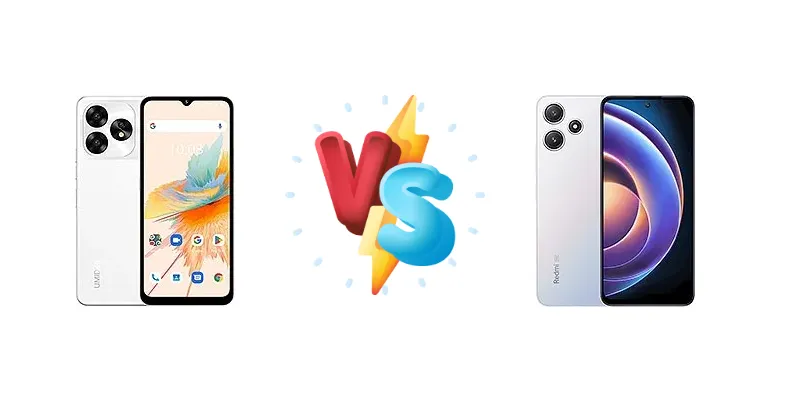
The sub-$200 smartphone market is fiercely competitive. The Umidigi A15, powered by a Unisoc Tiger T616, aims to deliver solid performance at an aggressive price point. However, the Xiaomi Redmi Note 12R, featuring Qualcomm’s Snapdragon 4 Gen 2, enters the fray with a more modern and efficient chipset. This comparison will dissect the key differences to determine which device offers the best value.
🏆 Quick Verdict
For the average user prioritizing long-term performance and efficiency, the Xiaomi Redmi Note 12R is the superior choice. Its Snapdragon 4 Gen 2, built on a 4nm process, provides a noticeable advantage in both CPU and GPU performance, alongside better thermal management, despite slightly slower charging.
| Network |
|---|
| 2G bands | GSM 850 / 900 / 1800 / 1900 | GSM 850 / 900 / 1800 / 1900 |
| 3G bands | HSDPA 850 / 900 / 1700(AWS) / 1900 / 2100 | HSDPA 850 / 900 / 2100 |
| 4G bands | 1, 2, 3, 4, 5, 7, 8, 12, 13, 17, 18, 19, 20, 25, 26, 28, 34, 38, 39, 40, 41, 66 | 1, 3, 5, 8, 34, 38, 39, 40, 41 |
| 5G bands | - | 1, 5, 8, 28, 41, 78 SA/NSA |
| Speed | HSPA, LTE | HSPA, LTE, 5G |
| Technology | GSM / HSPA / LTE | GSM / CDMA / HSPA / EVDO / LTE / 5G |
| Launch |
|---|
| Announced | 2023 | 2023, June 28 |
| Status | Available. Released 2023 | Available. Released 2023, June 28 |
| Body |
|---|
| Build | - | Glass front, plastic frame, glass back |
| Dimensions | 167.6 x 75.3 x 8.6 mm (6.60 x 2.96 x 0.34 in) | 168.6 x 76.3 x 8.2 mm (6.64 x 3.00 x 0.32 in) |
| SIM | Nano-SIM + Nano-SIM | Nano-SIM + Nano-SIM |
| Weight | 195 g (6.88 oz) | 199 g (7.02 oz) |
| Display |
|---|
| Resolution | 720 x 1650 pixels (~269 ppi density) | 1080 x 2460 pixels (~396 ppi density) |
| Size | 6.7 inches, 106.2 cm2 (~84.1% screen-to-body ratio) | 6.79 inches, 109.5 cm2 (~85.1% screen-to-body ratio) |
| Type | IPS LCD, 500 nits | IPS LCD, 90Hz, 550 nits |
| Platform |
|---|
| CPU | Octa-core (2x2.0 GHz Cortex-A75 & 6x1.8 GHz Cortex-A55) | Octa-core (2x2.2 GHz Cortex-A78 & 6x1.95 GHz Cortex-A55) |
| Chipset | Unisoc Tiger T616 (12 nm) | Qualcomm SM4450 Snapdragon 4 Gen 2 (4 nm) |
| GPU | Mali-G57 MP1 | Adreno 613 |
| OS | Android 13 | Android 13, MIUI 14 |
| Memory |
|---|
| Card slot | microSDXC (uses shared SIM slot) | microSDXC (uses shared SIM slot) |
| Internal | 256GB 8GB RAM | 128GB 4GB RAM, 128GB 6GB RAM, 128GB 8GB RAM, 256GB 8GB RAM |
| Main Camera |
|---|
| Dual | - | 50 MP, f/1.8, (wide), PDAF
2 MP (macro) |
| Features | LED flash | LED flash, HDR |
| Triple | 64 MP, f/1.8, (wide), AF
8 MP, f/2.2, 118˚ (ultrawide)
5 MP (macro) | - |
| Video | 1080p@30fps | 1080p@30fps |
| Selfie camera |
|---|
| Features | - | HDR |
| Single | 16 MP, f/2.2, (wide) | 5 MP, f/2.2, (wide), 1/5.0", 1.12µm |
| Video | 720p@30fps | 1080p@30fps |
| Sound |
|---|
| 35mm jack | Yes | Yes |
| Loudspeaker | Yes | Yes |
| Comms |
|---|
| Bluetooth | 5.0, A2DP, LE | 5.3, A2DP, LE |
| Infrared port | - | Yes |
| NFC | Yes | Yes (market/region dependent) |
| Positioning | GPS, GLONASS, GALILEO, BDS | GPS, GLONASS, GALILEO, BDS |
| Radio | FM radio | No |
| USB | USB Type-C | USB Type-C |
| WLAN | Wi-Fi 802.11 a/b/g/n/ac | Wi-Fi 802.11 a/b/g/n/ac, dual-band |
| Features |
|---|
| Sensors | Fingerprint (side-mounted), accelerometer, gyro, proximity, compass | Fingerprint (side-mounted), accelerometer, compass |
| Battery |
|---|
| Charging | 20W wired | 18W wired, PD |
| Type | 5000 mAh | Li-Po 5000 mAh |
| Misc |
|---|
| Colors | Graphite Black, Jade Green, Lavender Purple, Pearl White, Space Gray | Black, Blue, Silver |
| Models | - | 23076RA4BC |
| Price | About 200 EUR | About 150 EUR |
Umidigi A15
- Faster 20W wired charging
- Potentially lower price point
- Unisoc chipset offers a different experience for those seeking alternatives to Qualcomm
- Less efficient Unisoc Tiger T616 chipset
- Older CPU architecture (Cortex-A75)
- Potentially lower sustained performance
Xiaomi Redmi Note 12R
- More efficient Snapdragon 4 Gen 2 (4nm)
- Superior CPU architecture (Cortex-A78)
- Better long-term performance and software support
- Slower 18W charging
- Potentially slightly higher price
- Qualcomm chipset is more common, less 'unique'
Display Comparison
Neither device boasts a standout display. Specifications are not provided, so we must rely on market segment expectations. Both likely feature 1080p LCD panels. However, the Redmi Note 12R, given Xiaomi’s typical display calibration, likely offers slightly more accurate color reproduction. The absence of high refresh rates on either device suggests a focus on battery life over visual fluidity. Bezels are expected to be comparable, typical of this price bracket.
Camera Comparison
Without detailed camera specifications, a direct comparison is difficult. However, given the price point, both devices likely feature a primary sensor around 50MP. The Redmi Note 12R, benefiting from Qualcomm’s image signal processor (ISP), is expected to deliver slightly better image processing, particularly in low-light conditions. The Umidigi A15 may rely more heavily on software algorithms, potentially leading to less natural-looking images. The inclusion of a 2MP macro lens on either device is largely a marketing gimmick and should not be a deciding factor.
Performance
The core difference lies in the chipsets. The Xiaomi Redmi Note 12R’s Snapdragon 4 Gen 2 (4nm) is a significant upgrade over the Umidigi A15’s Unisoc Tiger T616 (12nm). The 4nm process inherently offers better power efficiency, translating to less heat generation and sustained performance. While both are octa-core CPUs, the Redmi Note 12R utilizes Cortex-A78 cores (2x2.2 GHz) which are architecturally superior to the A15’s Cortex-A75 cores (2x2.0 GHz), resulting in faster single-core performance. This difference will be most noticeable in app launch times and demanding tasks. The Redmi Note 12R’s GPU will also provide a more enjoyable gaming experience.
Battery Life
Battery capacity is not specified, but both devices likely house batteries in the 5000mAh range. The Umidigi A15’s 20W wired charging is faster than the Redmi Note 12R’s 18W charging with Power Delivery (PD). However, the Snapdragon 4 Gen 2’s superior efficiency means the Redmi Note 12R will likely consume less power during typical usage, potentially offsetting the slower charging speed. A full charge on the A15 will be quicker, but the 12R will likely last longer on a single charge.
Buying Guide
Buy the Umidigi A15 if you prioritize faster charging speeds (20W vs 18W) and are primarily focused on basic tasks like calling, texting, and light social media use. Buy the Xiaomi Redmi Note 12R if you value smoother multitasking, improved gaming performance, and a more future-proof chipset that will handle software updates and demanding apps more effectively.
Frequently Asked Questions
❓ Will the Unisoc T616 in the Umidigi A15 struggle with demanding games like PUBG Mobile?
The Unisoc T616 can run PUBG Mobile, but expect to play at lower graphics settings and potentially experience frame drops during intense action. The Snapdragon 4 Gen 2 in the Redmi Note 12R will provide a significantly smoother and more consistent gaming experience.
❓ Does the Redmi Note 12R support fast software updates and security patches?
Xiaomi generally provides more consistent software updates and security patches compared to Umidigi. The Redmi Note 12R is more likely to receive timely updates, ensuring your device remains secure and benefits from new features.
❓ Is the 18W charging on the Redmi Note 12R significantly slower than the 20W charging on the Umidigi A15 in real-world use?
While 20W is technically faster, the Snapdragon 4 Gen 2's efficiency means the Redmi Note 12R consumes less power. This can minimize the impact of the slower charging speed, and the difference in 0-100% charge time may not be as drastic as the wattage difference suggests.