
Umidigi A15 vs Xiaomi Poco M5: Which Budget Phone Reigns Supreme?
| Phones Images | |||||
|---|---|---|---|---|---|
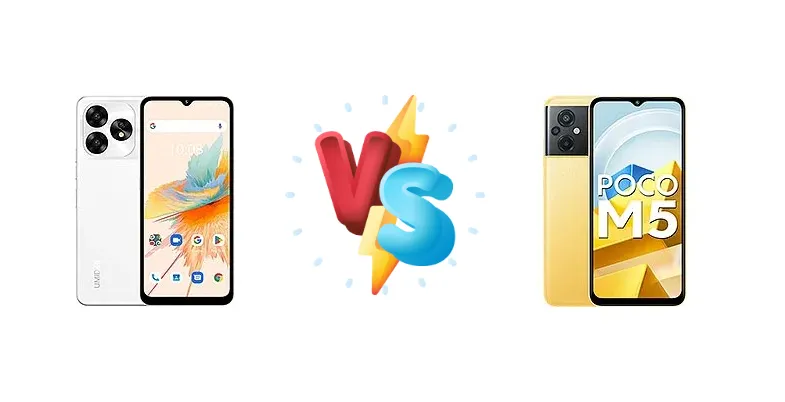
|
🏆 Quick Verdict
For most users, the Xiaomi Poco M5 emerges as the stronger choice. Its Helio G99 chipset, built on a more efficient 6nm process, provides a noticeable performance advantage, particularly in gaming. While the Umidigi A15 offers 20W charging, the Poco M5’s overall package delivers a more refined experience.
| PHONES | ||
|---|---|---|
| Phone Names | Umidigi A15 | Xiaomi Poco M5 |
| Network | ||
|---|---|---|
| 2G bands | GSM 850 / 900 / 1800 / 1900 | GSM 850 / 900 / 1800 / 1900 |
| 3G bands | HSDPA 850 / 900 / 1700(AWS) / 1900 / 2100 | HSDPA 850 / 900 / 1700(AWS) / 1900 / 2100 |
| 4G bands | 1, 2, 3, 4, 5, 7, 8, 12, 13, 17, 18, 19, 20, 25, 26, 28, 34, 38, 39, 40, 41, 66 | 1, 2, 3, 4, 5, 7, 8, 20, 28, 38, 40, 41 |
| Speed | HSPA, LTE | HSPA, LTE |
| Technology | GSM / HSPA / LTE | GSM / HSPA / LTE |
| Launch | ||
|---|---|---|
| Announced | 2023 | 2022, September 05 |
| Status | Available. Released 2023 | Available. Released 2022, September 13 |
| Body | ||
|---|---|---|
| Build | - | Glass front (Gorilla Glass 3), plastic frame, plastic back |
| Dimensions | 167.6 x 75.3 x 8.6 mm (6.60 x 2.96 x 0.34 in) | 164 x 76.1 x 8.9 mm (6.46 x 3.00 x 0.35 in) |
| SIM | Nano-SIM + Nano-SIM | Nano-SIM + Nano-SIM |
| Weight | 195 g (6.88 oz) | 201 g (7.09 oz) |
| Display | ||
|---|---|---|
| Protection | - | Corning Gorilla Glass 3 |
| Resolution | 720 x 1650 pixels (~269 ppi density) | 1080 x 2408 pixels, 20:9 ratio (~401 ppi density) |
| Size | 6.7 inches, 106.2 cm2 (~84.1% screen-to-body ratio) | 6.58 inches, 104.3 cm2 (~83.6% screen-to-body ratio) |
| Type | IPS LCD, 500 nits | IPS LCD, 90Hz, 500 nits (HBM) |
| Platform | ||
|---|---|---|
| CPU | Octa-core (2x2.0 GHz Cortex-A75 & 6x1.8 GHz Cortex-A55) | Octa-core (2x2.2 GHz Cortex-A76 & 6x2.0 GHz Cortex-A55) |
| Chipset | Unisoc Tiger T616 (12 nm) | Mediatek Helio G99 (6 nm) |
| GPU | Mali-G57 MP1 | Mali-G57 MC2 |
| OS | Android 13 | Android 12, upgradable to Android 14, HyperOS |
| Memory | ||
|---|---|---|
| Card slot | microSDXC (uses shared SIM slot) | microSDXC (dedicated slot) |
| Internal | 256GB 8GB RAM | 64GB 4GB RAM, 128GB 4GB RAM, 128GB 6GB RAM |
| - | UFS 2.2 | |
| Main Camera | ||
|---|---|---|
| Features | LED flash | LED flash, HDR, panorama |
| Triple | 64 MP, f/1.8, (wide), AF 8 MP, f/2.2, 118˚ (ultrawide) 5 MP (macro) | 50 MP, f/1.8, (wide), PDAF 2 MP (macro) Auxiliary lens |
| Video | 1080p@30fps | 1080p@30fps |
| Selfie camera | ||
|---|---|---|
| Single | 16 MP, f/2.2, (wide) | 5 MP, f/2.2, (wide), 1/5.0", 1.12µm |
| Video | 720p@30fps | 1080p@30fps |
| Sound | ||
|---|---|---|
| 3.5mm jack | - | Yes |
| 35mm jack | Yes | Yes |
| Loudspeaker | Yes | Yes |
| Comms | ||
|---|---|---|
| Bluetooth | 5.0, A2DP, LE | 5.3, A2DP, LE |
| Infrared port | - | Yes |
| NFC | Yes | Yes |
| Positioning | GPS, GLONASS, GALILEO, BDS | GPS, GLONASS, GALILEO, BDS |
| Radio | FM radio | FM radio |
| USB | USB Type-C | USB Type-C 2.0, OTG |
| WLAN | Wi-Fi 802.11 a/b/g/n/ac | Wi-Fi 802.11 a/b/g/n/ac, dual-band, Wi-Fi Direct |
| Features | ||
|---|---|---|
| Sensors | Fingerprint (side-mounted), accelerometer, gyro, proximity, compass | Fingerprint (side-mounted), accelerometer, proximity, compass |
| Battery | ||
|---|---|---|
| Charging | 20W wired | 18W wired |
| Type | 5000 mAh | Li-Po 5000 mAh |
| Misc | ||
|---|---|---|
| Colors | Graphite Black, Jade Green, Lavender Purple, Pearl White, Space Gray | Black, Green, Yellow |
| Models | - | 22071219CG |
| Price | About 200 EUR | About 100 EUR |
| SAR | - | 1.04 W/kg (head) 0.83 W/kg (body) |
| SAR EU | - | 0.52 W/kg (head) 0.83 W/kg (body) |
| Tests | ||
|---|---|---|
| Battery life | - | Endurance rating 121h |
| Camera | - | Photo / Video |
| Display | - | Contrast ratio: 1363:1 |
| Loudspeaker | - | -27.6 LUFS (Good) |
| Performance | - | AnTuTu: 386311 (v9) GeekBench: 1896 (v5.1) GFXBench: 12fps (ES 3.1 onscreen) |
Umidigi A15
- Faster 20W charging
- Potentially more efficient chipset for basic tasks
- Competitive price point
- Less powerful chipset for gaming
- 12nm process may lead to more heat
- Display likely less bright than Poco M5
Xiaomi Poco M5
- More powerful Helio G99 chipset
- 6nm process for better efficiency and thermals
- Brighter display for outdoor visibility
- Slower 18W charging
- May be slightly more expensive
- Similar battery life despite slower charging
Display Comparison
The Xiaomi Poco M5 boasts a display with a measured peak brightness of 448 nits and a 1363:1 contrast ratio. While the Umidigi A15’s display specifications are not provided, it’s reasonable to assume it falls slightly behind in brightness given the Poco M5’s focus on visual clarity. The identical contrast ratios suggest similar panel technology, likely IPS LCDs. Neither phone is expected to offer high refresh rates, but the Poco M5’s higher brightness will be beneficial for outdoor visibility.
Camera Comparison
Both phones are listed as having Photo/Video capabilities, but detailed camera specifications are absent. Given the price point, we can expect similar camera performance, likely centered around a primary sensor with modest resolution. The absence of details suggests neither phone will excel in low-light photography or offer advanced features like optical image stabilization (OIS). The usefulness of any included macro cameras (often 2MP) is questionable, offering limited detail and image quality.
Performance
The core difference lies in the chipsets. The Poco M5’s MediaTek Helio G99 (6nm) features two Cortex-A76 cores clocked at 2.2 GHz, paired with six Cortex-A55 cores at 2.0 GHz. This contrasts with the Umidigi A15’s Unisoc Tiger T616 (12nm), which uses two Cortex-A75 cores at 2.0 GHz and six Cortex-A55 cores at 1.8 GHz. The 6nm fabrication process of the Helio G99 is a significant advantage, offering improved power efficiency and thermal performance compared to the 12nm Tiger T616. This translates to sustained performance during demanding tasks like gaming. The slightly higher clock speeds on the Poco M5’s A76 cores further contribute to its performance edge.
Battery Life
Both the Umidigi A15 and Xiaomi Poco M5 achieve an impressive endurance rating of 121 hours, suggesting comparable battery life under similar usage conditions. However, the Umidigi A15 supports 20W wired charging, while the Poco M5 is limited to 18W. This means the A15 should theoretically charge faster, potentially reducing downtime. Despite the difference in wattage, the overall battery experience will likely be similar due to the efficient power management of the Helio G99 in the Poco M5.
Buying Guide
Buy the Umidigi A15 if you prioritize faster charging speeds and are primarily focused on basic smartphone tasks like calling, texting, and light social media use. Buy the Xiaomi Poco M5 if you value gaming performance, a more efficient processor, and a slightly brighter display, even if it means slightly slower charging.