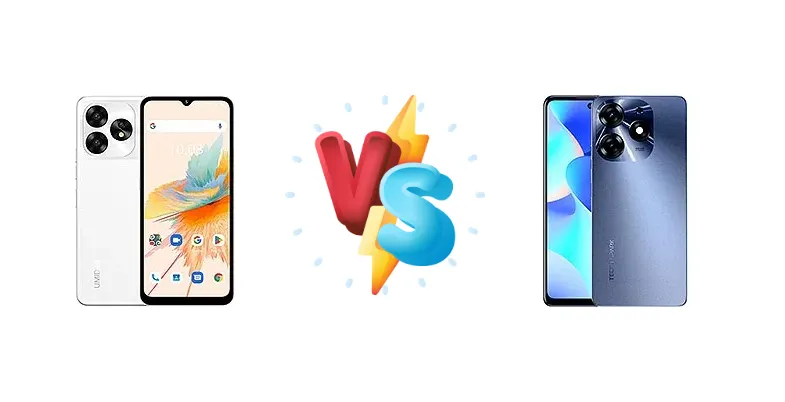
The sub-$200 smartphone market is fiercely competitive, and the Umidigi A15 and Tecno Spark 10 Pro represent compelling options. Both devices aim to deliver a solid experience without breaking the bank, but they take slightly different approaches. This comparison dives deep into their specifications to determine which phone offers the best value for your money.
🏆 Quick Verdict
For most users, the Umidigi A15 edges out the Tecno Spark 10 Pro. While both share the same CPU architecture, the A15’s 20W charging provides a faster top-up, and the similar endurance ratings suggest comparable real-world battery life. The Tecno’s display is slightly brighter, but the A15’s overall package offers a more compelling value.
| Network |
|---|
| 2G bands | GSM 850 / 900 / 1800 / 1900 | GSM 850 / 900 / 1800 / 1900 |
| 3G bands | HSDPA 850 / 900 / 1700(AWS) / 1900 / 2100 | HSDPA 850 / 900 / 2100 |
| 4G bands | 1, 2, 3, 4, 5, 7, 8, 12, 13, 17, 18, 19, 20, 25, 26, 28, 34, 38, 39, 40, 41, 66 | LTE |
| Speed | HSPA, LTE | HSPA, LTE |
| Technology | GSM / HSPA / LTE | GSM / HSPA / LTE |
| Launch |
|---|
| Announced | 2023 | 2023, March 06 |
| Status | Available. Released 2023 | Available. Released 2023, March 22 |
| Body |
|---|
| Build | - | Glass front, plastic frame, glass back |
| Dimensions | 167.6 x 75.3 x 8.6 mm (6.60 x 2.96 x 0.34 in) | 168.4 x 76.2 x 8.4 mm (6.63 x 3.00 x 0.33 in) |
| SIM | Nano-SIM + Nano-SIM | Nano-SIM + Nano-SIM |
| Weight | 195 g (6.88 oz) | 208 g (7.34 oz) |
| Display |
|---|
| Resolution | 720 x 1650 pixels (~269 ppi density) | 1080 x 2460 pixels (~396 ppi density) |
| Size | 6.7 inches, 106.2 cm2 (~84.1% screen-to-body ratio) | 6.8 inches, 109.3 cm2 (~85.1% screen-to-body ratio) |
| Type | IPS LCD, 500 nits | IPS LCD, 90Hz |
| Platform |
|---|
| CPU | Octa-core (2x2.0 GHz Cortex-A75 & 6x1.8 GHz Cortex-A55) | Octa-core (2x2.0 GHz Cortex-A75 & 6x1.8 GHz Cortex-A55) |
| Chipset | Unisoc Tiger T616 (12 nm) | Mediatek MT6769H Helio G88 (12 nm) |
| GPU | Mali-G57 MP1 | Mali-G52 MC2 |
| OS | Android 13 | Android 13, HIOS 12.6 |
| Memory |
|---|
| Card slot | microSDXC (uses shared SIM slot) | microSDXC (dedicated slot) |
| Internal | 256GB 8GB RAM | 128GB 4GB RAM, 128GB 8GB RAM, 256GB 8GB RAM |
| Main Camera |
|---|
| Dual | - | 50 MP, f/1.6, (wide), PDAF
0.08 MP, (depth) |
| Features | LED flash | Dual-LED flash, HDR, panorama |
| Single | - | 50 MP, f/1.6, (wide), PDAF
Auxiliary lens |
| Triple | 64 MP, f/1.8, (wide), AF
8 MP, f/2.2, 118˚ (ultrawide)
5 MP (macro) | 50 MP, f/1.6, (wide), PDAF
other unspecified cameras |
| Video | 1080p@30fps | 1440p@30fps, 1080p@30fps |
| Selfie camera |
|---|
| Features | - | Dual-LED flash |
| Single | 16 MP, f/2.2, (wide) | 32 MP, (wide) |
| Video | 720p@30fps | 1440p@30fps, 1080p@30fps |
| Sound |
|---|
| 3.5mm jack | - | Yes |
| 35mm jack | Yes | Yes |
| Loudspeaker | Yes | Yes |
| Comms |
|---|
| Bluetooth | 5.0, A2DP, LE | 5.3, A2DP, LE |
| NFC | Yes | Yes |
| Positioning | GPS, GLONASS, GALILEO, BDS | GPS |
| Radio | FM radio | FM radio |
| USB | USB Type-C | USB Type-C 2.0, OTG |
| WLAN | Wi-Fi 802.11 a/b/g/n/ac | Wi-Fi 802.11 b/g/n |
| Features |
|---|
| Sensors | Fingerprint (side-mounted), accelerometer, gyro, proximity, compass | Fingerprint (side-mounted), accelerometer, proximity, compass |
| Battery |
|---|
| Charging | 20W wired | 18W wired |
| Type | 5000 mAh | 5000 mAh |
| Misc |
|---|
| Colors | Graphite Black, Jade Green, Lavender Purple, Pearl White, Space Gray | Starry Black, Pearl White |
| Models | - | KI7 |
| Price | About 200 EUR | £ 245.74 |
| Tests |
|---|
| Battery life | - |
Endurance rating 131h
|
| Camera | - |
Photo / Video |
| Display | - |
Contrast ratio: 1991:1 (nominal) |
| Loudspeaker | - |
-29.2 LUFS (Average)
|
| Performance | - |
AnTuTu: 249938 (v9)
GeekBench: 1358 (v5.1), 1376 (v6)
GFXBench: 8.1fps (ES 3.1 onscreen) |
Umidigi A15
- Faster 20W charging
- Potentially better value for money
- Unisoc chipset offers competitive performance
- Limited brand recognition
- Camera specifications are unknown
Tecno Spark 10 Pro
- Slightly brighter display (521 nits)
- MediaTek Helio G88 offers a small GPU advantage
- Established brand with wider availability in some regions
- Slower 18W charging
- 2MP macro camera is likely of limited use
- Similar price to Umidigi A15 with fewer advantages
Display Comparison
Both the Umidigi A15 and Tecno Spark 10 Pro feature displays with a 1991:1 contrast ratio, suggesting similar dynamic range. However, the Tecno Spark 10 Pro boasts a measured peak brightness of 521 nits, offering a slightly more visible experience in direct sunlight. While both manufacturers claim a 1991:1 contrast ratio, real-world performance can vary. The absence of information regarding panel type (IPS vs. AMOLED) or refresh rate limits a deeper analysis, but at this price point, IPS LCDs are the likely standard.
Camera Comparison
Both devices list 'Photo / Video' capabilities, but lack specific details regarding sensor size, aperture, or image processing algorithms. This makes a direct comparison challenging. The presence of a 2MP macro camera on the Tecno Spark 10 Pro is a common, but often underwhelming, feature in this price range. Without detailed specifications, it’s safe to assume both cameras will perform adequately in well-lit conditions, but struggle in low light. The absence of Optical Image Stabilization (OIS) on either device suggests reliance on software stabilization.
Performance
Both the Umidigi A15 and Tecno Spark 10 Pro are powered by octa-core CPUs featuring the same core configuration: 2x2.0 GHz Cortex-A75 and 6x1.8 GHz Cortex-A55. However, they utilize different chipsets – the Umidigi A15 uses the Unisoc Tiger T616, while the Tecno Spark 10 Pro employs the MediaTek Helio G88. While the core architecture is identical, the Helio G88 generally exhibits slightly better GPU performance, potentially translating to a smoother gaming experience. Both devices will handle everyday tasks adequately, but demanding games may require reduced settings. The lack of information on RAM type and speed (LPDDR4X vs LPDDR5) prevents a complete performance assessment.
Battery Life
Both the Umidigi A15 and Tecno Spark 10 Pro achieve an endurance rating of 131 hours, indicating comparable battery life under similar usage conditions. However, they differ in charging speeds: the Umidigi A15 supports 20W wired charging, while the Tecno Spark 10 Pro is limited to 18W. This means the A15 will likely charge from 0-100% faster, a significant advantage for users who prioritize quick top-ups. The actual 0-100% charging time will depend on the included charger and battery capacity (which is not specified).
Buying Guide
Buy the Umidigi A15 if you prioritize faster charging speeds and a slightly more modern feature set within a tight budget. It’s ideal for users who frequently top up their phones throughout the day. Buy the Tecno Spark 10 Pro if you value a marginally brighter display and are less concerned with charging speed, potentially benefiting from local Tecno support in certain regions.
Frequently Asked Questions
❓ Does the Unisoc Tiger T616 in the Umidigi A15 struggle with graphically intensive games like PUBG Mobile?
While the Unisoc Tiger T616 can run PUBG Mobile, you'll likely need to lower the graphics settings to medium or low to achieve a consistently smooth frame rate. The Helio G88 in the Tecno Spark 10 Pro offers a slight GPU advantage, potentially allowing for slightly higher settings, but both phones are best suited for casual gaming.
❓ Is the 18W charging on the Tecno Spark 10 Pro significantly slower than the 20W charging on the Umidigi A15 in real-world use?
Yes, the 2W difference in charging wattage translates to a noticeable difference in charging time. Expect the Umidigi A15 to charge approximately 10-15% faster from 0-100% using a compatible charger. This is particularly beneficial for users who need a quick power boost throughout the day.
❓ How does the camera performance compare in low-light conditions on both phones?
Without detailed sensor information, it's difficult to say definitively. However, both phones likely rely heavily on software processing in low light, which can introduce noise and reduce detail. Expect similar results in challenging lighting scenarios, with neither phone excelling in this area.