
Umidigi A15 vs Samsung Galaxy A14: Which Budget Phone Reigns Supreme?
| Phones Images | |||||
|---|---|---|---|---|---|
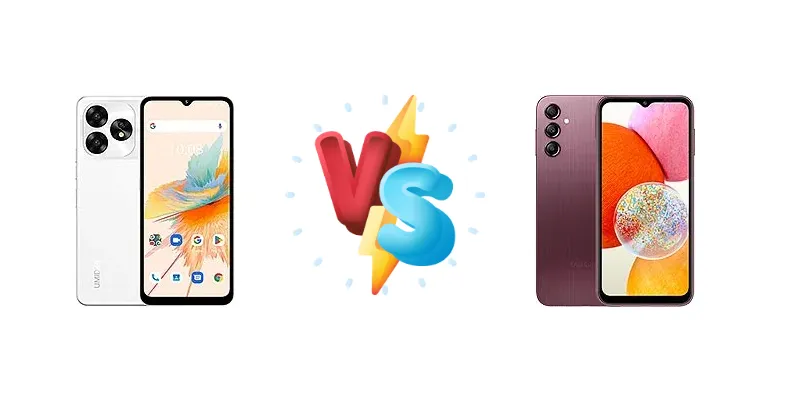
|
🏆 Quick Verdict
For the average user prioritizing consistent performance and brand reliability, the Samsung Galaxy A14 (specifically the Exynos 850 version) is the better choice. While the Umidigi A15 boasts faster 20W charging, the A14’s potentially more efficient chipset and Samsung’s software support provide a smoother long-term experience.
| PHONES | ||
|---|---|---|
| Phone Names | Umidigi A15 | Samsung Galaxy A14 |
| Network | ||
|---|---|---|
| 2G bands | GSM 850 / 900 / 1800 / 1900 | GSM 850 / 900 / 1800 / 1900 |
| 3G bands | HSDPA 850 / 900 / 1700(AWS) / 1900 / 2100 | HSDPA 850 / 900 / 2100 |
| 4G bands | 1, 2, 3, 4, 5, 7, 8, 12, 13, 17, 18, 19, 20, 25, 26, 28, 34, 38, 39, 40, 41, 66 | 1, 3, 5, 7, 8, 20, 28, 38, 40, 41 |
| Speed | HSPA, LTE | HSPA, LTE |
| Technology | GSM / HSPA / LTE | GSM / HSPA / LTE |
| Launch | ||
|---|---|---|
| Announced | 2023 | 2023, February 28 |
| Status | Available. Released 2023 | Available. Released 2023, March 27 |
| Body | ||
|---|---|---|
| Build | - | Glass front, plastic back, plastic frame |
| Dimensions | 167.6 x 75.3 x 8.6 mm (6.60 x 2.96 x 0.34 in) | 167.7 x 78 x 9.1 mm (6.60 x 3.07 x 0.36 in) |
| SIM | Nano-SIM + Nano-SIM | · Nano-SIM· Nano-SIM + Nano-SIM |
| Weight | 195 g (6.88 oz) | 201 g (7.09 oz) |
| Display | ||
|---|---|---|
| Resolution | 720 x 1650 pixels (~269 ppi density) | 1080 x 2408 pixels, 20:9 ratio (~400 ppi density) |
| Size | 6.7 inches, 106.2 cm2 (~84.1% screen-to-body ratio) | 6.6 inches, 104.9 cm2 (~80.2% screen-to-body ratio) |
| Type | IPS LCD, 500 nits | PLS LCD |
| Platform | ||
|---|---|---|
| CPU | Octa-core (2x2.0 GHz Cortex-A75 & 6x1.8 GHz Cortex-A55) | Octa-core (2x2.0 GHz Cortex-A75 & 6x1.8 GHz Cortex-A55) - Version AOcta-core (4x2.0 GHz Cortex-A55 & 4x2.0 GHz Cortex-A55) - Version B |
| Chipset | Unisoc Tiger T616 (12 nm) | Mediatek MT6769 Helio G80 (12 nm) - Version AExynos 850 (8 nm) - Version B |
| GPU | Mali-G57 MP1 | Mali-G52 MC2 |
| OS | Android 13 | Android 13, upgradable to Android 15, One UI 7 |
| Memory | ||
|---|---|---|
| Card slot | microSDXC (uses shared SIM slot) | microSDXC (dedicated slot) |
| Internal | 256GB 8GB RAM | 64GB 4GB RAM, 128GB 4GB RAM, 128GB 6GB RAM |
| Main Camera | ||
|---|---|---|
| Features | LED flash | LED flash, panorama, HDR |
| Single | - | 13 MP, f/2.0, (wide) |
| Triple | 64 MP, f/1.8, (wide), AF 8 MP, f/2.2, 118˚ (ultrawide) 5 MP (macro) | 50 MP, f/1.8, 26mm (wide), 1/2.75", 0.64µm, PDAF 5 MP, f/2.2, 17mm (ultrawide), 1/5.0", 1.12µm 2 MP (macro) |
| Video | 1080p@30fps | 1080p@30fps |
| Selfie camera | ||
|---|---|---|
| Single | 16 MP, f/2.2, (wide) | 13 MP, f/2.0, 26mm (wide), 1/3.1", 1.12µm |
| Video | 720p@30fps | 1080p@30fps |
| Sound | ||
|---|---|---|
| 3.5mm jack | - | Yes |
| 35mm jack | Yes | Yes |
| Loudspeaker | Yes | Yes |
| Comms | ||
|---|---|---|
| Bluetooth | 5.0, A2DP, LE | 5.1 or 5.3, A2DP, LE |
| NFC | Yes | Yes (market/region dependent) |
| Positioning | GPS, GLONASS, GALILEO, BDS | GPS, GALILEO, GLONASS, BDS, QZSS |
| Radio | FM radio | Unspecified |
| USB | USB Type-C | USB Type-C 2.0 |
| WLAN | Wi-Fi 802.11 a/b/g/n/ac | Wi-Fi 802.11 a/b/g/n/ac, dual-band, Wi-Fi Direct |
| Features | ||
|---|---|---|
| Sensors | Fingerprint (side-mounted), accelerometer, gyro, proximity, compass | Fingerprint (side-mounted), accelerometer, proximity, compass |
| Battery | ||
|---|---|---|
| Charging | 20W wired | 15W wired |
| Type | 5000 mAh | Li-Po 5000 mAh |
| Misc | ||
|---|---|---|
| Colors | Graphite Black, Jade Green, Lavender Purple, Pearl White, Space Gray | Black, Dark Red, Silver, Green |
| Models | - | SM-A145F, SM-A145F/DSN, SM-A145M, SM-A145M/DS, SM-A145P, SM-A145R |
| Price | About 200 EUR | € 85.76 / $ 147.60 / £ 79.95 |
| SAR EU | - | 0.46 W/kg (head) 1.37 W/kg (body) |
Umidigi A15
- Faster 20W charging
- Competitive price
- Modern CPU core configuration
- Less established brand
- Potential software update concerns
- Unknown camera performance
Samsung Galaxy A14
- Samsung brand reputation
- Potentially more efficient Exynos 850 variant
- Likely better software support
- Slower 15W charging
- Helio G80 variant offers less performance advantage
- Can be slightly more expensive
Display Comparison
Neither device boasts a standout display. Both are likely utilizing LCD panels, common in this price segment. While specific details like peak brightness and color accuracy are unavailable, the focus here is on functionality rather than visual fidelity. Bezels are expected to be noticeable on both, and neither supports high refresh rates. The display experience will likely be similar, prioritizing visibility over immersive quality.
Camera Comparison
Camera performance is likely to be similar, with both phones relying on budget sensors. Details on sensor sizes and apertures are missing, but it’s safe to assume both will struggle in low-light conditions. The inclusion of a 2MP macro camera on both devices is largely a marketing tactic, offering minimal practical benefit. Image processing will likely differ, with Samsung’s software potentially providing more pleasing results out-of-the-box, though this is subjective. Focusing on the main sensor’s capabilities is key, and without specific details, it’s difficult to declare a clear winner.
Performance
The performance landscape is more nuanced. The Umidigi A15 utilizes the Unisoc Tiger T616, a 12nm chip with a Cortex-A75 based core configuration. The Samsung Galaxy A14, however, comes in two variants: one with the Mediatek Helio G80 (also 12nm) and another with the Exynos 850 (8nm). The Exynos 850, built on a smaller 8nm process, offers a significant advantage in power efficiency, potentially leading to less thermal throttling during sustained tasks. While both chipsets feature the same Cortex-A75/A55 CPU configuration, the Exynos 850’s architecture is more modern, offering better overall performance. The Helio G80 version of the A14 will likely perform similarly to the A15 in CPU-bound tasks, but the Exynos version will pull ahead. RAM configurations are not specified, but LPDDR4X is expected on both.
Battery Life
The Umidigi A15’s 20W wired charging is its standout feature, promising significantly faster top-ups compared to the Samsung Galaxy A14’s 15W charging. While battery capacity isn’t specified, both are likely in the 5000mAh range. The faster charging of the A15 will be particularly beneficial for users who frequently need to quickly replenish their battery. However, the Exynos 850 version of the A14’s superior power efficiency could offset the slower charging, potentially resulting in comparable real-world battery life despite the wattage difference.
Buying Guide
Buy the Umidigi A15 if you absolutely need the fastest possible charging speeds in this price bracket and are comfortable with a less established brand. It’s ideal for users who frequently find themselves needing a quick power boost. Buy the Samsung Galaxy A14 if you value a well-known brand, potentially better software support, and a more refined user experience, even if it means slightly slower charging. This is the better option for those seeking a reliable daily driver.