
Umidigi A15 vs Realme 10T: A Detailed Comparison for Budget Shoppers
| Phones Images | |||||
|---|---|---|---|---|---|
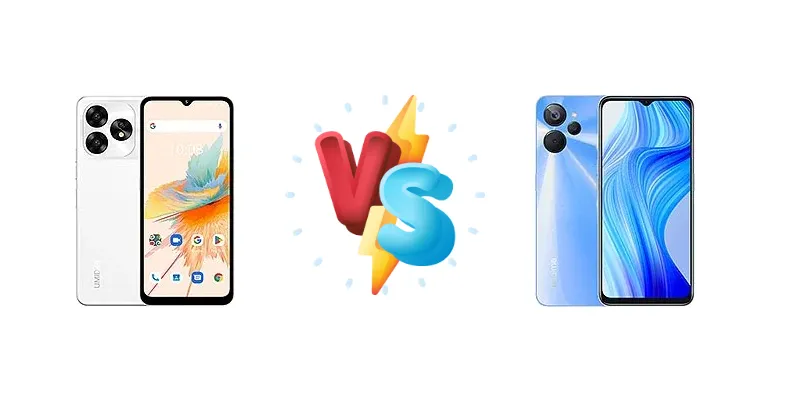
|
🏆 Quick Verdict
For the average user prioritizing responsiveness and sustained performance, the Realme 10T is the better choice. Its Mediatek Dimensity 810, built on a 6nm process, provides a noticeable performance advantage over the Umidigi A15’s Unisoc Tiger T616, despite the A15’s slightly faster charging.
| PHONES | ||
|---|---|---|
| Phone Names | Umidigi A15 | Realme 10T |
| Network | ||
|---|---|---|
| 2G bands | GSM 850 / 900 / 1800 / 1900 | GSM 850 / 900 / 1800 / 1900 |
| 3G bands | HSDPA 850 / 900 / 1700(AWS) / 1900 / 2100 | HSDPA 800 / 850 / 900 / 1700(AWS) / 1900 / 2100 |
| 4G bands | 1, 2, 3, 4, 5, 7, 8, 12, 13, 17, 18, 19, 20, 25, 26, 28, 34, 38, 39, 40, 41, 66 | 1, 2, 3, 4, 5, 7, 8, 12, 13, 17, 18, 19, 20, 26, 28, 38, 39, 40, 41, 66 |
| 5G bands | - | 1, 3, 5, 7, 8, 20, 28, 38, 40, 41, 66, 77, 78 SA/NSA |
| Speed | HSPA, LTE | HSPA, LTE, 5G |
| Technology | GSM / HSPA / LTE | GSM / HSPA / LTE / 5G |
| Launch | ||
|---|---|---|
| Announced | 2023 | 2023, March 21 |
| Status | Available. Released 2023 | Available. Released 2023, March 23 |
| Body | ||
|---|---|---|
| Dimensions | 167.6 x 75.3 x 8.6 mm (6.60 x 2.96 x 0.34 in) | 164.4 x 75.1 x 8.1 mm (6.47 x 2.96 x 0.32 in) |
| SIM | Nano-SIM + Nano-SIM | Nano-SIM + Nano-SIM |
| Weight | 195 g (6.88 oz) | 187 g (6.60 oz) |
| Display | ||
|---|---|---|
| Resolution | 720 x 1650 pixels (~269 ppi density) | 1080 x 2408 pixels, 20:9 ratio (~400 ppi density) |
| Size | 6.7 inches, 106.2 cm2 (~84.1% screen-to-body ratio) | 6.6 inches, 104.9 cm2 (~85.0% screen-to-body ratio) |
| Type | IPS LCD, 500 nits | IPS LCD, 90Hz, 400 nits (typ) |
| Platform | ||
|---|---|---|
| CPU | Octa-core (2x2.0 GHz Cortex-A75 & 6x1.8 GHz Cortex-A55) | Octa-core (2x2.4 GHz Cortex-A76 & 6x2.0 GHz Cortex-A55) |
| Chipset | Unisoc Tiger T616 (12 nm) | Mediatek Dimensity 810 (6 nm) |
| GPU | Mali-G57 MP1 | Mali-G57 MC2 |
| OS | Android 13 | Android 12, Realme UI 3.0 |
| Memory | ||
|---|---|---|
| Card slot | microSDXC (uses shared SIM slot) | microSDXC (dedicated slot) |
| Internal | 256GB 8GB RAM | 128GB 4GB RAM, 128GB 8GB RAM, 256GB 8GB RAM |
| - | UFS 2.2 | |
| Main Camera | ||
|---|---|---|
| Features | LED flash | LED flash, HDR, panorama |
| Triple | 64 MP, f/1.8, (wide), AF 8 MP, f/2.2, 118˚ (ultrawide) 5 MP (macro) | 50 MP, f/1.8, (wide), 1/2.76", 0.64µm, PDAF Unspecified MP, f/2.8, 46mm (telephoto) 2 MP (macro) |
| Video | 1080p@30fps | 1080p@30fps |
| Selfie camera | ||
|---|---|---|
| Features | - | HDR, panorama |
| Single | 16 MP, f/2.2, (wide) | 8 MP, f/2.0, 27mm (wide) |
| Video | 720p@30fps | 1080p@30fps |
| Sound | ||
|---|---|---|
| 3.5mm jack | - | Yes |
| 35mm jack | Yes | Yes |
| Loudspeaker | Yes | Yes |
| Comms | ||
|---|---|---|
| Bluetooth | 5.0, A2DP, LE | 5.2, A2DP, LE |
| NFC | Yes | No |
| Positioning | GPS, GLONASS, GALILEO, BDS | GPS, GLONASS, BDS |
| Radio | FM radio | No |
| USB | USB Type-C | USB Type-C 2.0, OTG |
| WLAN | Wi-Fi 802.11 a/b/g/n/ac | Wi-Fi 802.11 a/b/g/n/ac, dual-band |
| Features | ||
|---|---|---|
| Sensors | Fingerprint (side-mounted), accelerometer, gyro, proximity, compass | Fingerprint (side-mounted), accelerometer, proximity, compass |
| Battery | ||
|---|---|---|
| Charging | 20W wired | 18W wired |
| Type | 5000 mAh | 5000 mAh |
| Misc | ||
|---|---|---|
| Colors | Graphite Black, Jade Green, Lavender Purple, Pearl White, Space Gray | Electric Black, Dash Blue |
| Price | About 200 EUR | About 200 EUR |
Umidigi A15
- Faster 20W charging for quicker top-ups.
- Potentially lower price point, offering better value for basic users.
- Unisoc chipset may offer good efficiency for light tasks.
- Less powerful Unisoc Tiger T616 chipset limits performance.
- 12nm process is less efficient than the Realme's 6nm.
- Likely to struggle with demanding games and multitasking.
Realme 10T
- More powerful Mediatek Dimensity 810 chipset for smoother performance.
- 6nm process offers better power efficiency and thermal management.
- Superior CPU architecture for faster app loading and multitasking.
- Slower 18W charging compared to the Umidigi A15.
- May be slightly more expensive.
- Potentially higher power draw under heavy load.
Display Comparison
Neither device's display specifications are provided, so a direct comparison is limited. However, given the price bracket, both likely utilize LCD panels. Realme, historically, tends to prioritize slightly higher peak brightness and color accuracy in its displays, potentially offering a marginally better viewing experience. Bezels are likely comparable, focusing on minimizing cost rather than achieving ultra-thin designs.
Camera Comparison
Without detailed camera specifications, a comprehensive comparison is impossible. However, it’s reasonable to assume both phones feature a primary camera and potentially a depth or macro sensor. The image signal processor (ISP) within the Dimensity 810 likely offers superior image processing capabilities, potentially resulting in better dynamic range and noise reduction in photos and videos compared to the Unisoc chipset. The absence of sensor size or aperture information prevents a more definitive assessment.
Performance
The core difference lies in the chipsets. The Realme 10T’s Mediatek Dimensity 810 (6nm) boasts a clear advantage over the Umidigi A15’s Unisoc Tiger T616 (12nm). The 6nm fabrication process is significantly more efficient, translating to lower power consumption and reduced thermal throttling under sustained load. The Dimensity 810’s Cortex-A76 cores, clocked at 2.4 GHz, also outperform the A15’s Cortex-A75 cores at 2.0 GHz. This means faster app loading times, smoother multitasking, and a more enjoyable gaming experience on the Realme 10T. While both utilize 6x Cortex-A55 cores for efficiency, the Dimensity 810’s overall architecture is more modern and capable.
Battery Life
Battery capacity isn't specified for either device. However, the charging speeds offer a clear distinction. The Umidigi A15 supports 20W wired charging, while the Realme 10T is limited to 18W. While the difference isn't massive, 20W will result in slightly faster charging times. The Dimensity 810’s superior power efficiency could offset the slower charging speed, potentially leading to comparable real-world battery life despite a potentially smaller battery capacity in the Realme 10T.
Buying Guide
Buy the Umidigi A15 if you prioritize maximizing battery life with moderate usage and appreciate the convenience of 20W charging, even if it comes at the cost of processing speed. Buy the Realme 10T if you frequently multitask, enjoy mobile gaming, or need a phone that feels consistently snappy and responsive, and are willing to accept slightly slower charging.