
Umidigi A15 Tab vs Xiaomi Redmi Pad SE 8.7: A Detailed Comparison
| Phones Images | |||||
|---|---|---|---|---|---|
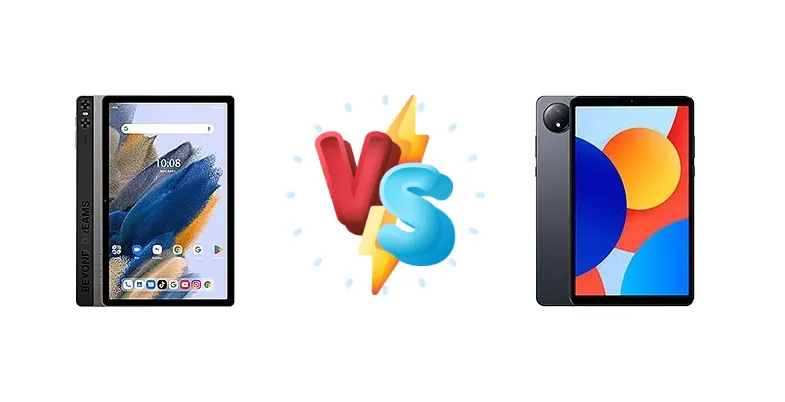
|
🏆 Quick Verdict
For the average user prioritizing slightly faster charging and a potentially more refined software experience, the Umidigi A15 Tab emerges as the winner. However, the Redmi Pad SE 8.7 remains a strong contender, particularly in regions where the 18W charger is unavailable, as the difference in charging speed becomes negligible.
| PHONES | ||
|---|---|---|
| Phone Names | Umidigi A15 Tab | Xiaomi Redmi Pad SE 8.7 |
| Network | ||
|---|---|---|
| 2G bands | GSM 850 / 900 / 1800 / 1900 | GSM 850 / 900 / 1800 / 1900 |
| 3G bands | HSDPA 850 / 900 / 1700(AWS) / 1900 / 2100 | HSDPA 800 / 850 / 900 / 1700(AWS) / 1900 / 2100 |
| 4G bands | 1, 3, 4, 5, 7, 8, 12, 17, 20, 28, 38, 40, 41, 66 | 1, 2, 3, 4, 5, 7, 8, 13, 18, 19, 20, 26, 28, 38, 40, 41, 66 |
| Speed | HSPA, LTE | HSPA, LTE - cellular model only |
| Technology | GSM / HSPA / LTE | GSM / HSPA / LTE |
| Launch | ||
|---|---|---|
| Announced | 2023 | 2024, July 29 |
| Status | Available. Released 2023 | Available. Released 2024, August 08 |
| Body | ||
|---|---|---|
| Build | - | Glass front (Gorilla Glass 3) |
| Dimensions | 257.5 x 162 x 7.5 mm (10.14 x 6.38 x 0.30 in) | 211.6 x 125.5 x 8.8 mm (8.33 x 4.94 x 0.35 in) |
| SIM | Nano-SIM + Nano-SIM | Nano-SIM + Nano-SIM (cellular model only) |
| Weight | 491 g (1.08 lb) | 370 / 373 / 375 g (13.05 oz) |
| Display | ||
|---|---|---|
| Protection | - | Corning Gorilla Glass 3 |
| Resolution | 1200 x 2000 pixels, 5:3 ratio (~212 ppi density) | 800 x 1340 pixels, 5:3 ratio (~179 ppi density) |
| Size | 11.0 inches, 344.4 cm2 (~82.6% screen-to-body ratio) | 8.7 inches, 214.9 cm2 (~80.9% screen-to-body ratio) |
| Type | IPS LCD, 420 nits | IPS LCD, 1B colors, 90Hz, 600 nits (HBM) |
| Platform | ||
|---|---|---|
| CPU | Octa-core (2x2.0 GHz Cortex-A75 & 6x1.8 GHz Cortex-A55) | Octa-core (2x2.0 GHz Cortex-A75 & 6x1.8 GHz Cortex-A55) |
| Chipset | Unisoc Tiger T616 (12 nm) | Mediatek Helio G85 (12 nm) |
| GPU | Mali-G57 MP1 | Mali-G52 MC2 |
| OS | Android 13 | Android 14, HyperOS |
| Memory | ||
|---|---|---|
| Card slot | microSDXC (uses shared SIM slot) | microSDXC (dedicated slot) |
| Internal | 256GB 8GB RAM | 64GB 4GB RAM, 128GB 4GB RAM, 128GB 6GB RAM |
| Main Camera | ||
|---|---|---|
| Dual | 13 MP, f/2.2, (wide) Auxiliary lens | - |
| Features | LED flash | LED flash |
| Single | - | 8 MP, f/2.0, (wide), 1/4.0", 1.12µm |
| Video | 1080p@30fps | 1080p@30fps |
| Selfie camera | ||
|---|---|---|
| Single | 8 MP, f/2.2, (wide) | 5 MP, f/2.2, (wide), 1/5.0", 1.12µm |
| Video | 720p@30fps | 1080p@30fps |
| Sound | ||
|---|---|---|
| 35mm jack | No | Yes |
| Loudspeaker | Yes, with stereo speakers (4 speakers) | Yes, with stereo speakers |
| Comms | ||
|---|---|---|
| Bluetooth | 5.0, A2DP, LE | 5.3, A2DP, LE |
| Infrared port | - | Yes |
| NFC | No | No |
| Positioning | GPS, GLONASS, GALILEO | GPS, GALILEO, GLONASS, BDS - cellular model only |
| Radio | FM radio | FM radio |
| USB | USB Type-C | USB Type-C 2.0 |
| WLAN | Wi-Fi 802.11 a/b/g/n/ac | Wi-Fi 802.11 a/b/g/n/ac, dual-band |
| Features | ||
|---|---|---|
| Sensors | Accelerometer, proximity (accessories only), compass | Accelerometer, proximity (accessories only), compass |
| Battery | ||
|---|---|---|
| Charging | 20W wired | 18W wired (Int'l) 10W wired (India) |
| Type | 7500 mAh | 6650 mAh |
| Misc | ||
|---|---|---|
| Colors | Space Grey | Aurora Green (Forest Green), Sky Blue (Ocean Blue), Graphite Gray (Urban Grey) |
| Models | - | 220233L2G |
| Price | - | About 120 EUR |
| SAR | - | 0.90 W/kg (head) 0.65 W/kg (body) |
| SAR EU | - | 0.40 W/kg (head) 0.99 W/kg (body) |
Umidigi A15 Tab
- Faster 20W charging for quicker power-ups.
- Potentially cleaner software experience.
- Competitive performance due to the Unisoc T616.
- Brand recognition is lower than Xiaomi.
- Software update support may be less consistent.
Xiaomi Redmi Pad SE 8.7
- Established Xiaomi ecosystem and brand reputation.
- Potentially better GPU driver optimization with the Helio G85.
- Wider availability of accessories.
- Slower charging speed, especially in India (10W).
- Software can include pre-installed bloatware.
Display Comparison
Neither Umidigi nor Xiaomi provide detailed display specifications beyond the screen size. Both tablets likely utilize IPS LCD panels, common in this price bracket. The absence of information regarding peak brightness, color gamut coverage, or refresh rates suggests a focus on cost optimization. Bezels are expected to be noticeable on both devices, impacting the overall screen-to-body ratio. Color accuracy is likely to be standard for budget tablets, suitable for casual viewing but not professional color-critical work.
Camera Comparison
Camera performance is unlikely to be a key differentiator in this segment. Detailed camera specifications are absent, suggesting both tablets feature basic camera setups primarily intended for video calls and casual snapshots. The focus should not be on image quality, but rather on functionality. Expect a primary camera on both devices, likely around 8-13MP, and potentially a secondary depth or macro sensor (though the utility of a 2MP macro sensor is minimal). Image processing will be basic, prioritizing speed over detail and dynamic range.
Performance
Both the Umidigi A15 Tab and the Xiaomi Redmi Pad SE 8.7 are powered by octa-core processors built on a 12nm process – the Unisoc Tiger T616 and the MediaTek Helio G85 respectively. Critically, both CPUs share the same core configuration: 2x2.0 GHz Cortex-A75 and 6x1.8 GHz Cortex-A55. This means raw CPU performance will be very similar. The Helio G85, however, benefits from a slightly more mature GPU driver ecosystem, potentially offering a marginal advantage in gaming. RAM configurations are not specified, but both will likely offer options around 4-6GB, impacting multitasking capabilities. Thermal management will be passive on both devices, meaning sustained performance may be limited during intensive tasks.
Battery Life
Battery capacity is not specified for either device. However, given their size and target price point, both tablets likely house batteries in the 5000-6000 mAh range. The Umidigi A15 Tab supports 20W wired charging, while the Redmi Pad SE 8.7 supports 18W (international) or 10W (India). This charging speed difference is significant; 20W will noticeably reduce charging times compared to 10W. Even the 18W charger on the international Redmi Pad SE will be slightly slower than the Umidigi, but the difference will be less pronounced. Real-world 0-100% charge times will depend on the charger used and background processes, but the Umidigi A15 Tab has a clear advantage in this area.
Buying Guide
Buy the Umidigi A15 Tab if you need faster 20W charging for quicker top-ups, and value a potentially more streamlined software experience. Buy the Xiaomi Redmi Pad SE 8.7 if you prefer the established Xiaomi ecosystem and are comfortable with potentially slower charging speeds, especially in India where the 10W charger is standard. Both are excellent choices for media consumption and light productivity.