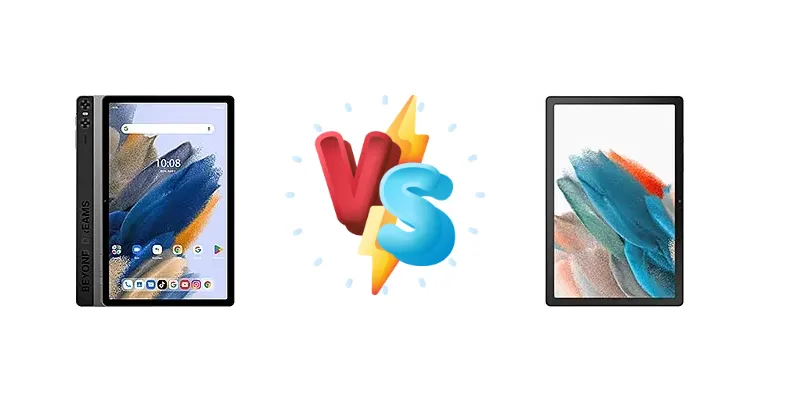
The sub-$200 tablet market is fiercely competitive, and the Umidigi A15 Tab and Samsung Galaxy Tab A8 10.5 (2021) are two strong contenders. Both aim to deliver a functional Android tablet experience without breaking the bank, but subtle differences in their core specifications – particularly the chipset and charging capabilities – can significantly impact daily use. This comparison dives deep into these nuances to determine which tablet offers the best value.
🏆 Quick Verdict
For the average user prioritizing slightly faster performance and quicker charging, the Umidigi A15 Tab emerges as the winner. While the Samsung Galaxy Tab A8 benefits from brand recognition and a potentially more refined software experience, the A15 Tab’s Unisoc Tiger T616 chipset and 20W charging provide a tangible edge in responsiveness and convenience.
| Network |
|---|
| 2G bands | GSM 850 / 900 / 1800 / 1900 | GSM 850 / 900 / 1800 / 1900 |
| 3G bands | HSDPA 850 / 900 / 1700(AWS) / 1900 / 2100 | HSDPA 850 / 900 / 1700(AWS) / 1900 / 2100 |
| 4G bands | 1, 3, 4, 5, 7, 8, 12, 17, 20, 28, 38, 40, 41, 66 | 1, 2, 3, 4, 5, 7, 8, 12, 17, 20, 28, 38, 40, 41, 66 |
| Speed | HSPA, LTE | HSPA, LTE - cellular model only |
| Technology | GSM / HSPA / LTE | GSM / HSPA / LTE |
| Launch |
|---|
| Announced | 2023 | 2021, December 15 |
| Status | Available. Released 2023 | Available. Released 2022, January 17 |
| Body |
|---|
| Dimensions | 257.5 x 162 x 7.5 mm (10.14 x 6.38 x 0.30 in) | 246.8 x 161.9 x 6.9 mm (9.72 x 6.37 x 0.27 in) |
| SIM | Nano-SIM + Nano-SIM | Nano-SIM (cellular model only) |
| Weight | 491 g (1.08 lb) | 508 g (1.12 lb) |
| Display |
|---|
| Resolution | 1200 x 2000 pixels, 5:3 ratio (~212 ppi density) | 1200 x 1920 pixels, 16:10 ratio (~216 ppi density) |
| Size | 11.0 inches, 344.4 cm2 (~82.6% screen-to-body ratio) | 10.5 inches, 319.7 cm2 (~80.0% screen-to-body ratio) |
| Type | IPS LCD, 420 nits | TFT LCD |
| Platform |
|---|
| CPU | Octa-core (2x2.0 GHz Cortex-A75 & 6x1.8 GHz Cortex-A55) | Octa-core (2x2.0 GHz Cortex-A75 & 6x2.0 GHz Cortex-A55) |
| Chipset | Unisoc Tiger T616 (12 nm) | Unisoc Tiger T618 (12 nm) |
| GPU | Mali-G57 MP1 | Mali G52 MP2 |
| OS | Android 13 | Android 11, upgradable to Android 14, One UI 6 |
| Memory |
|---|
| Card slot | microSDXC (uses shared SIM slot) | microSDXC (dedicated slot) |
| Internal | 256GB 8GB RAM | 32GB 2GB RAM, 32GB 3GB RAM, 64GB 2GB RAM, 64GB 3GB RAM, 64GB 4GB RAM, 128GB 3GB RAM, 128GB 4GB RAM |
| Main Camera |
|---|
| Dual | 13 MP, f/2.2, (wide)
Auxiliary lens | - |
| Features | LED flash | - |
| Single | - | 8 MP, AF |
| Video | 1080p@30fps | 1080p@30fps |
| Selfie camera |
|---|
| Single | 8 MP, f/2.2, (wide) | 5 MP |
| Video | 720p@30fps | 1080p@30fps |
| Sound |
|---|
| 3.5mm jack | - | Yes |
| 35mm jack | No | Yes |
| Loudspeaker | Yes, with stereo speakers (4 speakers) | Yes, with stereo speakers (4 speakers) |
| Comms |
|---|
| Bluetooth | 5.0, A2DP, LE | 5.0, A2DP, LE |
| NFC | No | No |
| Positioning | GPS, GLONASS, GALILEO | GPS, GLONASS, BDS, GALILEO, QZSS - cellular model only |
| Radio | FM radio | No |
| USB | USB Type-C | USB Type-C 2.0 |
| WLAN | Wi-Fi 802.11 a/b/g/n/ac | Wi-Fi 802.11 a/b/g/n/ac, dual-band, Wi-Fi Direct |
| Features |
|---|
| Sensors | Accelerometer, proximity (accessories only), compass | Accelerometer, gyro, proximity, compass |
| Battery |
|---|
| Charging | 20W wired | 15W wired |
| Type | 7500 mAh | Li-Po 7040 mAh |
| Misc |
|---|
| Colors | Space Grey | Gray, Silver, Pink Gold |
| Models | - | SM-X200, SM-X205 |
| Price | - | About 230 EUR |
| SAR EU | - | 0.92 W/kg (body) |
Umidigi A15 Tab
- Faster 20W charging for quicker top-ups.
- Potentially newer Unisoc T616 chipset with minor architectural improvements.
- Competitive price point offering strong value.
- Less established brand reputation compared to Samsung.
- Software updates may be less frequent.
Samsung Galaxy Tab A8 10.5 (2021)
- Well-known and trusted Samsung brand.
- Potentially smoother software experience.
- Slightly higher Cortex-A55 clock speed (2.0 GHz).
- Slower 15W charging.
- Chipset is a generation older than the A15 Tab.
- May be slightly more expensive for comparable storage.
Display Comparison
Both tablets utilize 10.5-inch displays, but detailed specifications like resolution, panel type (IPS vs. TFT), and peak brightness are not provided. Given the price point, both likely employ IPS LCD panels. The real-world difference in visual quality will likely be minimal. Bezels are expected to be relatively substantial on both devices, reflecting their budget positioning. Color accuracy is also likely to be standard for this segment, prioritizing viewing angles over professional-grade color reproduction.
Camera Comparison
Camera performance is unlikely to be a deciding factor for either tablet. Details regarding sensor size and image processing are unavailable. Given the market segment, both tablets likely feature basic camera setups primarily intended for video calls and occasional snapshots. Focusing on megapixel counts would be misleading; image quality will be heavily influenced by software processing and lens quality, neither of which are typically prioritized in budget tablets.
Performance
The core difference lies in the chipsets: the Umidigi A15 Tab features the Unisoc Tiger T616, while the Samsung Galaxy Tab A8 uses the T618. Both are 12nm octa-core processors with the same 2x2.0 GHz Cortex-A75 and 6x1.8 GHz Cortex-A55 configuration. However, the Tab A8’s Cortex-A55 cores run at 2.0 GHz versus 1.8 GHz on the A15 Tab. This slight clock speed increase *could* translate to marginally better multi-tasking performance on the Samsung, but the difference is unlikely to be dramatic in real-world usage. The A15 Tab’s chipset is newer, potentially benefiting from minor architectural improvements within the Unisoc design. Neither chipset is designed for demanding gaming, but both should handle casual games and streaming apps adequately.
Battery Life
Battery capacity is not specified for either device. However, the charging speeds are a clear differentiator. The Umidigi A15 Tab supports 20W wired charging, while the Samsung Galaxy Tab A8 is limited to 15W. This means the A15 Tab will recharge significantly faster, a crucial advantage for users who rely on their tablet throughout the day. While a larger battery capacity on the Tab A8 could offset the slower charging, the 20W charging on the A15 Tab provides a more immediate and noticeable benefit.
Buying Guide
Buy the Umidigi A15 Tab if you need a tablet that feels a bit snappier in everyday tasks and appreciate faster charging speeds, making it ideal for users who frequently consume media on the go. Buy the Samsung Galaxy Tab A8 10.5 (2021) if you prioritize brand reliability, a potentially smoother software experience, and are less concerned with maximizing performance within a tight budget.
Frequently Asked Questions
❓ Will the Unisoc T616 in the Umidigi A15 Tab struggle with multitasking?
While not a powerhouse, the Unisoc T616 is capable of handling moderate multitasking with several apps open simultaneously. The 6x Cortex-A55 cores provide sufficient background processing power for common tasks like browsing, streaming, and light productivity. However, demanding applications or numerous heavy apps running concurrently may lead to some slowdown.
❓ Is the 15W charging on the Samsung Galaxy Tab A8 noticeably slow in 2024?
Yes, 15W charging is relatively slow by modern standards. Expect a full charge to take over 3 hours, potentially longer depending on usage. The Umidigi A15 Tab’s 20W charging offers a significant improvement, reducing charge times considerably, making it a more convenient option for users who need to quickly top up their battery.
❓ Can either of these tablets be used for light gaming?
Both tablets can handle light gaming, such as casual puzzle games or older titles. However, they are not designed for graphically intensive games like PUBG or Genshin Impact. Expect lower frame rates and potentially reduced graphics settings if you attempt to play demanding games.
❓ What about software updates for the Umidigi A15 Tab? Are they reliable?
Umidigi’s software update track record is not as consistent as Samsung’s. While Umidigi does provide updates, they may be less frequent and take longer to roll out. Users should be aware that they may not receive the latest Android version as quickly as they would on a Samsung device.