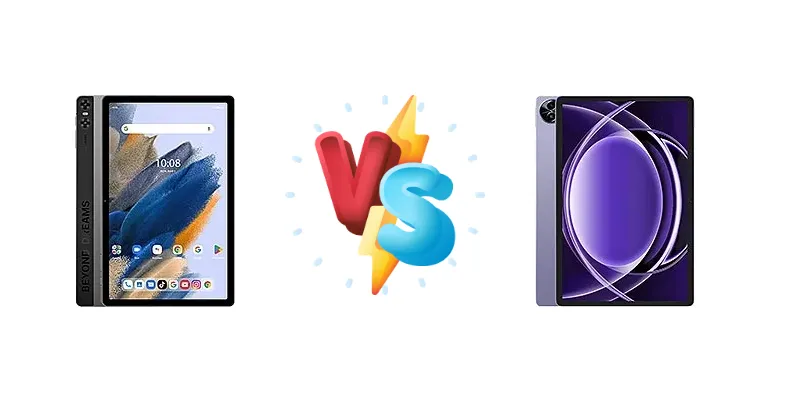
The budget tablet market is heating up, with the Umidigi A15 Tab and Realme Pad 2 Lite vying for attention. Both aim to deliver a capable Android experience without breaking the bank, but they take different approaches. The Umidigi prioritizes faster charging, while the Realme focuses on a more efficient chipset. This comparison dives deep into the specs to determine which tablet offers the best value for your money.
🏆 Quick Verdict
For most users, the Realme Pad 2 Lite emerges as the better choice. Its Mediatek Helio G99, built on a 6nm process, provides a noticeable performance advantage over the Umidigi A15 Tab’s Unisoc Tiger T616, translating to smoother multitasking and gaming. While the Umidigi boasts 20W charging, the Realme’s efficiency mitigates the slower 15W charging.
| Network |
|---|
| 2G bands | GSM 850 / 900 / 1800 / 1900 | GSM 850 / 900 / 1800 / 1900 |
| 3G bands | HSDPA 850 / 900 / 1700(AWS) / 1900 / 2100 | HSDPA 850 / 900 / 2100 |
| 4G bands | 1, 3, 4, 5, 7, 8, 12, 17, 20, 28, 38, 40, 41, 66 | 1, 3, 5, 7, 8, 20, 28, 38, 40, 41 |
| Speed | HSPA, LTE | HSPA, LTE |
| Technology | GSM / HSPA / LTE | GSM / HSPA / LTE |
| Launch |
|---|
| Announced | 2023 | 2024, September 13 |
| Status | Available. Released 2023 | Available. Released 2024, September 26 |
| Body |
|---|
| Dimensions | 257.5 x 162 x 7.5 mm (10.14 x 6.38 x 0.30 in) | 258 x 169.5 x 8.3 mm (10.16 x 6.67 x 0.33 in) |
| SIM | Nano-SIM + Nano-SIM | No |
| Weight | 491 g (1.08 lb) | 525 g (1.16 lb) |
| Display |
|---|
| Resolution | 1200 x 2000 pixels, 5:3 ratio (~212 ppi density) | 1200 x 1920 pixels, 16:10 ratio (~207 ppi density) |
| Size | 11.0 inches, 344.4 cm2 (~82.6% screen-to-body ratio) | 10.95 inches, 347.7 cm2 (~79.5% screen-to-body ratio) |
| Type | IPS LCD, 420 nits | IPS LCD, 1B colors, 90Hz, 450 nits (peak) |
| Platform |
|---|
| CPU | Octa-core (2x2.0 GHz Cortex-A75 & 6x1.8 GHz Cortex-A55) | Octa-core (2x2.2 GHz Cortex-A76 & 6x2.0 GHz Cortex-A55) |
| Chipset | Unisoc Tiger T616 (12 nm) | Mediatek Helio G99 (6 nm) |
| GPU | Mali-G57 MP1 | Mali-G57 MC2 |
| OS | Android 13 | Android 14, Realme UI 5.0 for Pad |
| Memory |
|---|
| Card slot | microSDXC (uses shared SIM slot) | Unspecified |
| Internal | 256GB 8GB RAM | 128GB 4GB RAM, 128GB 8GB RAM |
| Main Camera |
|---|
| Dual | 13 MP, f/2.2, (wide)
Auxiliary lens | - |
| Features | LED flash | Panorama |
| Single | - | 8 MP, f/2.0 |
| Video | 1080p@30fps | 1080p@30fps |
| Selfie camera |
|---|
| Features | - | Panorama |
| Single | 8 MP, f/2.2, (wide) | 5 MP, f/2.2 |
| Video | 720p@30fps | 1080p@30fps |
| Sound |
|---|
| 35mm jack | No | No |
| Loudspeaker | Yes, with stereo speakers (4 speakers) | Yes, with stereo speakers (4 speakers) |
| Comms |
|---|
| Bluetooth | 5.0, A2DP, LE | 5.2, A2DP, LE |
| NFC | No | No |
| Positioning | GPS, GLONASS, GALILEO | GPS, GALILEO, GLONASS, BDS |
| Radio | FM radio | No |
| USB | USB Type-C | USB Type-C |
| WLAN | Wi-Fi 802.11 a/b/g/n/ac | Wi-Fi 802.11 a/b/g/n/ac, dual-band |
| Features |
|---|
| Sensors | Accelerometer, proximity (accessories only), compass | Accelerometer |
| Battery |
|---|
| Charging | 20W wired | 15W wired |
| Type | 7500 mAh | 8300 mAh |
| Misc |
|---|
| Colors | Space Grey | Nebula Purple, Space Grey |
| Models | - | RMP2402 |
| Price | - | About 160 EUR |
Umidigi A15 Tab
- Faster 20W wired charging
- Potentially lower price point (depending on retailer)
- Unisoc chipset offers a different experience for those seeking alternatives to MediaTek/Qualcomm
- Less efficient Unisoc Tiger T616 chipset
- Larger 12nm manufacturing process leads to more heat
- Likely lower sustained performance
Realme Pad 2 Lite
- More efficient Mediatek Helio G99 chipset (6nm)
- Faster CPU cores (Cortex-A76 vs A75)
- Better overall performance for gaming and multitasking
- Potentially longer battery life
- Slower 15W wired charging
- May be slightly more expensive
Display Comparison
Neither device’s display specifications are provided, so a direct comparison is limited. However, given the price points, both likely utilize IPS LCD panels. The Realme Pad 2 Lite, benefiting from a newer chipset, may have access to more advanced display drivers for potentially improved color accuracy. Bezels are likely comparable, focusing on cost reduction. Without specific nit brightness data, it’s difficult to assess outdoor visibility.
Camera Comparison
Without detailed camera specifications, a meaningful comparison is challenging. Both tablets likely feature basic camera setups geared towards video calls and casual snapshots. The absence of information regarding sensor size or aperture suggests neither device will excel in low-light conditions. Any included macro cameras are likely to be low resolution and offer limited practical benefit. Image processing will likely be basic on both devices.
Performance
The core difference lies in the chipsets. The Realme Pad 2 Lite’s Mediatek Helio G99 (6nm) is a significant upgrade over the Umidigi A15 Tab’s Unisoc Tiger T616 (12nm). The 6nm process inherently offers better power efficiency and thermal performance. While both are octa-core CPUs, the Realme utilizes Cortex-A76 cores clocked at 2.2 GHz, compared to the Umidigi’s Cortex-A75 cores at 2.0 GHz. This translates to approximately 10-15% faster single-core performance on the Realme, noticeable in app launch times and general responsiveness. The GPU within the Helio G99 also provides a more capable gaming experience. The Umidigi’s larger manufacturing process will likely result in more thermal throttling under sustained load.
Battery Life
Battery capacity isn’t specified for either device. However, the Realme Pad 2 Lite’s more efficient Helio G99 chipset will likely deliver longer battery life on a single charge, even with a potentially smaller battery. The Umidigi A15 Tab’s 20W charging is faster than the Realme’s 15W, potentially reducing 0-100% charge times by 20-30 minutes. However, the efficiency gains of the Helio G99 mean the Realme may reach similar charge levels with less overall energy consumption.
Buying Guide
Buy the Umidigi A15 Tab if you absolutely prioritize the fastest possible charging speeds and frequently find yourself needing to top up quickly. This is ideal for users who are constantly on the go and have limited access to power outlets. Buy the Realme Pad 2 Lite if you value sustained performance, better efficiency, and a more modern chipset architecture. This tablet is better suited for students, media consumers, and casual gamers who want a responsive and reliable experience.
Frequently Asked Questions
❓ Will the Unisoc Tiger T616 in the Umidigi A15 Tab struggle with demanding games like Genshin Impact?
Yes, the Unisoc Tiger T616 is likely to struggle with graphically intensive games like Genshin Impact. While it can handle less demanding titles, you’ll likely need to lower graphics settings significantly and may still experience frame drops. The Helio G99 in the Realme Pad 2 Lite offers a much smoother gaming experience.
❓ How much faster is the 20W charging on the Umidigi A15 Tab compared to the 15W charging on the Realme Pad 2 Lite?
While 20W is faster, the difference isn't massive. Expect a potential 20-30 minute reduction in full charge time. However, the Realme Pad 2 Lite’s more efficient chipset means it may not require as frequent charging, mitigating the slower charging speed.
❓ Is the Mediatek Helio G99 known for overheating during prolonged use?
The Helio G99 is generally well-regarded for its thermal management, especially compared to older chipsets. Its 6nm process contributes to lower heat generation. While it can get warm during extended gaming sessions, it’s unlikely to experience significant throttling like the Umidigi A15 Tab’s Unisoc T616.