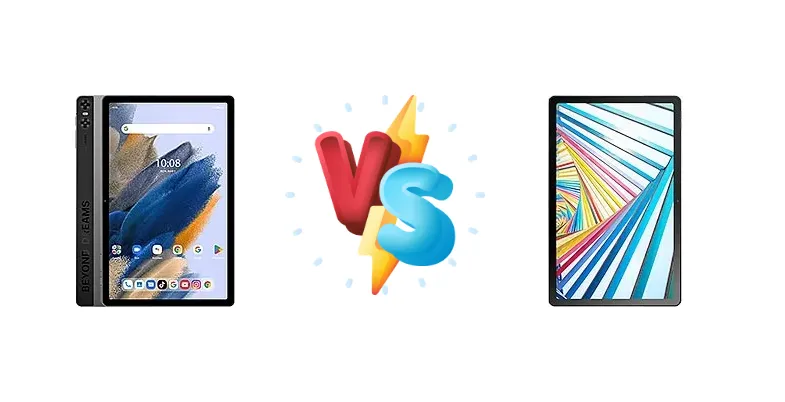
The sub-$200 tablet market is fiercely competitive, offering a surprising amount of functionality for the price. We pit the Umidigi A15 Tab against the Lenovo Tab M10 Plus (3rd Gen) to determine which provides the best balance of performance, features, and value for everyday users. This comparison will focus on the core differences in their chipsets and how those translate to real-world usage.
🏆 Quick Verdict
For most users, the Lenovo Tab M10 Plus (3rd Gen) with the Snapdragon 680 offers a smoother, more responsive experience thanks to its more efficient 6nm process and generally faster CPU. While the Umidigi A15 Tab is a viable option, the Lenovo’s performance edge justifies the potentially slight price premium.
| Network |
|---|
| 2G bands | GSM 850 / 900 / 1800 / 1900 | GSM 850 / 900 / 1800 / 1900 |
| 3G bands | HSDPA 850 / 900 / 1700(AWS) / 1900 / 2100 | HSDPA 800 / 850 / 900 / 1900 / 2100 |
| 4G bands | 1, 3, 4, 5, 7, 8, 12, 17, 20, 28, 38, 40, 41, 66 | 1, 2, 3, 4, 5, 7, 8, 19, 20, 26, 28, 28, 38, 40, 41 |
| Speed | HSPA, LTE | HSPA 42.2/5.76 Mbps, LTE Cat13 390/75 Mbps - cellular model only |
| Technology | GSM / HSPA / LTE | GSM / HSPA / LTE |
| Launch |
|---|
| Announced | 2023 | 2022, May |
| Status | Available. Released 2023 | Available. Released 2022, May |
| Body |
|---|
| Dimensions | 257.5 x 162 x 7.5 mm (10.14 x 6.38 x 0.30 in) | 251.2 x 158.8 x 7.5 mm (9.89 x 6.25 x 0.30 in) |
| SIM | Nano-SIM + Nano-SIM | Nano-SIM (cellular model only) |
| Weight | 491 g (1.08 lb) | 465 g (1.03 lb) |
| | - | Stylus support |
| Display |
|---|
| Resolution | 1200 x 2000 pixels, 5:3 ratio (~212 ppi density) | 1200 x 2000 pixels, 5:3 ratio (~220 ppi density) |
| Size | 11.0 inches, 344.4 cm2 (~82.6% screen-to-body ratio) | 10.61 inches, 320.4 cm2 (~80.3% screen-to-body ratio) |
| Type | IPS LCD, 420 nits | IPS LCD, 400 nits (typ) |
| Platform |
|---|
| CPU | Octa-core (2x2.0 GHz Cortex-A75 & 6x1.8 GHz Cortex-A55) | Octa-core (4x2.4 GHz Kryo 265 Gold & 4x1.9 GHz Kryo 265 Silver) - LTE model Octa-core (2x2.0 GHz Cortex-A75 & 6x1.8 GHz Cortex-A55) - Wi-Fi only model |
| Chipset | Unisoc Tiger T616 (12 nm) | Qualcomm SM6225 Snapdragon 680 4G (6 nm) - LTE model Mediatek MT6769V/CU Helio G80 (12 nm) - Wi-Fi only model |
| GPU | Mali-G57 MP1 | Adreno 610 - LTE model Mali-G52 MC2 - Wi-Fi only model |
| OS | Android 13 | Android 12 |
| Memory |
|---|
| Card slot | microSDXC (uses shared SIM slot) | microSDXC (dedicated slot) |
| Internal | 256GB 8GB RAM | 32GB 3GB RAM, 64GB 4GB RAM, 128GB 4GB RAM, 128GB 6GB RAM |
| | - | eMCP/uMCP |
| Main Camera |
|---|
| Dual | 13 MP, f/2.2, (wide)
Auxiliary lens | - |
| Features | LED flash | - |
| Single | - | 8 MP, AF |
| Video | 1080p@30fps | 1080p |
| Selfie camera |
|---|
| Single | 8 MP, f/2.2, (wide) | 8 MP |
| Video | 720p@30fps | - |
| Sound |
|---|
| 3.5mm jack | - | Yes |
| 35mm jack | No | Yes |
| Loudspeaker | Yes, with stereo speakers (4 speakers) | Yes, with stereo speakers (4 speakers) |
| Comms |
|---|
| Bluetooth | 5.0, A2DP, LE | 5.0, A2DP, LE |
| NFC | No | No |
| Positioning | GPS, GLONASS, GALILEO | GPS, GLONASS, BDS - cellular model only |
| Radio | FM radio | FM Radio |
| USB | USB Type-C | USB Type-C 2.0 |
| WLAN | Wi-Fi 802.11 a/b/g/n/ac | Wi-Fi 802.11 a/b/g/n/ac, dual-band, Wi-Fi Direct |
| Features |
|---|
| Sensors | Accelerometer, proximity (accessories only), compass | Accelerometer, proximity, gyro |
| Battery |
|---|
| Charging | 20W wired | 20W wired |
| Type | 7500 mAh | Li-Po 7700 mAh |
| Misc |
|---|
| Colors | Space Grey | Storm Grey, Frost Blue |
| Price | - | About 260 EUR |
Umidigi A15 Tab
- Lower price point makes it highly accessible.
- Adequate performance for basic tasks.
- 20W fast charging provides reasonable recharge times.
- Unisoc T616 chipset is less efficient than the Snapdragon 680.
- Potential for more throttling under sustained load.
Lenovo Tab M10 Plus (3rd Gen)
- Snapdragon 680 (or Helio G80) offers superior performance and efficiency.
- Potential for 4G connectivity (depending on the model).
- Likely better image processing thanks to the Snapdragon ISP.
- May be slightly more expensive than the Umidigi A15 Tab.
- Battery capacity not specified, potentially similar to the Umidigi.
Display Comparison
Both tablets lack detailed display specifications in the provided data, but assuming typical IPS LCD panels for this price range, the key differentiator will be brightness and color accuracy. Without specific nit ratings, it’s difficult to declare a winner. However, Lenovo often employs slightly better panel calibration in its tablets, potentially offering more accurate colors. Bezels are likely comparable, typical of budget tablets. The absence of high refresh rate panels is expected at this price point.
Camera Comparison
Camera performance is unlikely to be a deciding factor for either tablet. Both are positioned as budget devices, and camera quality typically reflects that. Without specific sensor details beyond the chipsets, it’s safe to assume both feature basic camera setups. Focusing on the chipset, the Snapdragon 680’s ISP (Image Signal Processor) is generally more advanced than the Unisoc T616’s, potentially resulting in slightly better image processing, particularly in low-light conditions. However, expectations should remain modest.
Performance
The core of the performance difference lies in the chipsets. The Lenovo Tab M10 Plus (3rd Gen) offers two variants: a Snapdragon 680 (6nm) and a Helio G80 (12nm). The Snapdragon 680, built on a 6nm process, provides a significant efficiency advantage over the Umidigi A15 Tab’s Unisoc Tiger T616 (12nm). This translates to less heat generation and potentially less throttling during sustained workloads. While both CPUs feature an octa-core configuration with similar Cortex-A75 and A55 cores, the Snapdragon 680’s Kryo 265 Gold cores operate at a higher clock speed (2.4 GHz vs 2.0 GHz), offering a noticeable performance boost in CPU-intensive tasks. The Unisoc T616 will be adequate for everyday tasks, but the Snapdragon 680 will handle multitasking and demanding apps more smoothly.
Battery Life
Both tablets feature 20W wired charging, suggesting similar charging speeds. Battery capacity isn’t specified, but the Snapdragon 680’s superior power efficiency will likely result in longer battery life for the Lenovo Tab M10 Plus (3rd Gen) despite potentially having a similar capacity battery. The 6nm process allows the Lenovo tablet to accomplish more per watt, extending usage time between charges. The Umidigi A15 Tab will still provide a full day of light to moderate use, but the Lenovo offers a more comfortable buffer.
Buying Guide
Buy the Umidigi A15 Tab if you prioritize a lower upfront cost and primarily need a tablet for basic tasks like web browsing, video playback, and light reading. Buy the Lenovo Tab M10 Plus (3rd Gen) if you value a more fluid user experience, better multitasking capabilities, and the potential for 4G connectivity (depending on the model) – making it ideal for users who are frequently on the go.
Frequently Asked Questions
❓ Will the Umidigi A15 Tab struggle with multiple apps open simultaneously?
The Unisoc T616 chipset, while capable, has limited RAM management capabilities. Expect some app reloading or slowdowns when running several apps concurrently. The Lenovo Tab M10 Plus (3rd Gen) with the Snapdragon 680 will handle multitasking significantly better.
❓ Does the Lenovo Tab M10 Plus (3rd Gen) support cellular data on all models?
No, the Lenovo Tab M10 Plus (3rd Gen) comes in both Wi-Fi-only (Helio G80) and 4G LTE (Snapdragon 680) variants. Ensure you select the model with the Snapdragon 680 if you require cellular connectivity.
❓ Is the 20W charging speed sufficient for quick top-ups?
20W charging is adequate for these tablets, providing a full charge in approximately 2-3 hours. It's not the fastest charging available, but it's sufficient for overnight charging or quick top-ups throughout the day.