
Umidigi A13S vs Samsung Galaxy A04s: A Detailed Comparison for Budget Shoppers
| Phones Images | |||||
|---|---|---|---|---|---|
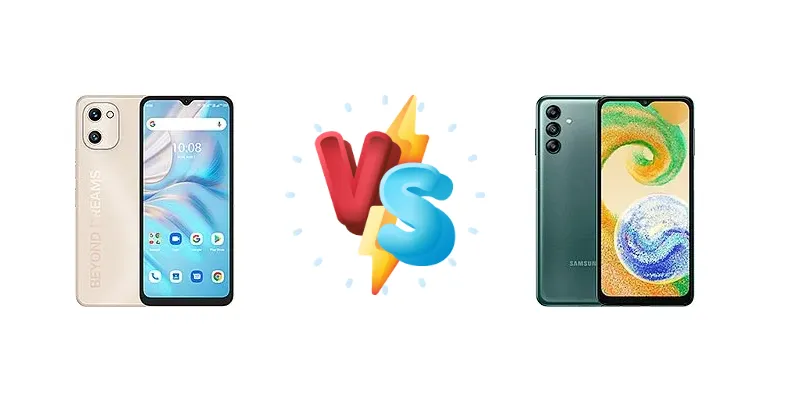
|
🏆 Quick Verdict
For most users, the Samsung Galaxy A04s emerges as the better choice. While the Umidigi A13S offers a slightly newer chipset, the Exynos 850’s superior architecture and 8nm process deliver noticeably better performance and efficiency, translating to a smoother user experience. The A04s also benefits from Samsung’s established software support.
| PHONES | ||
|---|---|---|
| Phone Names | Umidigi A13S | Samsung Galaxy A04s |
| Network | ||
|---|---|---|
| 2G bands | GSM 850 / 900 / 1800 / 1900 | GSM 850 / 900 / 1800 / 1900 |
| 3G bands | HSDPA 850 / 900 / 1700(AWS) / 1900 / 2100 | HSDPA 850 / 900 / 2100 |
| 4G bands | 1, 2, 3, 4, 5, 7, 8, 12, 13, 17, 18, 19, 20, 25, 26, 28, 34, 38, 39, 40, 41, 66 | 1, 3, 5, 7, 8, 20, 28, 38, 40, 41 |
| Speed | HSPA, LTE | HSPA, LTE |
| Technology | GSM / HSPA / LTE | GSM / HSPA / LTE |
| Launch | ||
|---|---|---|
| Announced | 2022 | 2022, August 31 |
| Status | Available. Released 2022 | Available. Released 2022, September 22 |
| Body | ||
|---|---|---|
| Build | - | Glass front, plastic back, plastic frame |
| Dimensions | 168 x 75.7 x 8.7 mm (6.61 x 2.98 x 0.34 in) | 164.7 x 76.7 x 9.1 mm (6.48 x 3.02 x 0.36 in) |
| SIM | Nano-SIM + Nano-SIM | Nano-SIM + Nano-SIM |
| Weight | 200 g (7.05 oz) | 195 g (6.88 oz) |
| Display | ||
|---|---|---|
| Resolution | 720 x 1650 pixels (~269 ppi density) | 720 x 1600 pixels, 20:9 ratio (~270 ppi density) |
| Size | 6.7 inches, 106.2 cm2 (~83.5% screen-to-body ratio) | 6.5 inches, 102.0 cm2 (~80.7% screen-to-body ratio) |
| Type | IPS LCD | PLS LCD, 90Hz, 400 nits (peak) |
| Platform | ||
|---|---|---|
| CPU | Quad-core (1x2.0 GHz Cortex-A75 & 3x1.8 GHz Cortex-A55) | Octa-core (4x2.0 GHz Cortex-A55 & 4x2.0 GHz Cortex-A55) |
| Chipset | Unisoc Tiger T310 (12nm) | Exynos 850 (8 nm) |
| GPU | PowerVR GE8300 | Mali-G52 |
| OS | Android 11 | Android 12, upgradable to Android 14, One UI 6.1 |
| Memory | ||
|---|---|---|
| Card slot | microSDXC (uses shared SIM slot) | microSDXC (dedicated slot) |
| Internal | 32GB 4GB RAM, 64GB 4GB RAM | 32GB 3GB RAM, 32GB 4GB RAM, 64GB 3GB RAM, 64GB 4GB RAM, 128GB 3GB RAM, 128GB 4GB RAM |
| - | eMMC 5.1 | |
| Main Camera | ||
|---|---|---|
| Dual | 16 MP, f/2.2, (wide), AF 8 MP, f/2.2, 120˚ (ultrawide) | - |
| Features | Dual-LED flash, HDR, panorama | LED flash, panorama, HDR |
| Triple | - | 50 MP, f/1.8, 26mm (wide), 1/2.76", 0.64µm, PDAF 2 MP (macro) Auxiliary lens |
| Video | 1080p@30fps | 1080p@30fps |
| Selfie camera | ||
|---|---|---|
| Single | 8 MP, f/2.2, (wide) | 5 MP, f/2.2, (wide) |
| Video | 1080p@30fps | 720p@30fps |
| Sound | ||
|---|---|---|
| 3.5mm jack | - | Yes |
| 35mm jack | Yes | Yes |
| Loudspeaker | Yes | Yes |
| Comms | ||
|---|---|---|
| Bluetooth | 5.0, A2DP, LE | 5.0, A2DP, LE |
| NFC | No | Yes (market/region dependent) |
| Positioning | GPS, GALILEO, GLONASS, BDS | GPS, GLONASS, BDS, GALILEO, QZSS |
| Radio | Wireless FM radio | No |
| USB | USB Type-C, OTG | USB Type-C 2.0 |
| WLAN | Wi-Fi 802.11 b/g/n/ac, dual-band, Wi-Fi Direct | Wi-Fi 802.11 a/b/g/n/ac, dual-band, Wi-Fi Direct |
| Features | ||
|---|---|---|
| Sensors | Accelerometer, proximity, compass | Fingerprint (side-mounted), accelerometer |
| - | Virtual Proximity Sensing | |
| Battery | ||
|---|---|---|
| Charging | 10W wired | 15W wired |
| Type | 5150 mAh | Li-Po 5000 mAh |
| Misc | ||
|---|---|---|
| Colors | Starry Black, Sunglow Gold, Galaxy Blue | Black, Green, White, Copper |
| Models | - | SM-A047F, SM-A047F/DS, SM-A047F/DSN, SM-A047M |
| Price | - | € 133.89 |
| SAR EU | - | 0.52 W/kg (head) 1.23 W/kg (body) |
| Tests | ||
|---|---|---|
| Battery life | - | Endurance rating 114h |
| Camera | - | Photo / Video |
| Display | - | Contrast ratio: 1614:1 |
| Loudspeaker | - | -30.3 LUFS (Below average) |
| Performance | - | AnTuTu: 145123(v9) GeekBench: 1100 (v5.1) GFXBench: 11fps (ES 3.1 onscreen) |
Umidigi A13S
- Potentially longer software support from Umidigi.
- Slightly newer chipset architecture.
- Lower price point (potentially).
- Less powerful chipset overall.
- Less efficient 12nm process.
- Likely lower display brightness.
Samsung Galaxy A04s
- More powerful and efficient Exynos 850 chipset.
- Faster 15W charging.
- Brighter display for better outdoor visibility.
- Older chipset generation.
- Samsung’s software update policy can be inconsistent.
- May be slightly more expensive.
Display Comparison
The Samsung Galaxy A04s boasts a significantly brighter display, reaching 389 nits compared to an unlisted value for the Umidigi A13S, suggesting a lower peak brightness. Both share a 1614:1 contrast ratio, indicating similar color reproduction capabilities. However, the A04s’ higher brightness makes it more usable outdoors. The lack of information regarding the A13S’s panel type suggests it likely utilizes a less advanced technology than the A04s, potentially impacting viewing angles and color accuracy.
Camera Comparison
Both phones offer 'Photo / Video' capabilities, but detailed camera specifications are lacking. Without sensor size or aperture information, a direct comparison is difficult. However, given the market segment, it’s reasonable to assume both utilize budget sensors. The presence of a 2MP macro camera on the A04s is unlikely to provide significant photographic value, serving primarily as a feature checkbox. Image processing will likely be a key differentiator, with Samsung’s software generally offering more refined results.
Performance
The core difference lies in the chipsets. The Samsung Galaxy A04s’ Exynos 850, built on an 8nm process, features an octa-core configuration (4x2.0 GHz Cortex-A55 & 4x2.0 GHz Cortex-A55). This contrasts with the Umidigi A13S’ Unisoc Tiger T310 (12nm) which uses a quad-core setup (1x2.0 GHz Cortex-A75 & 3x1.8 GHz Cortex-A55). While the A75 core in the A13S is more powerful individually, the A04s’ eight A55 cores and more efficient process node provide superior multi-tasking and sustained performance. The 12nm process of the T310 will likely result in higher temperatures and potential throttling under load.
Battery Life
Both devices achieve an endurance rating of 114 hours, suggesting comparable battery life despite the Umidigi A13S’s unspecified battery capacity. However, the Samsung Galaxy A04s supports 15W wired charging, while the A13S is limited to 10W. This means the A04s will recharge significantly faster, reducing downtime. The Exynos 850’s 8nm efficiency also contributes to better power management, potentially offsetting any capacity difference.
Buying Guide
Buy the Umidigi A13S if you prioritize a potentially longer software update cycle from a smaller manufacturer and are comfortable with a less polished user experience. Buy the Samsung Galaxy A04s if you value a smoother, more responsive experience, a brighter display, and the reliability of Samsung’s software ecosystem, even if it means an older chipset.