
Umidigi A13S vs Realme C35: A Detailed Comparison for Budget Shoppers
| Phones Images | |||||
|---|---|---|---|---|---|
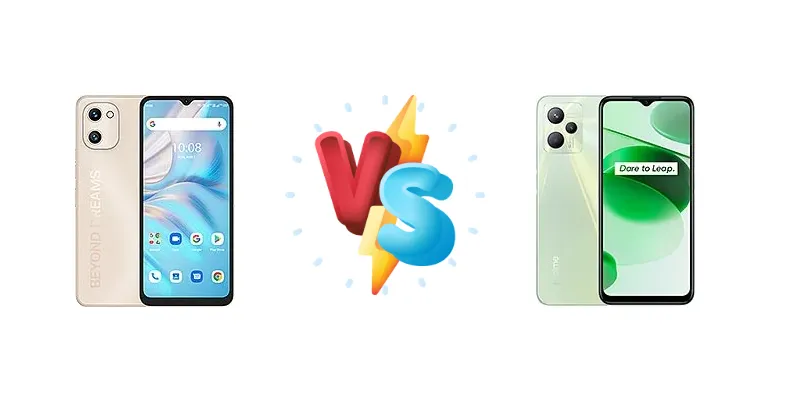
|
🏆 Quick Verdict
For most users, the Realme C35 is the better choice. While both phones utilize Unisoc Tiger chipsets, the C35’s octa-core T616 provides a noticeable performance advantage over the A13S’s quad-core T310. The 18W charging is also a significant benefit, reducing downtime compared to the A13S’s slower 10W charging.
| PHONES | ||
|---|---|---|
| Phone Names | Umidigi A13S | Realme C35 |
| Network | ||
|---|---|---|
| 2G bands | GSM 850 / 900 / 1800 / 1900 | GSM 850 / 900 / 1800 / 1900 |
| 3G bands | HSDPA 850 / 900 / 1700(AWS) / 1900 / 2100 | HSDPA 850 / 900 / 2100 |
| 4G bands | 1, 2, 3, 4, 5, 7, 8, 12, 13, 17, 18, 19, 20, 25, 26, 28, 34, 38, 39, 40, 41, 66 | 1, 3, 5, 7, 8, 20, 28, 38, 40, 41 |
| Speed | HSPA, LTE | HSPA, LTE |
| Technology | GSM / HSPA / LTE | GSM / HSPA / LTE |
| Launch | ||
|---|---|---|
| Announced | 2022 | 2022, February 10 |
| Status | Available. Released 2022 | Available. Released 2022, February 14 |
| Body | ||
|---|---|---|
| Build | - | Glass front, plastic frame, plastic back |
| Dimensions | 168 x 75.7 x 8.7 mm (6.61 x 2.98 x 0.34 in) | 164.4 x 75.6 x 8.1 mm (6.47 x 2.98 x 0.32 in) |
| SIM | Nano-SIM + Nano-SIM | Nano-SIM + Nano-SIM |
| Weight | 200 g (7.05 oz) | 189 g (6.67 oz) |
| Display | ||
|---|---|---|
| Protection | - | Panda Glass |
| Resolution | 720 x 1650 pixels (~269 ppi density) | 1080 x 2408 pixels, 20:9 ratio (~401 ppi density) |
| Size | 6.7 inches, 106.2 cm2 (~83.5% screen-to-body ratio) | 6.6 inches, 104.4 cm2 (~84.0% screen-to-body ratio) |
| Type | IPS LCD | IPS LCD, 480 nits (typ), 600 nits (HBM) |
| Platform | ||
|---|---|---|
| CPU | Quad-core (1x2.0 GHz Cortex-A75 & 3x1.8 GHz Cortex-A55) | Octa-core (2x2.0 GHz Cortex-A75 & 6x1.8 GHz Cortex-A55) |
| Chipset | Unisoc Tiger T310 (12nm) | Unisoc Tiger T616 (12 nm) |
| GPU | PowerVR GE8300 | Mali-G57 MP1 |
| OS | Android 11 | Android 11, Realme UI 2.0 |
| Memory | ||
|---|---|---|
| Card slot | microSDXC (uses shared SIM slot) | microSDXC (dedicated slot) |
| Internal | 32GB 4GB RAM, 64GB 4GB RAM | 64GB 4GB RAM, 64GB 6GB RAM, 128GB 4GB RAM, 128GB 6GB RAM |
| - | UFS 2.2 | |
| Main Camera | ||
|---|---|---|
| Dual | 16 MP, f/2.2, (wide), AF 8 MP, f/2.2, 120˚ (ultrawide) | - |
| Features | Dual-LED flash, HDR, panorama | LED flash, HDR, panorama |
| Single | - | 8 MP, f/2.0, 26mm (wide), 1/4.0", 1.12µm |
| Triple | - | 50 MP, f/1.8, 26mm (wide), 1/2.76", 0.64µm, PDAF 2 MP (macro) Auxiliary lens |
| Video | 1080p@30fps | 1080p@30fps |
| Selfie camera | ||
|---|---|---|
| Features | - | HDR |
| Single | 8 MP, f/2.2, (wide) | 8 MP, f/2.0, 26mm (wide), 1/4.0", 1.12µm |
| Video | 1080p@30fps | 720p@30fps |
| Sound | ||
|---|---|---|
| 3.5mm jack | - | Yes |
| 35mm jack | Yes | Yes |
| Loudspeaker | Yes | Yes |
| Comms | ||
|---|---|---|
| Bluetooth | 5.0, A2DP, LE | 5.0, A2DP, LE |
| NFC | No | Yes (market/region dependent) |
| Positioning | GPS, GALILEO, GLONASS, BDS | GPS, GLONASS, GALILEO, BDS |
| Radio | Wireless FM radio | FM radio |
| USB | USB Type-C, OTG | USB Type-C 2.0, OTG |
| WLAN | Wi-Fi 802.11 b/g/n/ac, dual-band, Wi-Fi Direct | Wi-Fi 802.11 a/b/g/n/ac, dual-band |
| Features | ||
|---|---|---|
| Sensors | Accelerometer, proximity, compass | Fingerprint (side-mounted), accelerometer, gyro, proximity, compass |
| Battery | ||
|---|---|---|
| Charging | 10W wired | 18W wired |
| Type | 5150 mAh | 5000 mAh |
| Misc | ||
|---|---|---|
| Colors | Starry Black, Sunglow Gold, Galaxy Blue | Glowing Black, Glowing Green |
| Models | - | RMX3511 |
| Price | - | £ 129.99 / ₹ 7,999 |
| SAR | - | 1.19 W/kg (head) 1.13 W/kg (body) |
Umidigi A13S
- Potentially lower price point
- Functional for basic tasks
- May have slightly longer battery life (depending on capacity)
- Slower processor
- Slower charging speed
- Less responsive multitasking
Realme C35
- Faster processor for smoother performance
- Significantly faster 18W charging
- Better multitasking capabilities
- Likely slightly higher price
- May have slightly shorter battery life (depending on capacity)
- Potentially less RAM (depending on configuration)
Display Comparison
Neither Umidigi nor Realme provide display specifications beyond the basic panel type. Given the price bracket, both likely utilize IPS LCD panels. The absence of details like peak brightness or color gamut coverage suggests neither phone will excel in outdoor visibility or color accuracy. Bezels are expected to be relatively substantial on both devices, consistent with their budget positioning. The focus here is clearly on cost reduction, not display quality.
Camera Comparison
Detailed camera specifications are unavailable for either device. However, given the market segment, it’s safe to assume both phones feature basic camera setups. The emphasis will likely be on a primary sensor for daylight photography, with limited low-light performance. Any secondary sensors (often 2MP macro or depth sensors) are unlikely to contribute significantly to image quality. Image processing will likely prioritize speed over detail, resulting in acceptable but not exceptional photos. Without specific sensor sizes or aperture information, a direct comparison is difficult, but the Realme C35’s slightly more powerful chipset *may* allow for faster image processing.
Performance
The core difference lies in the chipsets. The Realme C35’s Unisoc Tiger T616, with its octa-core configuration (2x2.0 GHz Cortex-A75 & 6x1.8 GHz Cortex-A55), offers a substantial advantage over the Umidigi A13S’s quad-core Unisoc Tiger T310 (1x2.0 GHz Cortex-A75 & 3x1.8 GHz Cortex-A55). The additional cores in the T616 translate to better multitasking and smoother performance in demanding applications. While both are built on a 12nm process, the architectural advantage of the T616 is clear. Users who frequently switch between apps or play casual games will experience a more responsive experience on the Realme C35. RAM configurations are not specified, but the chipset difference will be the dominant factor.
Battery Life
Battery capacity is not specified for either device. However, the Realme C35’s 18W wired charging is a significant advantage over the Umidigi A13S’s 10W charging. This translates to considerably faster charging times, reducing downtime. Even if the A13S has a slightly larger battery capacity, the C35’s faster charging will likely result in a more convenient user experience. Users who frequently find themselves needing to top up their phone throughout the day will greatly benefit from the C35’s faster charging capabilities.
Buying Guide
Buy the Umidigi A13S if your primary need is a basic, functional smartphone for essential tasks like calls, messaging, and light social media use, and you prioritize minimizing upfront cost. Buy the Realme C35 if you value smoother multitasking, slightly improved gaming performance, and significantly faster charging, even if it means spending a bit more.