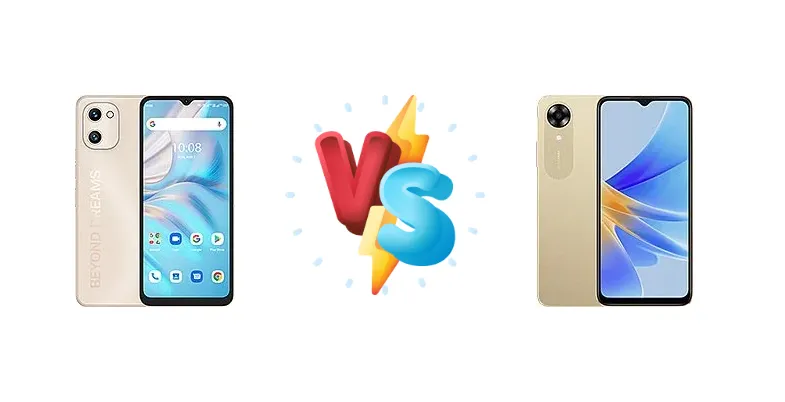
The Umidigi A13S and Oppo A17k represent the fiercely competitive sub-$150 smartphone market. Both aim to deliver essential smartphone functionality at an accessible price point, but they take different approaches to achieving this. The A13S leverages the Unisoc Tiger T310, while the A17k opts for the MediaTek Helio G35. This comparison will dissect the key differences between these two devices, focusing on performance, efficiency, and overall user experience.
🏆 Quick Verdict
For the average user prioritizing multi-tasking and responsiveness, the Oppo A17k emerges as the better choice. Its octa-core Helio G35 chipset, despite using the same 12nm process as the A13S’s Unisoc chip, offers a significant advantage in CPU performance, making everyday tasks smoother. However, the Umidigi A13S may appeal to those seeking a slightly more power-efficient option for basic usage.
| Network |
|---|
| 2G bands | GSM 850 / 900 / 1800 / 1900 | GSM 850 / 900 / 1800 / 1900 |
| 3G bands | HSDPA 850 / 900 / 1700(AWS) / 1900 / 2100 | HSDPA 850 / 900 / 2100 |
| 4G bands | 1, 2, 3, 4, 5, 7, 8, 12, 13, 17, 18, 19, 20, 25, 26, 28, 34, 38, 39, 40, 41, 66 | 1, 3, 5, 8, 38, 40, 41 |
| Speed | HSPA, LTE | HSPA, LTE |
| Technology | GSM / HSPA / LTE | GSM / HSPA / LTE |
| Launch |
|---|
| Announced | 2022 | 2022, October 13 |
| Status | Available. Released 2022 | Available. Released 2022, October 18 |
| Body |
|---|
| Dimensions | 168 x 75.7 x 8.7 mm (6.61 x 2.98 x 0.34 in) | 164.2 x 75.6 x 8.3 mm (6.46 x 2.98 x 0.33 in) |
| SIM | Nano-SIM + Nano-SIM | Nano-SIM + Nano-SIM |
| Weight | 200 g (7.05 oz) | 189 g (6.67 oz) |
| | - | IPX4 water resistance |
| Display |
|---|
| Protection | - | Panda Glass |
| Resolution | 720 x 1650 pixels (~269 ppi density) | 720 x 1612 pixels, 20:9 ratio (~269 ppi density) |
| Size | 6.7 inches, 106.2 cm2 (~83.5% screen-to-body ratio) | 6.56 inches, 103.4 cm2 (~83.3% screen-to-body ratio) |
| Type | IPS LCD | IPS LCD, 480 nits (typ), 600 nits (HBM) |
| Platform |
|---|
| CPU | Quad-core (1x2.0 GHz Cortex-A75 & 3x1.8 GHz Cortex-A55) | Octa-core (4x2.3 GHz Cortex-A53 & 4x1.8 GHz Cortex-A53) |
| Chipset | Unisoc Tiger T310 (12nm) | Mediatek MT6765 Helio G35 (12 nm) |
| GPU | PowerVR GE8300 | PowerVR GE8320 |
| OS | Android 11 | Android 12, ColorOS 12.1 |
| Memory |
|---|
| Card slot | microSDXC (uses shared SIM slot) | microSDXC |
| Internal | 32GB 4GB RAM, 64GB 4GB RAM | 64GB 3GB RAM |
| | - | eMMC 5.1 |
| Main Camera |
|---|
| Dual | 16 MP, f/2.2, (wide), AF
8 MP, f/2.2, 120˚ (ultrawide) | - |
| Features | Dual-LED flash, HDR, panorama | LED flash, panorama |
| Single | - | 8 MP, f/2.0, (wide), AF |
| Video | 1080p@30fps | 1080p@30fps |
| Selfie camera |
|---|
| Single | 8 MP, f/2.2, (wide) | 5 MP, f/2.2, (wide) |
| Video | 1080p@30fps | 1080p@30fps |
| Sound |
|---|
| 3.5mm jack | - | Yes |
| 35mm jack | Yes | Yes |
| Loudspeaker | Yes | Yes |
| Comms |
|---|
| Bluetooth | 5.0, A2DP, LE | 5.3, A2DP, LE, aptX HD |
| NFC | No | No |
| Positioning | GPS, GALILEO, GLONASS, BDS | GPS, GLONASS, BDS, GALILEO |
| Radio | Wireless FM radio | Unspecified |
| USB | USB Type-C, OTG | microUSB 2.0, OTG |
| WLAN | Wi-Fi 802.11 b/g/n/ac, dual-band, Wi-Fi Direct | Wi-Fi 802.11 a/b/g/n/ac, dual-band |
| Features |
|---|
| Sensors | Accelerometer, proximity, compass | Fingerprint (side-mounted), accelerometer, proximity, compass |
| Battery |
|---|
| Charging | 10W wired | - |
| Type | 5150 mAh | Li-Po 5000 mAh |
| Misc |
|---|
| Colors | Starry Black, Sunglow Gold, Galaxy Blue | Navy Blue, Gold |
| Models | - | CPH2471 |
| Price | - | About 130 EUR |
Umidigi A13S
- Potentially better power efficiency for basic tasks.
- May be slightly cheaper depending on retailer.
- Unisoc chipset offers a different experience for those seeking alternatives to MediaTek.
- Quad-core processor limits multi-tasking performance.
- Likely slower app loading times.
- Less responsive user interface compared to the A17k.
Oppo A17k
- Octa-core processor delivers smoother performance.
- More responsive user experience.
- Better suited for running multiple apps simultaneously.
- May have slightly shorter battery life under heavy use.
- Potentially higher price point.
- MediaTek chipset is common in this segment, offering less differentiation.
Display Comparison
Neither device boasts a standout display. Given the lack of detailed display specs, we can assume both utilize standard IPS LCD panels common in this price bracket. The focus here is likely on cost optimization rather than visual fidelity. Bezels are expected to be noticeable on both, and color accuracy will likely be adequate but not exceptional. Without knowing the peak brightness or color gamut coverage, it's difficult to declare a clear winner; however, Oppo generally has slightly better display calibration in this segment.
Camera Comparison
Both phones likely feature basic camera setups geared towards casual photography. Without detailed sensor information, it’s safe to assume both rely on relatively small sensors. The A17k may have a slight edge due to Oppo’s generally more refined image processing algorithms, but the difference will likely be minimal. Any 2MP macro or depth sensors on either device should be considered marketing features rather than genuinely useful components. Image quality will be acceptable in good lighting conditions, but expect significant noise and a lack of detail in low-light scenarios.
Performance
The core difference lies in the chipsets. The Oppo A17k’s MediaTek Helio G35 is an octa-core processor (4x2.3 GHz Cortex-A53 & 4x1.8 GHz Cortex-A53), while the Umidigi A13S features the Unisoc Tiger T310, a quad-core setup (1x2.0 GHz Cortex-A75 & 3x1.8 GHz Cortex-A55). While both are built on a 12nm process, the Helio G35’s eight cores provide a substantial advantage in multi-threaded workloads. The Cortex-A75 core in the A13S is more powerful than the A53 cores in the A17k, but the sheer number of cores in the A17k will translate to smoother performance when running multiple apps or more demanding software. This difference will be most noticeable during app switching and general system responsiveness. The A13S may be slightly more efficient for single-core tasks, but the A17k’s overall performance advantage is more significant for typical smartphone usage.
Battery Life
Battery capacity isn’t specified, but both phones likely house batteries in the 4000-5000 mAh range, typical for this price point. The Umidigi A13S, with its less powerful and potentially more efficient chipset, *could* offer slightly longer battery life under light usage. However, the Oppo A17k’s faster processor will consume more power during active use. Both devices are limited to 10W wired charging, meaning charging times will be relatively slow – expect several hours to fully charge from 0%.
Buying Guide
Buy the Umidigi A13S if you primarily need a phone for very basic tasks like calls, texts, and light social media browsing, and battery life is your absolute top priority. Buy the Oppo A17k if you want a more responsive experience for multi-tasking, running more demanding apps, or enjoying occasional gaming, even if it means slightly reduced battery longevity. The A17k is the better all-rounder for most users.
Frequently Asked Questions
❓ Will the Helio G35 in the Oppo A17k struggle with popular games like PUBG Mobile?
While the Helio G35 can run PUBG Mobile, you'll likely need to play at the lowest graphics settings and potentially accept lower frame rates for a smooth experience. It's not a gaming-focused chipset, so don't expect flagship-level performance. The Umidigi A13S would likely perform even worse in demanding games.
❓ Is the 10W charging on either phone fast enough for daily use?
No, 10W charging is quite slow by today's standards. Expect a full charge to take several hours (likely 3-5 hours). Neither phone prioritizes fast charging, focusing instead on keeping costs down. Consider this a trade-off for the affordable price point.
❓ How much storage do these phones typically come with, and can it be expanded?
These phones typically ship with 32GB or 64GB of internal storage. Thankfully, both the Umidigi A13S and Oppo A17k support microSD card expansion, allowing you to add more storage for photos, videos, and apps. This is crucial given the limited base storage.
❓ Which phone is better for someone who primarily uses WhatsApp and Facebook?
The Oppo A17k is the better choice for WhatsApp and Facebook. The Helio G35's octa-core processor will ensure these apps run smoothly, even with multiple chats and background activity. The Umidigi A13S might feel sluggish when switching between apps or loading media within these platforms.