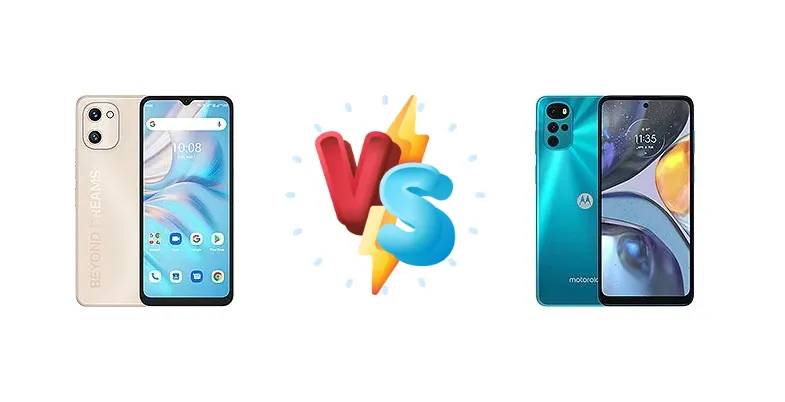
The sub-$150 smartphone market is fiercely competitive. The Umidigi A13S and Motorola Moto G22 both aim to deliver essential smartphone functionality at an accessible price point, but they take different approaches to achieving this. This comparison dives deep into their core specifications, focusing on performance, charging, and overall value to determine which device best suits your needs.
🏆 Quick Verdict
For the average user prioritizing responsiveness and faster charging, the Motorola Moto G22 is the better choice. Its Helio G37 chipset, with its octa-core configuration, offers a noticeable performance advantage over the Umidigi A13S’s quad-core Unisoc T310, and the 20W charging (in some regions) significantly reduces downtime.
| Network |
|---|
| 2G bands | GSM 850 / 900 / 1800 / 1900 | GSM 850 / 900 / 1800 / 1900 |
| 3G bands | HSDPA 850 / 900 / 1700(AWS) / 1900 / 2100 | HSDPA 850 / 900 / 1900 / 2100 |
| 4G bands | 1, 2, 3, 4, 5, 7, 8, 12, 13, 17, 18, 19, 20, 25, 26, 28, 34, 38, 39, 40, 41, 66 | 1, 3, 5, 7, 8, 20, 38, 40, 41 |
| Speed | HSPA, LTE | HSPA 42.2/5.76 Mbps, LTE Cat4 150/50 Mbps |
| Technology | GSM / HSPA / LTE | GSM / HSPA / LTE |
| Launch |
|---|
| Announced | 2022 | 2022, March 04 |
| Status | Available. Released 2022 | Available. Released 2022, March 04 |
| Body |
|---|
| Build | - | Glass front, plastic frame, plastic back |
| Dimensions | 168 x 75.7 x 8.7 mm (6.61 x 2.98 x 0.34 in) | 164 x 75 x 8.5 mm (6.46 x 2.95 x 0.33 in) |
| SIM | Nano-SIM + Nano-SIM | · Nano-SIM· Nano-SIM + Nano-SIM |
| Weight | 200 g (7.05 oz) | 185 g (6.53 oz) |
| | - | Water-repellent design |
| Display |
|---|
| Resolution | 720 x 1650 pixels (~269 ppi density) | 720 x 1600 pixels, 20:9 ratio (~268 ppi density) |
| Size | 6.7 inches, 106.2 cm2 (~83.5% screen-to-body ratio) | 6.5 inches, 103.5 cm2 (~84.2% screen-to-body ratio) |
| Type | IPS LCD | IPS LCD, 90Hz |
| Platform |
|---|
| CPU | Quad-core (1x2.0 GHz Cortex-A75 & 3x1.8 GHz Cortex-A55) | Octa-core (4x2.3 GHz Cortex-A53 & 4x1.8 GHz Cortex-A53) |
| Chipset | Unisoc Tiger T310 (12nm) | Mediatek MT6765V/CB Helio G37 (12 nm) |
| GPU | PowerVR GE8300 | PowerVR GE8320 |
| OS | Android 11 | Android 12 |
| Memory |
|---|
| Card slot | microSDXC (uses shared SIM slot) | microSDXC (dedicated slot) |
| Internal | 32GB 4GB RAM, 64GB 4GB RAM | 64GB 4GB RAM, 128GB 4GB RAM |
| Main Camera |
|---|
| Dual | 16 MP, f/2.2, (wide), AF
8 MP, f/2.2, 120˚ (ultrawide) | - |
| Features | Dual-LED flash, HDR, panorama | LED flash, HDR, panorama |
| Quad | - | 50 MP, f/1.8, (wide), 0.64µm, PDAF
8 MP, f/2.2, 118˚ (ultrawide), 1/4.0", 1.12µm
2 MP (macro)
Auxiliary lens |
| Video | 1080p@30fps | 1080p@30fps |
| Selfie camera |
|---|
| Features | - | HDR |
| Single | 8 MP, f/2.2, (wide) | 16 MP, f/2.5, (wide), 1.0µm |
| Video | 1080p@30fps | 1080p@30fps |
| Sound |
|---|
| 3.5mm jack | - | Yes |
| 35mm jack | Yes | Yes |
| Loudspeaker | Yes | Yes |
| Comms |
|---|
| Bluetooth | 5.0, A2DP, LE | 5.0, A2DP, LE |
| NFC | No | Yes (market/region dependent) |
| Positioning | GPS, GALILEO, GLONASS, BDS | GPS, GLONASS, GALILEO |
| Radio | Wireless FM radio | Unspecified |
| USB | USB Type-C, OTG | USB Type-C 2.0 |
| WLAN | Wi-Fi 802.11 b/g/n/ac, dual-band, Wi-Fi Direct | Wi-Fi 802.11 a/b/g/n/ac, dual-band, Wi-Fi Direct |
| Features |
|---|
| Sensors | Accelerometer, proximity, compass | Fingerprint (side-mounted), accelerometer, gyro, proximity, compass |
| Battery |
|---|
| Charging | 10W wired | 20W wired (India)
15W wired (Global) |
| Type | 5150 mAh | Li-Po 5000 mAh |
| Misc |
|---|
| Colors | Starry Black, Sunglow Gold, Galaxy Blue | Pearl White, Iceberg Blue, Cosmic Black, Mint Green |
| Models | - | XT2231-1, XT2231-2, XT2231-5 |
| Price | - | About 120 EUR |
Umidigi A13S
- Potentially lower price point
- Efficient Unisoc T310 chipset for basic tasks
- Likely similar battery life to Moto G22
- Quad-core processor limits multitasking performance
- Slow 10W charging
- Less responsive user experience
Motorola Moto G22
- Octa-core Helio G37 offers better performance
- Faster 20W (India) / 15W (Global) charging
- More responsive multitasking
- May be slightly more expensive than Umidigi A13S
- Helio G37 can be less power efficient than Unisoc T310
- Global version has slower 15W charging
Display Comparison
Neither device boasts a standout display. Both are likely utilizing LCD panels, common in this price bracket. While specific details like peak brightness and color gamut coverage are unavailable, the focus here is on the internal hardware. Display quality will likely be similar, prioritizing functionality over visual fidelity. Bezels are expected to be noticeable on both devices, reflecting their budget positioning.
Camera Comparison
Camera performance is likely to be similar, with both devices relying on budget sensors. Details on sensor size and aperture are missing, but it’s safe to assume both will feature a primary camera alongside auxiliary lenses of limited utility (likely a 2MP macro and depth sensor). Image processing will be a key differentiator, but without sample images, it’s difficult to assess. Expect adequate performance in good lighting conditions, but struggles in low light. The absence of Optical Image Stabilization (OIS) on either device will exacerbate low-light issues.
Performance
The core difference lies in the chipsets. The Motorola Moto G22’s MediaTek Helio G37 is an octa-core processor featuring four Cortex-A53 cores clocked at 2.3 GHz and another four at 1.8 GHz. This contrasts with the Umidigi A13S’s Unisoc Tiger T310, a quad-core chip with a single Cortex-A75 core at 2.0 GHz and three Cortex-A55 cores at 1.8 GHz. While the A75 core in the Umidigi offers higher single-core performance, the Helio G37’s eight cores provide superior multi-core performance, translating to smoother multitasking and a more responsive user experience. The Helio G37’s architecture is better suited for handling multiple applications simultaneously. The Unisoc T310, while efficient, will likely struggle with demanding tasks.
Battery Life
Battery capacity is not specified for either device, but both likely fall in the 5000mAh range, typical for this segment. However, charging speeds differ significantly. The Motorola Moto G22 supports 20W wired charging in India, while globally it’s limited to 15W. The Umidigi A13S is capped at 10W. This means the Moto G22 can potentially charge from 0-100% much faster, reducing downtime. While a larger battery capacity is beneficial, faster charging can be more impactful for daily usability, especially for users who frequently need to top up their devices.
Buying Guide
Buy the Umidigi A13S if you need a basic, functional smartphone for light tasks like calls, messaging, and occasional social media browsing, and are comfortable with slower performance and charging. Buy the Motorola Moto G22 if you prefer a more responsive experience for multitasking, streaming, and light gaming, and value the convenience of faster charging, even if it's not universally available at 20W.
Frequently Asked Questions
❓ Will the Motorola Moto G22 handle popular games like PUBG Mobile?
The Helio G37 is capable of running PUBG Mobile, but expect to play at lower graphics settings and frame rates to maintain a stable experience. It's not a gaming-focused chipset, so demanding titles will likely require compromises.
❓ Is the 10W charging on the Umidigi A13S painfully slow?
Yes, 10W charging is significantly slower than the 15W or 20W options on the Moto G22. A full charge will take considerably longer, potentially requiring overnight charging to ensure a full battery.
❓ Does the Unisoc Tiger T310 in the Umidigi A13S support widevine L1 for HD streaming?
Widevine L1 support is not confirmed for the Umidigi A13S. This means you may be limited to SD quality streaming on services like Netflix and Amazon Prime Video.
❓ What kind of storage does the Motorola Moto G22 use, and is it expandable?
The Moto G22 typically comes with eMMC storage, which is slower than UFS. However, it does offer a dedicated microSD card slot for storage expansion, allowing you to add up to 512GB of additional storage.