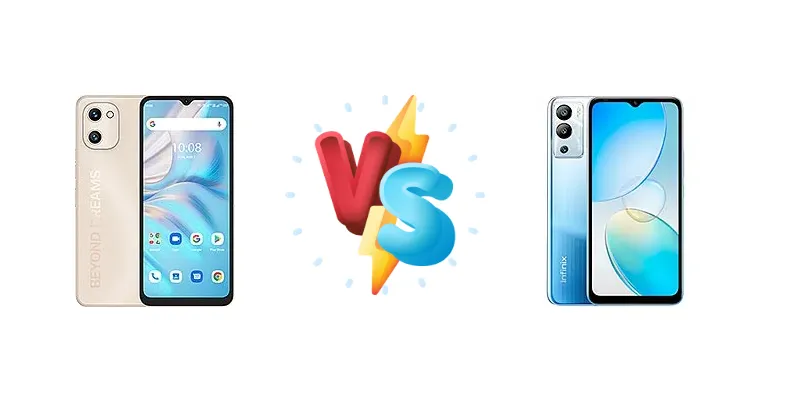
The Umidigi A13S and Infinix Hot 12i represent the fiercely competitive sub-$150 smartphone market. Both aim to deliver essential smartphone functionality at an incredibly low price point, but they achieve this with different chipsets and subtle variations in design. This comparison dissects their core components to determine which offers the best value for budget-conscious consumers.
🏆 Quick Verdict
For the average user prioritizing responsiveness in everyday tasks, the Umidigi A13S edges out the Infinix Hot 12i. Its Unisoc Tiger T310, featuring Cortex-A75 cores, provides a noticeable performance uplift over the Helio A22’s all-Cortex-A53 configuration, making it smoother for multitasking and app loading.
| Network |
|---|
| 2G bands | GSM 850 / 900 / 1800 / 1900 | GSM 850 / 900 / 1800 / 1900 |
| 3G bands | HSDPA 850 / 900 / 1700(AWS) / 1900 / 2100 | HSDPA 850 / 900 / 2100 |
| 4G bands | 1, 2, 3, 4, 5, 7, 8, 12, 13, 17, 18, 19, 20, 25, 26, 28, 34, 38, 39, 40, 41, 66 | 1, 3, 5, 8, 38, 40, 41 |
| Speed | HSPA, LTE | HSPA, LTE |
| Technology | GSM / HSPA / LTE | GSM / HSPA / LTE |
| | - | 1, 2, 3, 4, 5, 7, 8, 20, 28, 38, 40, 41 |
| Launch |
|---|
| Announced | 2022 | 2022, April 12 |
| Status | Available. Released 2022 | Available. Released 2022, April 12 |
| Body |
|---|
| Build | - | Glass front, plastic back, plastic frame |
| Dimensions | 168 x 75.7 x 8.7 mm (6.61 x 2.98 x 0.34 in) | 164.8 x 76.4 x 8.8 mm (6.49 x 3.01 x 0.35 in) |
| SIM | Nano-SIM + Nano-SIM | Nano-SIM + Nano-SIM |
| Weight | 200 g (7.05 oz) | 190 g (6.70 oz) |
| Display |
|---|
| Resolution | 720 x 1650 pixels (~269 ppi density) | 720 x 1612 pixels, 20:9 ratio (~267 ppi density) |
| Size | 6.7 inches, 106.2 cm2 (~83.5% screen-to-body ratio) | 6.6 inches, 104.6 cm2 (~83.1% screen-to-body ratio) |
| Type | IPS LCD | IPS LCD, 480 nits |
| Platform |
|---|
| CPU | Quad-core (1x2.0 GHz Cortex-A75 & 3x1.8 GHz Cortex-A55) | Quad-core 2.0 GHz Cortex-A53 |
| Chipset | Unisoc Tiger T310 (12nm) | Mediatek MT6761 Helio A22 (12 nm) |
| GPU | PowerVR GE8300 | PowerVR GE8320 |
| OS | Android 11 | Android 11, XOS 7.6 |
| Memory |
|---|
| Card slot | microSDXC (uses shared SIM slot) | microSDXC (dedicated slot) |
| Internal | 32GB 4GB RAM, 64GB 4GB RAM | 64GB 2GB RAM, 64GB 3GB RAM, 64GB 4GB RAM |
| | - | eMMC 5.1 |
| Main Camera |
|---|
| Dual | 16 MP, f/2.2, (wide), AF
8 MP, f/2.2, 120˚ (ultrawide) | - |
| Features | Dual-LED flash, HDR, panorama | Dual-LED flash |
| Single | - | 8 MP |
| Triple | - | 13 MP, f/1.8, (wide), AF
Auxiliary lenses |
| Video | 1080p@30fps | 1080p@30fps |
| Selfie camera |
|---|
| Features | - | LED flash |
| Single | 8 MP, f/2.2, (wide) | 8 MP |
| Video | 1080p@30fps | 1080p@30fps |
| Sound |
|---|
| 3.5mm jack | - | Yes |
| 35mm jack | Yes | Yes |
| Loudspeaker | Yes | Yes |
| Comms |
|---|
| Bluetooth | 5.0, A2DP, LE | Yes |
| NFC | No | No |
| Positioning | GPS, GALILEO, GLONASS, BDS | GPS |
| Radio | Wireless FM radio | FM radio |
| USB | USB Type-C, OTG | microUSB 2.0 |
| WLAN | Wi-Fi 802.11 b/g/n/ac, dual-band, Wi-Fi Direct | Wi-Fi 802.11 a/b/g/n/ac, dual-band |
| Features |
|---|
| Sensors | Accelerometer, proximity, compass | Fingerprint (rear-mounted), accelerometer, proximity |
| Battery |
|---|
| Charging | 10W wired | 10W wired |
| Type | 5150 mAh | Li-Ion 5000 mAh |
| Misc |
|---|
| Colors | Starry Black, Sunglow Gold, Galaxy Blue | Racing Black, Horizon Blue, Haze Green, Champagne Gold |
| Models | - | X665B, X665 |
| Price | - | About 140 EUR |
Umidigi A13S
- More powerful CPU with Cortex-A75 core
- Potentially smoother multitasking experience
- Slightly better performance for demanding apps
- 10W charging is slow
- Likely basic camera performance
Infinix Hot 12i
- Extremely affordable price point
- Simple and straightforward user experience
- Decent battery life for basic usage
- Slower CPU performance
- Less responsive user interface
- Limited multitasking capabilities
Display Comparison
Neither device boasts a standout display. Both likely utilize standard IPS LCD panels, given their price bracket. The absence of detailed display specifications necessitates focusing on the chipset's impact on UI smoothness. A more powerful chipset, like the Umidigi A13S's, can mitigate the perception of a lower-quality display by ensuring fluid animations and transitions.
Camera Comparison
Given the price point, camera performance is unlikely to be a key differentiator. Both devices likely feature basic camera setups with limited features. Without specific sensor details, it's safe to assume both rely on budget sensors. The presence of a 2MP macro camera on either device is largely a marketing tactic, offering minimal practical benefit due to the low resolution and lack of optical image stabilization. Image processing will likely be basic, prioritizing speed over quality.
Performance
The core difference lies in the chipsets. The Umidigi A13S’s Unisoc Tiger T310 (12nm) employs a hybrid CPU architecture – a single high-performance Cortex-A75 core clocked at 2.0 GHz, paired with three Cortex-A55 cores at 1.8 GHz. This configuration provides a significant advantage in single-core performance compared to the Infinix Hot 12i’s MediaTek Helio A22 (12nm), which utilizes four Cortex-A53 cores at 2.0 GHz. While both are quad-core, the A75 core in the Umidigi offers substantially better performance per clock cycle. This translates to faster app launches and smoother multitasking. The 12nm fabrication process is identical, suggesting similar power efficiency, but the architectural advantage favors the Umidigi.
Battery Life
Both phones feature 10W wired charging, indicating similar charging speeds. Actual battery life will depend on usage patterns, but the efficiency of the Unisoc Tiger T310 in the Umidigi A13S might offer a slight edge in longevity, especially during moderate usage. The absence of fast charging technology means both devices will require several hours to fully charge from 0-100%.
Buying Guide
Buy the Umidigi A13S if you need a phone that feels slightly more responsive for daily use, even if it's just for browsing, social media, and light app usage. The A75 core in the T310 chipset offers a tangible benefit. Buy the Infinix Hot 12i if your primary concern is absolute cost and you only need a phone for the most basic tasks like calls, texts, and occasional light browsing, and are willing to accept slower performance.
Frequently Asked Questions
❓ Will the Unisoc Tiger T310 in the Umidigi A13S handle popular social media apps like TikTok and Instagram smoothly?
Yes, the Umidigi A13S’s chipset is better equipped to handle the demands of social media apps compared to the Helio A22. The Cortex-A75 core provides a performance boost that will result in smoother scrolling, faster loading times, and a more responsive experience within these applications.
❓ Is the Helio A22 in the Infinix Hot 12i sufficient for basic tasks like making calls and sending texts?
Absolutely. The Helio A22 is perfectly adequate for core smartphone functions like calls, texts, and using basic apps. However, it will struggle with more demanding tasks or running multiple apps simultaneously. It's designed for simplicity and essential connectivity.
❓ Can either of these phones run PUBG Mobile, and if so, at what settings?
While technically possible to launch PUBG Mobile on both devices, the experience will be far from ideal. Expect extremely low frame rates and significant lag, even on the lowest settings. Neither chipset is designed for demanding gaming.
❓ What type of storage does each phone use, and is it expandable?
While not specified, both phones likely utilize eMMC storage to keep costs down. Expandability via microSD card is highly probable, given the target market, but confirmation would require checking specific retailer listings or the manufacturer's website.