
Umidigi A13 vs Xiaomi Poco M4 Pro: A Detailed Comparison for Budget Buyers
| Phones Images | |||||
|---|---|---|---|---|---|
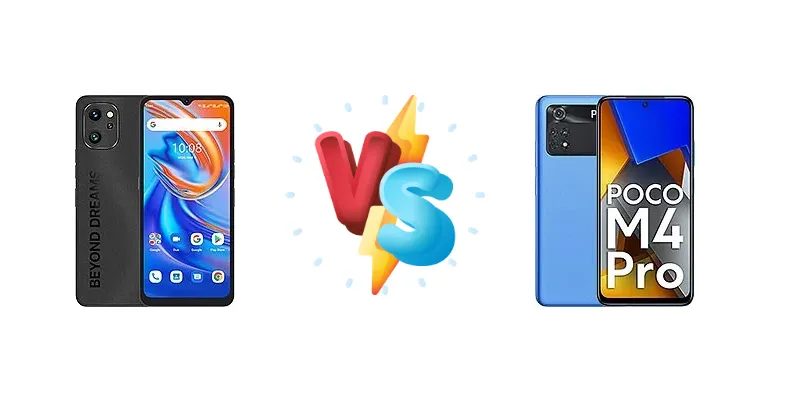
|
🏆 Quick Verdict
For most users, the Xiaomi Poco M4 Pro is the superior choice. Its significantly more powerful Helio G96 chipset and 33W fast charging provide a smoother user experience and quicker top-ups, justifying the slight price premium. However, the Umidigi A13 remains a viable option for those prioritizing absolute cost savings.
| PHONES | ||
|---|---|---|
| Phone Names | Umidigi A13 | Xiaomi Poco M4 Pro |
| Network | ||
|---|---|---|
| 2G bands | GSM 850 / 900 / 1800 / 1900 | GSM 850 / 900 / 1800 / 1900 |
| 3G bands | HSDPA 850 / 900 / 1700(AWS) / 1900 / 2100 | HSDPA 850 / 900 / 1700(AWS) / 1900 / 2100 - International |
| 4G bands | 1, 2, 3, 4, 5, 7, 8, 12, 13, 17, 18, 19, 20, 25, 26, 28, 34, 38, 39, 40, 41, 66 | 1, 2, 3, 4, 5, 7, 8, 20, 28, 38, 40, 41 - International |
| Speed | HSPA, LTE | HSPA, LTE |
| Technology | GSM / HSPA / LTE | GSM / HSPA / LTE |
| - | 1, 3, 5, 8, 40, 41 - India | |
| Launch | ||
|---|---|---|
| Announced | 2022 | 2022, February 28 |
| Status | Available. Released 2022 | Available. Released 2022, March 16 |
| Body | ||
|---|---|---|
| Build | - | Glass front (Gorilla Glass 3), plastic frame, plastic back |
| Dimensions | 168 x 75.7 x 8.7 mm (6.61 x 2.98 x 0.34 in) | 159.9 x 73.9 x 8.1 mm (6.30 x 2.91 x 0.32 in) |
| SIM | Nano-SIM + Nano-SIM | Nano-SIM + Nano-SIM |
| Weight | 200 g (7.05 oz) | 179.5 g (6.31 oz) |
| - | IP53, dust and splash resistant | |
| Display | ||
|---|---|---|
| Protection | - | Corning Gorilla Glass 3 |
| Resolution | 720 x 1650 pixels (~269 ppi density) | 1080 x 2400 pixels, 20:9 ratio (~409 ppi density) |
| Size | 6.7 inches, 106.2 cm2 (~83.5% screen-to-body ratio) | 6.43 inches, 99.8 cm2 (~84.5% screen-to-body ratio) |
| Type | IPS LCD | AMOLED, 90Hz, 700 nits, 1000 nits (peak) |
| Platform | ||
|---|---|---|
| CPU | Octa-core (2x1.8 GHz Cortex-A75 & 6x1.8 GHz Cortex-A55) | Octa-core (2x2.05 GHz Cortex-A76 & 6x2.0 GHz Cortex-A55) |
| Chipset | Unisoc T610 (12 nm) | Mediatek MT6781 Helio G96 (12 nm) |
| GPU | Mali-G52 MP2 | Mali-G57 MC2 |
| OS | Android 11 | Android 11, MIUI 13 for POCO |
| Memory | ||
|---|---|---|
| Card slot | microSDXC (uses shared SIM slot) | microSDXC (dedicated slot) |
| Internal | 128GB 4GB RAM | 64GB 6GB RAM, 128GB 6GB RAM, 128GB 8GB RAM, 256GB 8GB RAM |
| - | UFS 2.2 | |
| Main Camera | ||
|---|---|---|
| Dual | 20 MP, f/1.8, (wide), AF 8 MP, f/2.2, 120˚ (ultrawide) 5 MP (macro) | - |
| Features | Dual-LED flash, HDR, panorama | LED flash, HDR, panorama |
| Single | - | 16 MP, f/2.5, (wide), 1/3.06" 1.0µm |
| Triple | - | 64 MP, f/1.8, 26mm (wide), 0.7µm, PDAF 8 MP, f/2.2, 118˚ (ultrawide), 1/4.0", 1.12µm 2 MP (macro) |
| Video | 1080p@30fps | 1080p@30fps |
| Selfie camera | ||
|---|---|---|
| Features | - | HDR |
| Single | 8 MP, f/2.2, (wide) | 16 MP, f/2.5, (wide), 1/3.06" 1.0µm |
| Video | 1080p@30fps | 1080p@30fps |
| Sound | ||
|---|---|---|
| 3.5mm jack | - | Yes |
| 35mm jack | Yes | Yes |
| Loudspeaker | Yes | Yes, with stereo speakers |
| - | 24-bit/192kHz audio | |
| Comms | ||
|---|---|---|
| Bluetooth | 5.0, A2DP, LE | 5.0, A2DP, LE |
| Infrared port | - | Yes |
| NFC | No | Yes |
| Positioning | GPS, GALILEO, GLONASS, BDS | GPS, GLONASS, BDS, GALILEO |
| Radio | Wireless FM radio | FM radio, recording |
| USB | USB Type-C, OTG | USB Type-C 2.0, OTG |
| WLAN | Wi-Fi 802.11 b/g/n/ac, dual-band, Wi-Fi Direct | Wi-Fi 802.11 a/b/g/n/ac, dual-band, Wi-Fi Direct |
| Features | ||
|---|---|---|
| Sensors | Fingerprint (side-mounted), accelerometer, proximity, compass | Fingerprint (side-mounted), accelerometer, gyro, compass |
| - | Virtual proximity sensing | |
| Battery | ||
|---|---|---|
| Charging | 10W wired | 33W wired, PD3.0, QC3, 100% in 58 min |
| Type | 5150 mAh | Li-Po 5000 mAh |
| Misc | ||
|---|---|---|
| Colors | Starry Black, Sunglow Gold, Galaxy Blue | Power Black, Cool Blue, Poco Yellow |
| Models | - | MZB0B5VIN, 2201117PI, 2201117PG |
| Price | - | € 100.18 |
| SAR | - | 0.85 W/kg (head) 0.85 W/kg (body) |
| SAR EU | - | 0.59 W/kg (head) 0.84 W/kg (body) |
| Tests | ||
|---|---|---|
| Battery life | - | Endurance rating 126h |
| Camera | - | Photo / Video |
| Display | - | Contrast ratio: Infinite (nominal) |
| Loudspeaker | - | -25.2 LUFS (Very good) |
| Performance | - | AnTuTu: 318444 (v9) GeekBench: 1836 (v5.1) GFXBench: 12fps (ES 3.1 onscreen) |
Umidigi A13
- Lowest possible price point
- Acceptable battery endurance
- Functional for basic tasks
- Slow 10W charging
- Underpowered Unisoc T610 chipset
- Likely inferior camera performance
Xiaomi Poco M4 Pro
- Faster Helio G96 processor
- 33W fast charging with PD3.0/QC3
- Brighter display for outdoor visibility
- Slightly higher price
- May still lack advanced features found in higher-end phones
- Software updates may be less frequent than flagship models
Display Comparison
The Poco M4 Pro boasts a significantly brighter display, reaching a measured 737 nits, compared to an unspecified brightness for the Umidigi A13. This makes the Poco M4 Pro far more usable outdoors under direct sunlight. While both likely utilize IPS LCD panels (given the price points), the Poco’s higher brightness and infinite (nominal) contrast ratio suggest a more vibrant and visually appealing experience. Bezels are likely comparable, but the brightness difference is a key differentiator.
Camera Comparison
Both devices feature 'Photo / Video' capabilities, but specifics are lacking. Without sensor size or aperture information, a direct comparison is difficult. However, given the Poco M4 Pro’s positioning, it likely features a more capable primary sensor and potentially better image processing algorithms. The Umidigi A13 likely relies on software enhancements to compensate for a less sophisticated camera system. It's safe to assume the Poco M4 Pro will deliver more detailed and vibrant photos, especially in challenging lighting conditions.
Performance
The core difference lies in the chipsets. The Poco M4 Pro’s MediaTek Helio G96, with its 2x2.05 GHz Cortex-A76 cores, offers a substantial performance advantage over the Umidigi A13’s Unisoc T610 (2x1.8 GHz Cortex-A75). The Cortex-A76 architecture is a generation ahead of the A75, translating to faster app loading times and smoother multitasking. While both are 12nm chips, the G96’s superior CPU and GPU will handle demanding tasks and gaming more effectively. The Poco M4 Pro is the clear winner for users who prioritize performance.
Battery Life
Both phones achieve an endurance rating of 126 hours, suggesting similar overall battery life despite the Umidigi A13’s unspecified battery capacity. However, the Poco M4 Pro’s 33W wired charging (with PD3.0 and QC3 support) is a game-changer, achieving a full charge in just 58 minutes. The Umidigi A13’s slow 10W charging is a significant drawback, requiring considerably longer to replenish the battery. This charging speed difference dramatically impacts usability and convenience.
Buying Guide
Buy the Umidigi A13 if you need a functional smartphone for basic tasks like calling, texting, and light social media, and your budget is extremely limited. You'll be making compromises on performance and charging speed. Buy the Xiaomi Poco M4 Pro if you prefer a more responsive experience for gaming, streaming, and multitasking, and value the convenience of fast charging. It's a better all-rounder for the average smartphone user.