
Umidigi A13 vs Samsung Galaxy A23 5G: A Deep Dive into Budget 5G
| Phones Images | |||||
|---|---|---|---|---|---|
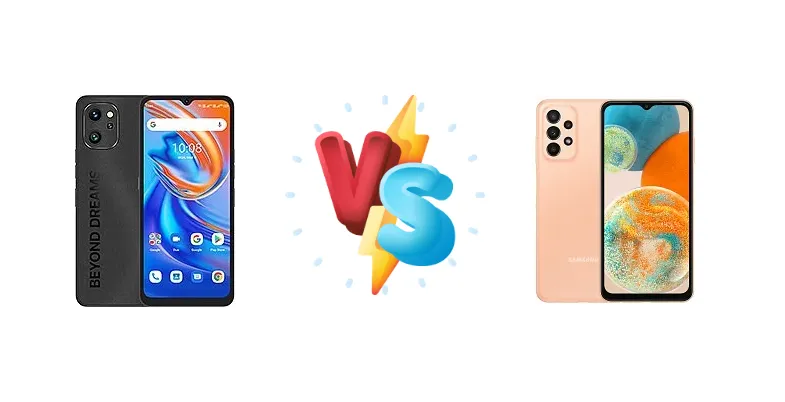
|
🏆 Quick Verdict
For most users, the Samsung Galaxy A23 5G is the superior choice. Its Snapdragon 695 chipset, built on a more efficient 6nm process, provides a noticeable performance advantage over the Umidigi A13’s Unisoc T610. While both offer similar battery endurance, the A23 5G’s 25W charging significantly reduces downtime.
| PHONES | ||
|---|---|---|
| Phone Names | Umidigi A13 | Samsung Galaxy A23 5G |
| Network | ||
|---|---|---|
| 2G bands | GSM 850 / 900 / 1800 / 1900 | GSM 850 / 900 / 1800 / 1900 |
| 3G bands | HSDPA 850 / 900 / 1700(AWS) / 1900 / 2100 | HSDPA 850 / 900 / 1700(AWS) / 1900 / 2100 |
| 4G bands | 1, 2, 3, 4, 5, 7, 8, 12, 13, 17, 18, 19, 20, 25, 26, 28, 34, 38, 39, 40, 41, 66 | 1, 2, 3, 4, 5, 7, 8, 12, 17, 20, 26, 28, 32, 38, 40, 41, 66 - International |
| 5G bands | - | 1, 3, 7, 8, 20, 28, 38, 40, 41, 77, 78 SA/NSA/Sub6 - International |
| Speed | HSPA, LTE | HSPA, LTE, 5G |
| Technology | GSM / HSPA / LTE | GSM / HSPA / LTE / 5G |
| - | 2, 5, 30, 66, 77 SA/NSA/Sub6/mmWave - USA | |
| Launch | ||
|---|---|---|
| Announced | 2022 | 2022, August 05 |
| Status | Available. Released 2022 | Available. Released 2022, September 02 |
| Body | ||
|---|---|---|
| Build | - | Glass front (Gorilla Glass 5), plastic frame, plastic back |
| Dimensions | 168 x 75.7 x 8.7 mm (6.61 x 2.98 x 0.34 in) | 165.4 x 76.9 x 8.4 mm (6.51 x 3.03 x 0.33 in) |
| SIM | Nano-SIM + Nano-SIM | · Nano-SIM· Nano-SIM + Nano-SIM |
| Weight | 200 g (7.05 oz) | 197 g (6.95 oz) |
| Display | ||
|---|---|---|
| Protection | - | Corning Gorilla Glass 5 |
| Resolution | 720 x 1650 pixels (~269 ppi density) | 1080 x 2408 pixels, 20:9 ratio (~400 ppi density) |
| Size | 6.7 inches, 106.2 cm2 (~83.5% screen-to-body ratio) | 6.6 inches, 104.9 cm2 (~82.5% screen-to-body ratio) |
| Type | IPS LCD | PLS LCD, 120Hz |
| Platform | ||
|---|---|---|
| CPU | Octa-core (2x1.8 GHz Cortex-A75 & 6x1.8 GHz Cortex-A55) | Octa-core (2x2.2 GHz Kryo 660 Gold & 6x1.7 GHz Kryo 660 Silver) |
| Chipset | Unisoc T610 (12 nm) | Qualcomm SM6375 Snapdragon 695 5G (6 nm) |
| GPU | Mali-G52 MP2 | Adreno 619 |
| OS | Android 11 | Android 12, upgradable to Android 14, One UI 6 |
| Memory | ||
|---|---|---|
| Card slot | microSDXC (uses shared SIM slot) | microSDXC (dedicated slot) |
| Internal | 128GB 4GB RAM | 64GB 4GB RAM, 64GB 6GB RAM, 128GB 4GB RAM, 128GB 6GB RAM, 128GB 8GB RAM |
| Main Camera | ||
|---|---|---|
| Dual | 20 MP, f/1.8, (wide), AF 8 MP, f/2.2, 120˚ (ultrawide) 5 MP (macro) | - |
| Features | Dual-LED flash, HDR, panorama | LED flash, panorama, HDR |
| Quad | - | 50 MP, f/1.8, 26mm (wide), 1/2.76", 0.64µm, PDAF, OIS 5 MP, f/2.2, 13mm, 123˚ (ultrawide), 1/5.0", 1.12µm 2 MP (macro) Auxiliary lens |
| Video | 1080p@30fps | 1080p@30fps |
| Selfie camera | ||
|---|---|---|
| Single | 8 MP, f/2.2, (wide) | 8 MP, f/2.0, 25mm (wide), 1/4.0", 1.12µm - USA 8 MP, f/2.2, 25mm (wide), 1/4.0", 1.12µm - International |
| Video | 1080p@30fps | 1080p@30fps |
| Sound | ||
|---|---|---|
| 3.5mm jack | - | Yes |
| 35mm jack | Yes | Yes |
| Loudspeaker | Yes | Yes |
| Comms | ||
|---|---|---|
| Bluetooth | 5.0, A2DP, LE | 5.1, A2DP, LE |
| NFC | No | Yes |
| Positioning | GPS, GALILEO, GLONASS, BDS | GPS, GLONASS, GALILEO, BDS |
| Radio | Wireless FM radio | FM radio (market/region dependent) |
| USB | USB Type-C, OTG | USB Type-C 2.0 |
| WLAN | Wi-Fi 802.11 b/g/n/ac, dual-band, Wi-Fi Direct | Wi-Fi 802.11 a/b/g/n/ac, dual-band, Wi-Fi Direct |
| Features | ||
|---|---|---|
| Sensors | Fingerprint (side-mounted), accelerometer, proximity, compass | Fingerprint (side-mounted), accelerometer, gyro, compass, barometer (USA only) |
| - | Virtual proximity sensing | |
| Battery | ||
|---|---|---|
| Charging | 10W wired | 25W wired |
| Type | 5150 mAh | Li-Po 5000 mAh |
| Misc | ||
|---|---|---|
| Colors | Starry Black, Sunglow Gold, Galaxy Blue | Black, White, Peach, Blue |
| Models | - | SM-A236U, SM-A236U1, SM-A236B, SM-A236B/DS, SM-A236B/DSN, SM-A236E, SM-S236DL |
| Price | - | $ 84.44 / £ 129.00 / € 125.28 / ₹ 21,000 |
| SAR | - | 0.68 W/kg (head) 0.57 W/kg (body) |
| SAR EU | - | 1.49 W/kg (head) 1.25 W/kg (body) |
| Tests | ||
|---|---|---|
| Battery life | - | Endurance rating 138h |
| Camera | - | Photo / Video |
| Display | - | Contrast ratio: 1328:1 (nominal) |
| Loudspeaker | - | -25.9 LUFS (Very good) |
| Performance | - | AnTuTu: 318821 (v9) GeekBench: 1940 (v5.1) GFXBench: 16fps (ES 3.1 onscreen) |
Umidigi A13
- Most affordable option
- Acceptable battery life
- Functional for basic tasks
- Slow 10W charging
- Less powerful Unisoc T610 chipset
- Display specifications are limited
Samsung Galaxy A23 5G
- Faster Snapdragon 695 5G chipset
- 25W fast charging
- Brighter display (508 nits)
- Higher price point
- Similar battery endurance to A13
- May still exhibit some budget limitations
Display Comparison
Both devices feature displays with a 1328:1 contrast ratio, suggesting similar visual characteristics in terms of black levels and color pop. However, the Samsung Galaxy A23 5G boasts a measured peak brightness of 508 nits, which will provide a significantly better viewing experience outdoors or in brightly lit environments compared to the Umidigi A13, whose brightness remains unspecified. The lack of information regarding the A13’s panel technology (LCD vs. AMOLED) and refresh rate puts it at a disadvantage, as the A23 5G likely offers a more fluid visual experience.
Camera Comparison
Both phones are listed as having Photo/Video capabilities, but detailed camera specifications are absent. Given Samsung’s established image processing algorithms and typically larger sensors in its A-series, the Galaxy A23 5G is likely to deliver superior image quality, especially in challenging lighting conditions. The absence of sensor size information for both devices makes a precise comparison impossible, but Samsung’s brand reputation suggests a more refined camera experience. It's reasonable to assume the A23 5G will offer more consistent results.
Performance
The core difference lies in the chipsets. The Samsung Galaxy A23 5G’s Qualcomm Snapdragon 695 5G, fabricated on a 6nm process, offers a clear architectural advantage over the Umidigi A13’s Unisoc T610 (12nm). The Snapdragon 695 utilizes 2x Kryo 660 Gold cores clocked at 2.2 GHz alongside 6x Kryo 660 Silver cores at 1.7 GHz, while the T610 features 2x Cortex-A75 cores at 1.8 GHz and 6x Cortex-A55 cores also at 1.8 GHz. The 6nm process and more modern core designs in the Snapdragon 695 translate to better power efficiency and sustained performance, particularly during demanding tasks. The A23 5G will handle multitasking and gaming with noticeably less lag.
Battery Life
Both the Umidigi A13 and Samsung Galaxy A23 5G achieve an endurance rating of 138 hours, indicating comparable battery life under similar usage patterns. However, the charging speeds differ dramatically. The Samsung Galaxy A23 5G supports 25W wired charging, allowing for significantly faster top-ups compared to the Umidigi A13’s slow 10W charging. This means the A23 5G can recover a substantial portion of its battery capacity in a shorter timeframe, minimizing downtime.
Buying Guide
Buy the Umidigi A13 if you prioritize absolute affordability and basic smartphone functionality. It’s a suitable option for users who primarily need a phone for calls, texts, and light social media use. Buy the Samsung Galaxy A23 5G if you value smoother performance for multitasking, gaming, and content consumption, alongside faster charging and the established reliability of the Samsung ecosystem.