
Umidigi A13 vs Realme 9i 5G: A Deep Dive into Budget 5G Performance
| Phones Images | |||||
|---|---|---|---|---|---|
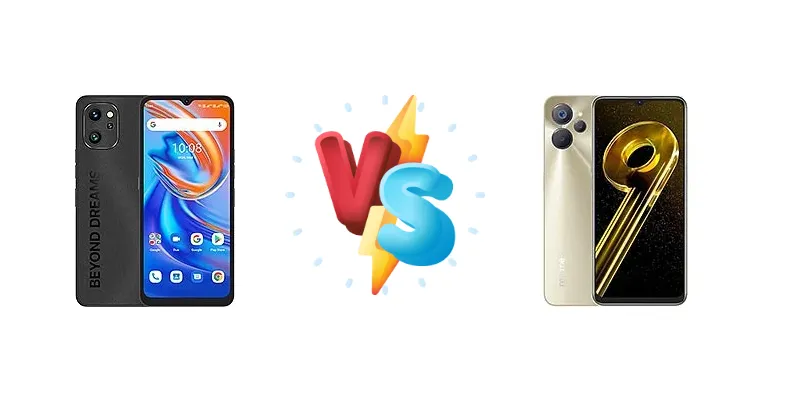
|
🏆 Quick Verdict
For the average user prioritizing responsiveness and future-proofing, the Realme 9i 5G is the clear winner. Its Mediatek Dimensity 810 chipset, built on a more efficient 6nm process, provides a substantial performance advantage over the Umidigi A13’s Unisoc T610, justifying the slight price premium.
| PHONES | ||
|---|---|---|
| Phone Names | Umidigi A13 | Realme 9i 5G |
| Network | ||
|---|---|---|
| 2G bands | GSM 850 / 900 / 1800 / 1900 | GSM 850 / 900 / 1800 / 1900 |
| 3G bands | HSDPA 850 / 900 / 1700(AWS) / 1900 / 2100 | HSDPA 850 / 900 / 1700(AWS) / 1900 / 2100 |
| 4G bands | 1, 2, 3, 4, 5, 7, 8, 12, 13, 17, 18, 19, 20, 25, 26, 28, 34, 38, 39, 40, 41, 66 | 1, 2, 3, 4, 5, 7, 8, 19, 20, 28, 34, 38, 39, 40, 41 |
| 5G bands | - | 1, 5, 7, 8, 28, 41, 77, 78 SA/NSA |
| Speed | HSPA, LTE | HSPA, LTE, 5G |
| Technology | GSM / HSPA / LTE | GSM / HSPA / LTE / 5G |
| Launch | ||
|---|---|---|
| Announced | 2022 | 2022, August 18 |
| Status | Available. Released 2022 | Available. Released 2022, August 24 |
| Body | ||
|---|---|---|
| Dimensions | 168 x 75.7 x 8.7 mm (6.61 x 2.98 x 0.34 in) | 164.4 x 75.1 x 8.1 mm (6.47 x 2.96 x 0.32 in) |
| SIM | Nano-SIM + Nano-SIM | Nano-SIM + Nano-SIM |
| Weight | 200 g (7.05 oz) | 187 g (6.60 oz) |
| Display | ||
|---|---|---|
| Protection | - | Panda Glass |
| Resolution | 720 x 1650 pixels (~269 ppi density) | 1080 x 2408 pixels, 20:9 ratio (~400 ppi density) |
| Size | 6.7 inches, 106.2 cm2 (~83.5% screen-to-body ratio) | 6.6 inches, 104.9 cm2 (~85.0% screen-to-body ratio) |
| Type | IPS LCD | IPS LCD, 90Hz, 400 nits (typ) |
| Platform | ||
|---|---|---|
| CPU | Octa-core (2x1.8 GHz Cortex-A75 & 6x1.8 GHz Cortex-A55) | Octa-core (2x2.4 GHz Cortex-A76 & 6x2.0 GHz Cortex-A55) |
| Chipset | Unisoc T610 (12 nm) | Mediatek Dimensity 810 (6 nm) |
| GPU | Mali-G52 MP2 | Mali-G57 MC2 |
| OS | Android 11 | Android 12, upgradable to Android 13, Realme UI 4.0 |
| Memory | ||
|---|---|---|
| Card slot | microSDXC (uses shared SIM slot) | microSDXC (dedicated slot) |
| Internal | 128GB 4GB RAM | 64GB 4GB RAM, 128GB 4GB RAM, 128GB 6GB RAM |
| - | UFS 2.2 | |
| Main Camera | ||
|---|---|---|
| Dual | 20 MP, f/1.8, (wide), AF 8 MP, f/2.2, 120˚ (ultrawide) 5 MP (macro) | - |
| Features | Dual-LED flash, HDR, panorama | LED flash, HDR, panorama |
| Single | - | 8 MP, f/2.0, 27mm (wide) |
| Triple | - | 50 MP, f/1.8, 26mm (wide), 1/2.76", 0.64µm, PDAF Unspecified MP, 46mm (telephoto) 2 MP (macro) |
| Video | 1080p@30fps | 1080p@30fps |
| Selfie camera | ||
|---|---|---|
| Features | - | HDR, panorama |
| Single | 8 MP, f/2.2, (wide) | 8 MP, f/2.0, 27mm (wide) |
| Video | 1080p@30fps | 1080p@30fps |
| Sound | ||
|---|---|---|
| 3.5mm jack | - | Yes |
| 35mm jack | Yes | Yes |
| Loudspeaker | Yes | Yes |
| Comms | ||
|---|---|---|
| Bluetooth | 5.0, A2DP, LE | 5.2, A2DP, LE |
| NFC | No | No |
| Positioning | GPS, GALILEO, GLONASS, BDS | GPS, GLONASS, GALILEO, BDS |
| Radio | Wireless FM radio | No |
| USB | USB Type-C, OTG | USB Type-C 2.0, OTG |
| WLAN | Wi-Fi 802.11 b/g/n/ac, dual-band, Wi-Fi Direct | Wi-Fi 802.11 a/b/g/n/ac, dual-band |
| Features | ||
|---|---|---|
| Sensors | Fingerprint (side-mounted), accelerometer, proximity, compass | Fingerprint (side-mounted), accelerometer, proximity, compass |
| Battery | ||
|---|---|---|
| Charging | 10W wired | 18W wired |
| Type | 5150 mAh | 5000 mAh |
| Misc | ||
|---|---|---|
| Colors | Starry Black, Sunglow Gold, Galaxy Blue | Soulful Blue, Rocking Black, Gold |
| Models | - | RMX3612 |
| Price | - | About 180 EUR |
Umidigi A13
- Most affordable option
- Functional for basic tasks
- Acceptable battery life for light use
- Significantly slower performance
- Less efficient chipset
- Slower charging speeds
Realme 9i 5G
- Superior performance with Dimensity 810
- Faster 18W charging
- More efficient 6nm process
- Slightly higher price
- May not have a dramatically better display
- Still a budget device with inherent limitations
Display Comparison
Neither device boasts a standout display. While specific panel details (like brightness in nits or color gamut coverage) are unavailable, the focus here is on the chipset impact on display responsiveness. The Realme 9i 5G’s more powerful GPU will likely translate to smoother scrolling and animations, even if the panel technology itself is similar. Bezels are expected to be comparable given the price point, and color accuracy will likely be standard for this segment.
Camera Comparison
Without detailed camera specs beyond the presence of sensors, a direct comparison is difficult. However, the chipset’s image signal processor (ISP) plays a crucial role. The Dimensity 810’s ISP is more advanced, offering better noise reduction, dynamic range, and image processing capabilities compared to the Unisoc T610’s ISP. This means the Realme 9i 5G will likely produce more detailed and visually appealing photos, especially in challenging lighting conditions. The presence of a 2MP macro camera on both devices is largely a marketing gimmick and shouldn't be a deciding factor.
Performance
The core difference lies in the chipsets. The Realme 9i 5G’s Mediatek Dimensity 810 (6nm) significantly outperforms the Umidigi A13’s Unisoc T610 (12nm). The 6nm process node is inherently more power-efficient, leading to better thermal management and sustained performance. The Dimensity 810’s Cortex-A76 cores, clocked at 2.4 GHz, are architecturally superior to the A75 cores in the T610 (1.8 GHz), resulting in faster single-core and multi-core performance. This translates to quicker app launches, smoother multitasking, and a more enjoyable gaming experience on the Realme 9i 5G. The Realme 9i 5G is likely to handle graphically intensive games at higher settings with fewer frame drops.
Battery Life
While battery capacity isn't specified, the Realme 9i 5G’s 18W charging is a clear advantage over the Umidigi A13’s 10W charging. This translates to significantly faster charging times – potentially reducing a full charge from over 3 hours on the Umidigi to around 1.5-2 hours on the Realme. The Dimensity 810’s 6nm efficiency also contributes to better battery life, meaning the Realme 9i 5G will likely last longer on a single charge despite potentially having a similar battery capacity.
Buying Guide
Buy the Umidigi A13 if you need a basic smartphone for essential tasks like calls, texts, and light social media browsing, and prioritize absolute affordability. Buy the Realme 9i 5G if you prefer a smoother, more responsive experience for multitasking, gaming, and demanding applications, and value the benefits of a more powerful and efficient processor.