
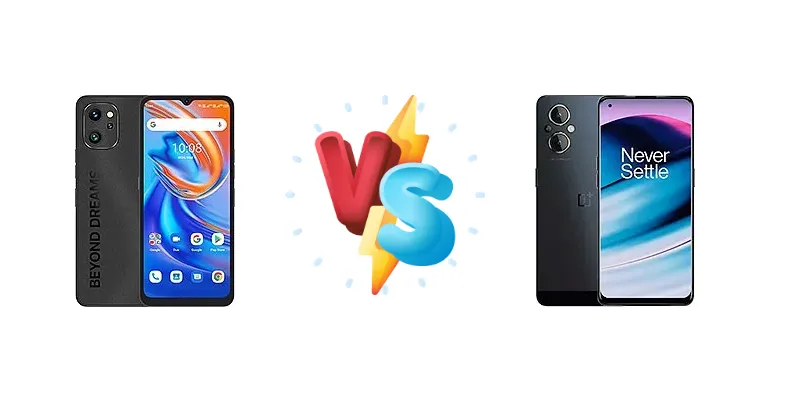
Umidigi A13 vs OnePlus Nord N20 5G: A Deep Dive into Budget 5G Contenders
| Phones Images | |||||
|---|---|---|---|---|---|
|
🏆 Quick Verdict
For most users, the OnePlus Nord N20 5G is the superior choice. Its Snapdragon 695 chipset, built on a more efficient 6nm process, provides a noticeable performance advantage over the Umidigi A13’s Unisoc T610. The significantly faster 33W charging also dramatically improves usability, offsetting the identical 129-hour endurance ratings.
| PHONES | ||
|---|---|---|
| Phone Names | Umidigi A13 | OnePlus Nord N20 5G |
| Network | ||
|---|---|---|
| 2G bands | GSM 850 / 900 / 1800 / 1900 | GSM 850 / 900 / 1800 / 1900 |
| 3G bands | HSDPA 850 / 900 / 1700(AWS) / 1900 / 2100 | HSDPA 850 / 900 / 1700(AWS) / 1900 / 2100 |
| 4G bands | 1, 2, 3, 4, 5, 7, 8, 12, 13, 17, 18, 19, 20, 25, 26, 28, 34, 38, 39, 40, 41, 66 | 1, 2, 3, 4, 5, 7, 8, 12, 13, 17, 20, 25, 26, 28, 38, 39, 40, 41, 66, 71 |
| 5G bands | - | 2, 25, 41, 66, 71 SA/NSA |
| Speed | HSPA, LTE | HSPA 42.2/5.76 Mbps, LTE Cat15 800/200 Mbps, 5G |
| Technology | GSM / HSPA / LTE | GSM / HSPA / LTE / 5G |
| Launch | ||
|---|---|---|
| Announced | 2022 | 2022, April 28 |
| Status | Available. Released 2022 | Available. Released 2022, April 28 |
| Body | ||
|---|---|---|
| Build | - | Glass front (Schott Xensation Up), plastic frame, plastic back |
| Dimensions | 168 x 75.7 x 8.7 mm (6.61 x 2.98 x 0.34 in) | 159.9 x 73.2 x 7.5 mm (6.30 x 2.88 x 0.30 in) |
| SIM | Nano-SIM + Nano-SIM | Nano-SIM |
| Weight | 200 g (7.05 oz) | 173 g (6.10 oz) |
| Display | ||
|---|---|---|
| Protection | - | Schott Xensation Up |
| Resolution | 720 x 1650 pixels (~269 ppi density) | 1080 x 2400 pixels, 20:9 ratio (~409 ppi density) |
| Size | 6.7 inches, 106.2 cm2 (~83.5% screen-to-body ratio) | 6.43 inches, 99.8 cm2 (~85.3% screen-to-body ratio) |
| Type | IPS LCD | AMOLED |
| - | Always-on display | |
| Platform | ||
|---|---|---|
| CPU | Octa-core (2x1.8 GHz Cortex-A75 & 6x1.8 GHz Cortex-A55) | Octa-core (2x2.2 GHz Kryo 660 Gold & 6x1.7 GHz Kryo 660 Silver) |
| Chipset | Unisoc T610 (12 nm) | Qualcomm SM6375 Snapdragon 695 5G (6 nm) |
| GPU | Mali-G52 MP2 | Adreno 619 |
| OS | Android 11 | Android 11, OxygenOS 11 |
| Memory | ||
|---|---|---|
| Card slot | microSDXC (uses shared SIM slot) | microSDXC (dedicated slot) |
| Internal | 128GB 4GB RAM | 128GB 6GB RAM |
| - | UFS 2.2 | |
| Main Camera | ||
|---|---|---|
| Dual | 20 MP, f/1.8, (wide), AF 8 MP, f/2.2, 120˚ (ultrawide) 5 MP (macro) | - |
| Features | Dual-LED flash, HDR, panorama | LED flash, HDR, panorama |
| Single | - | 16 MP, f/2.4, (wide) |
| Triple | - | 64 MP, f/1.8, (wide), PDAF 2 MP (macro) Auxiliary lens |
| Video | 1080p@30fps | 1080p@30fps |
| Selfie camera | ||
|---|---|---|
| Features | - | HDR |
| Single | 8 MP, f/2.2, (wide) | 16 MP, f/2.4, (wide) |
| Video | 1080p@30fps | 1080p@30fps |
| Sound | ||
|---|---|---|
| 3.5mm jack | - | Yes |
| 35mm jack | Yes | Yes |
| Loudspeaker | Yes | Yes |
| Comms | ||
|---|---|---|
| Bluetooth | 5.0, A2DP, LE | 5.1, A2DP, LE |
| NFC | No | Yes |
| Positioning | GPS, GALILEO, GLONASS, BDS | GPS (L1+L5), GLONASS, GALILEO, BDS |
| Radio | Wireless FM radio | No |
| USB | USB Type-C, OTG | USB Type-C 2.0, OTG |
| WLAN | Wi-Fi 802.11 b/g/n/ac, dual-band, Wi-Fi Direct | Wi-Fi 802.11 a/b/g/n/ac, dual-band, Wi-Fi Direct |
| Features | ||
|---|---|---|
| Sensors | Fingerprint (side-mounted), accelerometer, proximity, compass | Fingerprint (under display, optical), accelerometer, gyro, proximity, compass, barometer |
| Battery | ||
|---|---|---|
| Charging | 10W wired | 33W wired |
| Type | 5150 mAh | Li-Po 4500 mAh |
| Misc | ||
|---|---|---|
| Colors | Starry Black, Sunglow Gold, Galaxy Blue | Blue |
| Models | - | GN2200, CPH2459 |
| Price | - | About 120 EUR |
| Tests | ||
|---|---|---|
| Battery life | - | Endurance rating 129h |
| Display | - | Contrast ratio: Infinite (nominal) |
| Performance | - | AnTuTu: 316974 (v8), 380672 (v9) GeekBench: 1945 (v5.1) GFXBench: 16fps (ES 3.1 onscreen) |
Umidigi A13
- Lowest possible price point for 5G connectivity
- Functional for basic smartphone tasks
- Acceptable battery endurance
- Slow 10W charging
- Unisoc T610 chipset offers limited performance
- Likely lower quality display
OnePlus Nord N20 5G
- Faster Snapdragon 695 5G chipset
- Significantly faster 33W charging
- Brighter and more usable display
- Higher price than the Umidigi A13
- May still exhibit some performance limitations with demanding games
- Software support may be shorter than some competitors
Display Comparison
The OnePlus Nord N20 5G boasts a significantly brighter display, reaching a measured 647 nits, compared to an unspecified brightness for the Umidigi A13. While both phones offer an 'infinite' (nominal) contrast ratio, the higher peak brightness of the Nord N20 5G translates to better visibility outdoors and in brightly lit environments. The absence of refresh rate information for the Umidigi A13 suggests a standard 60Hz panel, while the Nord N20 5G likely offers a smoother experience, though this isn't explicitly stated. The Nord N20's display is the clear winner for visual clarity.
Camera Comparison
Without detailed camera specs for the Umidigi A13, a direct comparison is difficult. However, the market positioning suggests the Nord N20 5G likely has a more refined camera system. Focusing on the main sensors is crucial; the presence of numerous low-resolution auxiliary cameras (often 2MP) adds little value. The Snapdragon 695’s ISP (Image Signal Processor) also benefits image processing, potentially leading to better dynamic range and low-light performance on the Nord N20 5G. We assume the Nord N20 5G has a more capable primary camera.
Performance
The core difference lies in the chipsets. The OnePlus Nord N20 5G utilizes the Qualcomm Snapdragon 695 5G (6nm), featuring 2x2.2 GHz Kryo 660 Gold and 6x1.7 GHz Kryo 660 Silver cores. This 6nm process node is significantly more efficient than the 12nm Unisoc T610 in the Umidigi A13, which has 2x1.8 GHz Cortex-A75 and 6x1.8 GHz Cortex-A55 cores. The Snapdragon 695’s architectural advantages and smaller node size will result in better sustained performance and reduced thermal throttling during demanding tasks. While both are octa-core CPUs, the Snapdragon 695 offers a tangible performance edge.
Battery Life
Both phones achieve an endurance rating of 129 hours, indicating similar overall battery life under typical usage. However, the charging speeds are drastically different. The Umidigi A13 is limited to 10W wired charging, while the OnePlus Nord N20 5G supports 33W wired charging. This means the Nord N20 5G can replenish its battery much faster, reducing downtime and offering a more convenient user experience. A full charge on the Umidigi A13 will take significantly longer, making the Nord N20 5G the clear winner in terms of charging convenience.
Buying Guide
Buy the Umidigi A13 if your primary need is a functional, ultra-budget 5G phone for basic tasks like calls, messaging, and light social media, and you prioritize minimizing upfront cost above all else. Buy the OnePlus Nord N20 5G if you value smoother performance for multitasking and gaming, faster charging speeds for convenience, and a brighter, more usable display, even if it means spending a bit more.