
Umidigi A13 vs. Infinix Note 12 (2023): A Detailed Comparison for Budget Buyers
| Phones Images | |||||
|---|---|---|---|---|---|
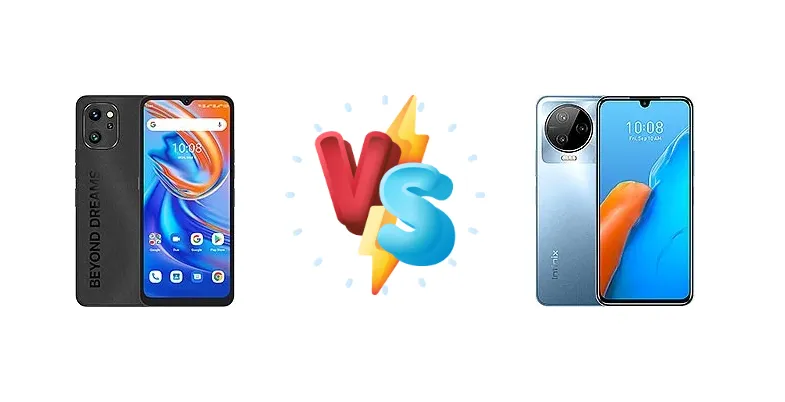
|
🏆 Quick Verdict
For most users, the Infinix Note 12 (2023) is the better choice. Its Mediatek Helio G99 chipset, built on a more efficient 6nm process, provides a noticeable performance boost over the Umidigi A13’s Unisoc T610. The 33W charging is a significant advantage, drastically reducing recharge times compared to the A13’s slow 10W charging.
| PHONES | ||
|---|---|---|
| Phone Names | Umidigi A13 | Infinix Note 12 (2023) |
| Network | ||
|---|---|---|
| 2G bands | GSM 850 / 900 / 1800 / 1900 | GSM 850 / 900 / 1800 / 1900 |
| 3G bands | HSDPA 850 / 900 / 1700(AWS) / 1900 / 2100 | HSDPA 850 / 900 / 1700(AWS) / 1900 / 2100 |
| 4G bands | 1, 2, 3, 4, 5, 7, 8, 12, 13, 17, 18, 19, 20, 25, 26, 28, 34, 38, 39, 40, 41, 66 | 1, 2, 3, 4, 5, 7, 8, 20, 28, 38, 40, 41 |
| Speed | HSPA, LTE | HSPA, LTE |
| Technology | GSM / HSPA / LTE | GSM / HSPA / LTE |
| - | 1, 3, 5, 8, 38, 40, 41 | |
| Launch | ||
|---|---|---|
| Announced | 2022 | 2022, October 06 |
| Status | Available. Released 2022 | Available. Released 2022, October 06 |
| Body | ||
|---|---|---|
| Build | - | Glass front, plastic frame, plastic back |
| Dimensions | 168 x 75.7 x 8.7 mm (6.61 x 2.98 x 0.34 in) | 164.4 x 76.5 x 7.8 mm (6.47 x 3.01 x 0.31 in) |
| SIM | Nano-SIM + Nano-SIM | Nano-SIM + Nano-SIM |
| Weight | 200 g (7.05 oz) | 195 g (6.88 oz) |
| Display | ||
|---|---|---|
| Resolution | 720 x 1650 pixels (~269 ppi density) | 1080 x 2400 pixels, 20:9 ratio (~393 ppi density) |
| Size | 6.7 inches, 106.2 cm2 (~83.5% screen-to-body ratio) | 6.7 inches, 108.4 cm2 (~86.2% screen-to-body ratio) |
| Type | IPS LCD | AMOLED |
| Platform | ||
|---|---|---|
| CPU | Octa-core (2x1.8 GHz Cortex-A75 & 6x1.8 GHz Cortex-A55) | Octa-core (2x2.2 GHz Cortex-A76 & 6x2.0 GHz Cortex-A55) |
| Chipset | Unisoc T610 (12 nm) | Mediatek Helio G99 (6 nm) |
| GPU | Mali-G52 MP2 | Mali-G57 MC2 |
| OS | Android 11 | Android 12, XOS 10.6 |
| Memory | ||
|---|---|---|
| Card slot | microSDXC (uses shared SIM slot) | microSDXC (dedicated slot) |
| Internal | 128GB 4GB RAM | 128GB 8GB RAM, 256GB 8GB RAM |
| Main Camera | ||
|---|---|---|
| Dual | 20 MP, f/1.8, (wide), AF 8 MP, f/2.2, 120˚ (ultrawide) 5 MP (macro) | - |
| Features | Dual-LED flash, HDR, panorama | Quad-LED flash, HDR, panorama |
| Single | - | 16 MP, (wide) |
| Triple | - | 50 MP, f/1.6, (wide), PDAF Auxiliary lenses |
| Video | 1080p@30fps | 1440p@30fps |
| Selfie camera | ||
|---|---|---|
| Single | 8 MP, f/2.2, (wide) | 16 MP, (wide) |
| Video | 1080p@30fps | 1440p@30fps |
| Sound | ||
|---|---|---|
| 3.5mm jack | - | Yes |
| 35mm jack | Yes | Yes |
| Loudspeaker | Yes | Yes, with dual speakers |
| Comms | ||
|---|---|---|
| Bluetooth | 5.0, A2DP, LE | Yes |
| NFC | No | Yes |
| Positioning | GPS, GALILEO, GLONASS, BDS | GPS |
| Radio | Wireless FM radio | FM radio |
| USB | USB Type-C, OTG | USB Type-C 2.0, OTG |
| WLAN | Wi-Fi 802.11 b/g/n/ac, dual-band, Wi-Fi Direct | Wi-Fi 802.11 a/b/g/n/ac, dual-band |
| Features | ||
|---|---|---|
| Sensors | Fingerprint (side-mounted), accelerometer, proximity, compass | Fingerprint (side-mounted), accelerometer, gyro, proximity, compass |
| - | 24-bit/192kHz audio | |
| Battery | ||
|---|---|---|
| Charging | 10W wired | 33W wired |
| Type | 5150 mAh | 5000 mAh |
| Misc | ||
|---|---|---|
| Colors | Starry Black, Sunglow Gold, Galaxy Blue | Volcanic Grey, Tuscany Blue, Alpine White |
| Models | - | X676C |
| Price | - | About 220 EUR |
Umidigi A13
- Extremely affordable price point
- Functional for basic smartphone tasks
- Potentially longer battery life due to less powerful chipset (though offset by slower charging)
- Slow 10W charging
- Unisoc T610 chipset struggles with demanding tasks
- Likely limited software support
Infinix Note 12 (2023)
- Faster and more efficient Mediatek Helio G99 chipset
- Significantly faster 33W charging
- Improved multitasking and gaming performance
- Slightly higher price than the Umidigi A13
- May not have the absolute longest battery life due to more powerful processor
- Software updates may be limited
Display Comparison
Neither device boasts a standout display. While specific panel details (like peak brightness or color gamut coverage) are unavailable, the core difference lies elsewhere. Both likely utilize LCD panels common in this price bracket. The focus here isn't on visual fidelity, but on the overall user experience, which is minimally impacted by display quality in both cases.
Camera Comparison
Both phones likely feature a multi-camera setup, but details beyond the main sensors are sparse. Given the price point, image quality will be adequate for casual snapshots, but don't expect flagship-level performance. The Infinix Note 12 (2023) *may* have a slight edge if it incorporates more advanced image processing algorithms, but without specific sensor size or aperture information, it's difficult to definitively say. The inclusion of a 2MP macro camera on either device is largely a marketing tactic, offering minimal practical benefit.
Performance
The performance gap is the most significant differentiator. The Infinix Note 12 (2023) utilizes the Mediatek Helio G99, fabricated on a 6nm process. This smaller node size translates to improved power efficiency and thermal performance compared to the Umidigi A13’s Unisoc T610 (12nm). The Helio G99’s CPU configuration – 2x2.2 GHz Cortex-A76 cores and 6x2.0 GHz Cortex-A55 cores – is also more powerful than the A13’s 2x1.8 GHz Cortex-A75 and 6x1.8 GHz Cortex-A55 setup. This means faster app loading times, smoother multitasking, and a more responsive gaming experience on the Infinix.
Battery Life
While battery capacity isn't specified, the real-world impact is heavily influenced by charging speed. The Infinix Note 12 (2023) supports 33W wired charging, allowing for a significantly faster 0-100% charge compared to the Umidigi A13’s sluggish 10W charging. This is a crucial advantage for users who rely heavily on their phones throughout the day and need quick top-ups. Even with a similar battery capacity, the faster charging of the Infinix will provide a more convenient user experience.
Buying Guide
Buy the Umidigi A13 if your primary need is an extremely affordable smartphone for basic tasks like calls, texts, and light social media use, and you aren't concerned with gaming or fast charging. Buy the Infinix Note 12 (2023) if you prioritize smoother performance for multitasking and gaming, and value significantly faster charging speeds, even if it means spending a bit more upfront.