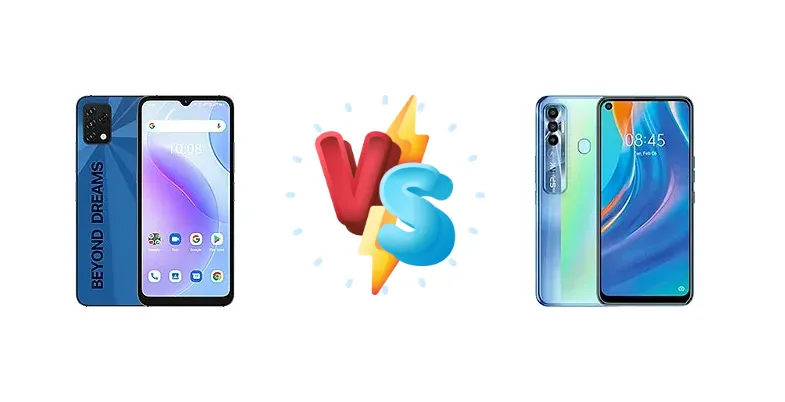
The sub-$150 smartphone market is fiercely competitive. Both the Umidigi A11S and Tecno Spark 7 Pro aim to deliver essential smartphone functionality at an accessible price point. However, they take different approaches to achieving this, primarily through their chipset choices. This comparison dissects those differences and helps you determine which device best suits your needs.
🏆 Quick Verdict
For the average user prioritizing responsiveness and multitasking, the Tecno Spark 7 Pro is the better choice. Its MediaTek Helio G80 chipset, with its octa-core configuration, provides a noticeable performance advantage over the Umidigi A11S’s Unisoc Tiger T310. While the A11S offers a functional experience, the Spark 7 Pro delivers a smoother, more capable one.
| Network |
|---|
| 2G bands | GSM 850 / 900 / 1800 / 1900 | GSM 850 / 900 / 1800 / 1900 |
| 3G bands | HSDPA 800 / 850 / 900 / 1700(AWS) / 1900 / 2100 | HSDPA 850 / 900 / 2100 |
| 4G bands | 1, 2, 3, 4, 5, 7, 8, 12, 13, 17, 18, 19, 20, 26, 28, 34, 38, 39, 40, 41, 66 | LTE |
| Speed | HSPA, LTE | HSPA 42.2/5.76 Mbps, LTE Cat4 150/50 Mbps |
| Technology | GSM / HSPA / LTE | GSM / HSPA / LTE |
| Launch |
|---|
| Announced | 2021. Released 2021 | 2021, April 27 |
| Status | Discontinued | Available. Released 2021, May 28 |
| Body |
|---|
| Build | - | Glass front, plastic frame, plastic back |
| Dimensions | 162.2 x 75 x 9.2 mm (6.39 x 2.95 x 0.36 in) | 164.9 x 76.2 x 8.8 mm (6.49 x 3.00 x 0.35 in) |
| SIM | Nano-SIM + Nano-SIM | Nano-SIM + Nano-SIM |
| Weight | 225 g (7.94 oz) | - |
| Display |
|---|
| Resolution | 720 x 1600 pixels, 20:9 ratio (~269 ppi density) | 720 x 1600 pixels, 20:9 ratio (~266 ppi density) |
| Size | 6.53 inches, 102.9 cm2 (~84.6% screen-to-body ratio) | 6.6 inches, 105.2 cm2 (~83.7% screen-to-body ratio) |
| Type | IPS LCD | IPS LCD, 90Hz |
| Platform |
|---|
| CPU | Quad-core (1x2.0 GHz Cortex-A75 & 3x1.8 GHz Cortex-A55) | Octa-core (2x2.0 GHz Cortex-A75 & 6x1.8 GHz Cortex-A55) |
| Chipset | Unisoc Tiger T310 (12nm) | Mediatek MT6769V/CU Helio G80 (12 nm) |
| GPU | PowerVR GE8300 | Mali-G52 MC2 |
| OS | Android 11 | Android 11, HIOS 7.5 |
| Memory |
|---|
| Card slot | microSDXC (dedicated slot) | microSDXC |
| Internal | 32GB 4GB RAM, 64GB 4GB RAM | 64GB 4GB RAM, 64GB 6GB RAM, 128GB 4GB RAM |
| | - | eMMC 5.1 |
| Main Camera |
|---|
| Features | Dual-LED flash, HDR, panorama | Quad-LED flash |
| Single | - | 8 MP |
| Triple | 16 MP, f/2.0, (wide), AF
8 MP, 120˚ (ultrawide)
5 MP (macro) | 48 MP, PDAF
Secondary unknown camera
Third unknown camera |
| Video | 1080p@30fps | 1080p@30fps |
| Selfie camera |
|---|
| Features | - | Dual-LED flash |
| Single | 8 MP, f/2.2, (wide) | 8 MP |
| Video | 1080p@30fps | 1080p@30fps |
| Sound |
|---|
| 3.5mm jack | - | Yes |
| 35mm jack | Yes | Yes |
| Loudspeaker | Yes | Yes |
| Comms |
|---|
| Bluetooth | 5.0, A2DP, LE | Yes |
| NFC | No | No |
| Positioning | GPS, GLONASS, GALILEO | GPS |
| Radio | No | FM radio |
| USB | USB Type-C, OTG | microUSB 2.0, OTG |
| WLAN | Wi-Fi 802.11 a/b/g/n/ac, dual-band, Wi-Fi Direct | Wi-Fi 802.11 b/g/n |
| Features |
|---|
| Sensors | Accelerometer, proximity, compass | Fingerprint (rear-mounted), accelerometer, proximity |
| Battery |
|---|
| Charging | 10W wired | - |
| Type | 5150 mAh | 5000 mAh |
| Misc |
|---|
| Colors | Mist Blue, Frost Grey | Alps Blue, Spruce Green, Neon Dream, Magnet Black |
Umidigi A11S
- Potentially slightly better battery life in very light use.
- Lower price point (likely).
- Functional for basic smartphone tasks.
- Significantly weaker performance compared to the Spark 7 Pro.
- Less responsive user experience.
- Likely inferior camera performance.
Tecno Spark 7 Pro
- Superior performance thanks to the Helio G80 chipset.
- Smoother multitasking and gaming experience.
- Potentially better camera image quality.
- May be slightly more expensive.
- 10W charging is slow on both devices.
- Still a budget device with inherent limitations.
Display Comparison
Neither device boasts a standout display. Both are likely utilizing LCD panels, common in this price bracket. The focus here isn't on visual fidelity, but functionality. Without specific display specs, it's reasonable to assume similar resolutions and brightness levels. The real differentiator will be software optimizations for color accuracy, which are difficult to assess without direct testing. Bezels are likely to be substantial on both devices, reflecting their budget nature.
Camera Comparison
Without detailed camera specifications, a direct comparison is challenging. However, the chipset plays a role. The Helio G80 in the Spark 7 Pro generally supports more advanced image signal processing (ISP) capabilities, potentially leading to better image quality, especially in low-light conditions. It's likely the Spark 7 Pro will offer more refined image processing algorithms. The presence of a dedicated ISP within the Helio G80 allows for faster image capture and processing. The A11S will likely rely more heavily on software processing, which can introduce artifacts and slower capture times. We can assume both devices will include a standard macro lens, but its utility will be limited by the sensor quality.
Performance
The core difference lies in the chipsets. The Tecno Spark 7 Pro’s MediaTek Helio G80 is a significant step up from the Umidigi A11S’s Unisoc Tiger T310. The Helio G80’s octa-core CPU (2x2.0 GHz Cortex-A75 & 6x1.8 GHz Cortex-A55) provides more processing power and efficiency compared to the A11S’s quad-core setup (1x2.0 GHz Cortex-A75 & 3x1.8 GHz Cortex-A55). This translates to faster app loading times, smoother multitasking, and a better gaming experience. While both are built on a 12nm process, the architectural advantages of the Helio G80 are clear. Users who play mobile games or frequently switch between apps will greatly benefit from the Spark 7 Pro.
Battery Life
Both devices likely feature similar battery capacities, typical for this price range (around 5000mAh is common). The difference will come down to power efficiency. The Helio G80, while more powerful, is also reasonably efficient. However, the A11S’s less demanding chipset *could* translate to slightly longer battery life in very light usage scenarios. Both devices are limited to 10W charging, meaning a full charge will take a considerable amount of time – likely over 3 hours. The impact of the chipset on battery drain during active use will be more significant than the charging speed difference.
Buying Guide
Buy the Umidigi A11S if you need a basic smartphone for essential tasks like calls, messaging, and light social media use, and are prioritizing absolute minimum cost. Buy the Tecno Spark 7 Pro if you prefer a more responsive experience for multitasking, occasional gaming, and a slightly more refined camera system, even if it means spending a bit more.
Frequently Asked Questions
❓ Will the Tecno Spark 7 Pro handle popular games like PUBG Mobile or Call of Duty?
The Helio G80 is capable of running PUBG Mobile and Call of Duty, but you'll likely need to use lower graphics settings to maintain a stable frame rate. Don't expect a flagship-level gaming experience, but it's playable. The Umidigi A11S will struggle with these titles, offering a significantly less enjoyable experience.
❓ Is the 10W charging on either phone a major drawback?
Yes, 10W charging is quite slow by today's standards. Expect a full charge to take over 3 hours. Neither phone offers fast charging capabilities. This is a compromise you have to make at this price point, and it's a shared limitation for both devices.
❓ How much storage does each phone typically offer, and can it be expanded?
While not specified, both phones likely come with 32GB or 64GB of internal storage. Crucially, both devices almost certainly support microSD card expansion, allowing you to add more storage for photos, videos, and apps. This is essential given the limited base storage.
❓ Which phone is better for someone who primarily uses WhatsApp and Facebook?
The Tecno Spark 7 Pro is the better choice, even for basic social media use. The smoother performance of the Helio G80 will make scrolling through Facebook and using WhatsApp a more responsive and enjoyable experience. The A11S will function, but may exhibit noticeable lag.