
Umidigi A11S vs Samsung Galaxy A12 (India): A Deep Dive into Budget Smartphone Performance
| Phones Images | |||||
|---|---|---|---|---|---|
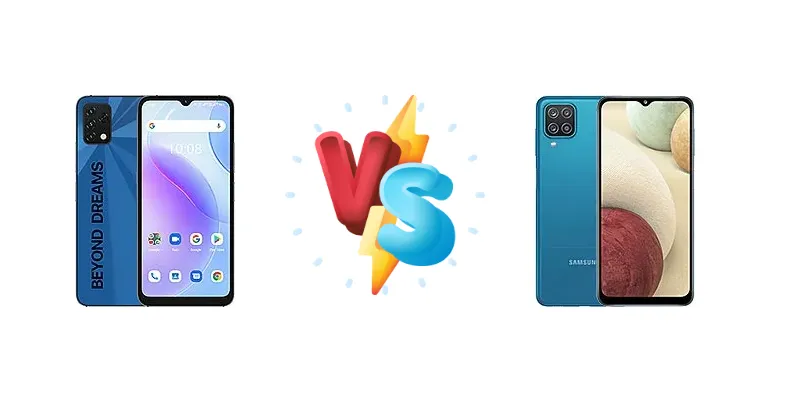
|
🏆 Quick Verdict
For most users, the Samsung Galaxy A12 (India) emerges as the better choice. Its Exynos 850 chipset, built on an 8nm process, provides a significant performance advantage over the Umidigi A11S’s 12nm Unisoc Tiger T310, translating to smoother multitasking and a more responsive user experience. While the A11S is cheaper, the A12’s superior processing power justifies the price difference.
| PHONES | ||
|---|---|---|
| Phone Names | Umidigi A11S | Samsung Galaxy A12 (India) |
| Network | ||
|---|---|---|
| 2G bands | GSM 850 / 900 / 1800 / 1900 | GSM 850 / 900 / 1800 / 1900 |
| 3G bands | HSDPA 800 / 850 / 900 / 1700(AWS) / 1900 / 2100 | HSDPA 850 / 900 / 2100 |
| 4G bands | 1, 2, 3, 4, 5, 7, 8, 12, 13, 17, 18, 19, 20, 26, 28, 34, 38, 39, 40, 41, 66 | 1, 3, 5, 7, 8, 20, 28, 38, 40, 41 |
| Speed | HSPA, LTE | HSPA 42.2/5.76 Mbps, LTE Cat4 150/50 Mbps |
| Technology | GSM / HSPA / LTE | GSM / HSPA / LTE |
| Launch | ||
|---|---|---|
| Announced | 2021. Released 2021 | 2021, August 12 |
| Status | Discontinued | Available. Released 2021, August 12 |
| Body | ||
|---|---|---|
| Build | - | Glass front, plastic back, plastic frame |
| Dimensions | 162.2 x 75 x 9.2 mm (6.39 x 2.95 x 0.36 in) | 164 x 75.8 x 8.9 mm (6.46 x 2.98 x 0.35 in) |
| SIM | Nano-SIM + Nano-SIM | · Nano-SIM· Nano-SIM + Nano-SIM |
| Weight | 225 g (7.94 oz) | 205 g (7.23 oz) |
| Display | ||
|---|---|---|
| Resolution | 720 x 1600 pixels, 20:9 ratio (~269 ppi density) | 720 x 1600 pixels, 20:9 ratio (~270 ppi density) |
| Size | 6.53 inches, 102.9 cm2 (~84.6% screen-to-body ratio) | 6.5 inches, 102.0 cm2 (~82.1% screen-to-body ratio) |
| Type | IPS LCD | PLS LCD |
| Platform | ||
|---|---|---|
| CPU | Quad-core (1x2.0 GHz Cortex-A75 & 3x1.8 GHz Cortex-A55) | Octa-core (4x2.0 GHz Cortex-A55 & 4x2.0 GHz Cortex-A55) |
| Chipset | Unisoc Tiger T310 (12nm) | Exynos 850 (8 nm) |
| GPU | PowerVR GE8300 | Mali-G52 |
| OS | Android 11 | Android 11, upgradable to Android 13, One UI 5.1 |
| Memory | ||
|---|---|---|
| Card slot | microSDXC (dedicated slot) | microSDXC (dedicated slot) |
| Internal | 32GB 4GB RAM, 64GB 4GB RAM | 64GB 4GB RAM, 128GB 4GB RAM, 128GB 6GB RAM |
| - | eMMC 5.1 | |
| Main Camera | ||
|---|---|---|
| Features | Dual-LED flash, HDR, panorama | LED flash, panorama, HDR |
| Quad | - | 48 MP, f/2.0, 26mm (wide), AF 5 MP, f/2.2, 123˚ (ultrawide) 2 MP (macro) Auxiliary lens |
| Triple | 16 MP, f/2.0, (wide), AF 8 MP, 120˚ (ultrawide) 5 MP (macro) | - |
| Video | 1080p@30fps | 1080p@30fps |
| Selfie camera | ||
|---|---|---|
| Single | 8 MP, f/2.2, (wide) | 8 MP, f/2.2 |
| Video | 1080p@30fps | 1080p@30fps |
| Sound | ||
|---|---|---|
| 3.5mm jack | - | Yes |
| 35mm jack | Yes | Yes |
| Loudspeaker | Yes | Yes |
| Comms | ||
|---|---|---|
| Bluetooth | 5.0, A2DP, LE | 5.0, A2DP, LE |
| NFC | No | No |
| Positioning | GPS, GLONASS, GALILEO | GPS, GLONASS, GALILEO, BDS |
| Radio | No | FM radio, RDS, recording |
| USB | USB Type-C, OTG | USB Type-C 2.0 |
| WLAN | Wi-Fi 802.11 a/b/g/n/ac, dual-band, Wi-Fi Direct | Wi-Fi 802.11 b/g/n, Wi-Fi Direct |
| Features | ||
|---|---|---|
| Sensors | Accelerometer, proximity, compass | Fingerprint (side-mounted), accelerometer |
| - | Virtual proximity sensing | |
| Battery | ||
|---|---|---|
| Charging | 10W wired | 15W wired |
| Type | 5150 mAh | Li-Po 5000 mAh |
| Misc | ||
|---|---|---|
| Colors | Mist Blue, Frost Grey | Black, Blue, White |
| Models | - | SM-A127F, SM-A127F/DS |
| Price | - | About 160 EUR |
| SAR | - | 0.79 W/kg (head) |
Umidigi A11S
- Lower price point makes it highly accessible.
- Potentially longer standby time due to less powerful chipset.
- Simple and straightforward Android experience.
- Unisoc Tiger T310 chipset offers significantly lower performance.
- 12nm process is less efficient, potentially leading to more heat.
- Slower 10W charging.
Samsung Galaxy A12 (India)
- Exynos 850 chipset delivers superior performance.
- 8nm process offers better power efficiency and thermal management.
- Faster 15W charging reduces downtime.
- Slightly higher price compared to the Umidigi A11S.
- May experience faster battery drain during intensive use.
- Samsung’s software can include bloatware.
Display Comparison
Neither device boasts a standout display. Both likely utilize LCD panels, a common cost-saving measure in this segment. However, the lack of detailed display specs (resolution, brightness) necessitates focusing on the chipset’s ability to drive the UI smoothly. The A12’s more powerful GPU, stemming from the Exynos 850, will likely result in slightly smoother animations and transitions, even if the panel itself is similar in quality. Bezels are expected to be substantial on both devices, typical for this price point.
Camera Comparison
Camera performance is likely to be similar, with both devices relying on budget sensors. Without specific sensor details, it’s difficult to make a definitive judgment. However, Samsung’s image processing algorithms are generally more refined, potentially leading to more pleasing results in various lighting conditions. The presence of a 2MP macro camera on both devices is largely a marketing gimmick; image quality will be limited. Focusing on the main sensor’s capabilities (which are unknown) and Samsung’s software optimization is key.
Performance
The core difference lies in the chipsets. The Samsung Galaxy A12’s Exynos 850, fabricated on an 8nm process, is a clear winner over the Umidigi A11S’s Unisoc Tiger T310 (12nm). The 8nm process allows for greater transistor density and improved power efficiency, leading to better sustained performance and less heat generation. While both are octa-core, the A12’s architecture – four Cortex-A55 cores at 2.0 GHz – is more efficient than the A11S’s mix of one Cortex-A75 and three Cortex-A55 cores. The A75 offers a performance boost, but the A12’s consistent A55 cluster provides a more balanced experience. This translates to faster app loading times and smoother multitasking on the A12.
Battery Life
Battery life will depend heavily on usage patterns. While the A12 offers 15W charging compared to the A11S’s 10W, the Exynos 850’s greater power consumption could offset this advantage. The 8nm process helps mitigate this, but demanding tasks will drain the A12’s battery faster. The A11S, with its less powerful chipset, will likely offer longer standby times and potentially better battery life for light users. The faster charging on the A12 will, however, reduce downtime for those who frequently need to top up.
Buying Guide
Buy the Umidigi A11S if you prioritize absolute affordability and are willing to compromise on performance for basic tasks like calls, messaging, and light social media use. Buy the Samsung Galaxy A12 (India) if you value a smoother, more responsive experience, especially when multitasking or using demanding apps, and appreciate the brand recognition and support of Samsung.