
Umidigi A11S vs Realme C25s: A Detailed Comparison for Budget Shoppers
| Phones Images | |||||
|---|---|---|---|---|---|
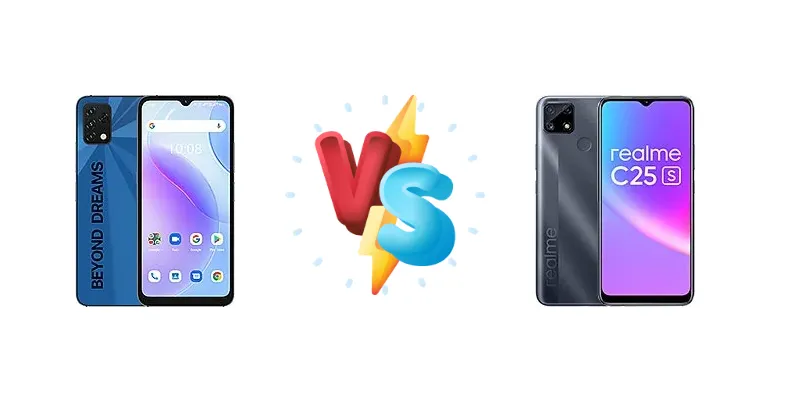
|
🏆 Quick Verdict
For the average user prioritizing basic tasks and battery life, the Umidigi A11S offers a solid experience. However, the Realme C25s, with its more powerful Helio G85 chipset and faster 18W charging, is the clear winner for users who demand better performance for gaming or multitasking, justifying a slight price premium.
| PHONES | ||
|---|---|---|
| Phone Names | Umidigi A11S | Realme C25s |
| Network | ||
|---|---|---|
| 2G bands | GSM 850 / 900 / 1800 / 1900 | GSM 850 / 900 / 1800 / 1900 |
| 3G bands | HSDPA 800 / 850 / 900 / 1700(AWS) / 1900 / 2100 | HSDPA 850 / 900 / 2100 |
| 4G bands | 1, 2, 3, 4, 5, 7, 8, 12, 13, 17, 18, 19, 20, 26, 28, 34, 38, 39, 40, 41, 66 | 1, 3, 5, 7, 8, 20, 28, 38, 40, 41 |
| Speed | HSPA, LTE | HSPA, LTE |
| Technology | GSM / HSPA / LTE | GSM / HSPA / LTE |
| Launch | ||
|---|---|---|
| Announced | 2021. Released 2021 | 2021, June 08 |
| Status | Discontinued | Available. Released 2021, June 09 |
| Body | ||
|---|---|---|
| Build | - | Glass front, plastic back, plastic frame |
| Dimensions | 162.2 x 75 x 9.2 mm (6.39 x 2.95 x 0.36 in) | 164.5 x 75.9 x 9.6 mm (6.48 x 2.99 x 0.38 in) |
| SIM | Nano-SIM + Nano-SIM | Nano-SIM + Nano-SIM |
| Weight | 225 g (7.94 oz) | 209 g (7.37 oz) |
| Display | ||
|---|---|---|
| Resolution | 720 x 1600 pixels, 20:9 ratio (~269 ppi density) | 720 x 1600 pixels, 20:9 ratio (~270 ppi density) |
| Size | 6.53 inches, 102.9 cm2 (~84.6% screen-to-body ratio) | 6.5 inches, 102.0 cm2 (~81.7% screen-to-body ratio) |
| Type | IPS LCD | IPS LCD, 480 nits (typ), 570 nits (peak) |
| Platform | ||
|---|---|---|
| CPU | Quad-core (1x2.0 GHz Cortex-A75 & 3x1.8 GHz Cortex-A55) | Octa-core (2x2.0 GHz Cortex-A75 & 6x1.8 GHz Cortex-A55) |
| Chipset | Unisoc Tiger T310 (12nm) | Mediatek MT6769Z Helio G85 (12 nm) |
| GPU | PowerVR GE8300 | Mali-G52 MC2 |
| OS | Android 11 | Android 11, Realme UI 2.0 |
| Memory | ||
|---|---|---|
| Card slot | microSDXC (dedicated slot) | microSDXC (dedicated slot) |
| Internal | 32GB 4GB RAM, 64GB 4GB RAM | 64GB 4GB RAM, 128GB 4GB RAM |
| - | eMMC 5.1 | |
| Main Camera | ||
|---|---|---|
| Features | Dual-LED flash, HDR, panorama | LED flash, HDR, panorama |
| Single | - | 8 MP, f/2.0, 26mm (wide), 1/4.0", 1.12µm |
| Triple | 16 MP, f/2.0, (wide), AF 8 MP, 120˚ (ultrawide) 5 MP (macro) | 48 MP, f/1.8, 26mm (wide), PDAF (International model) or 13 MP, f/2.2, 26mm (wide), 1/3.06", 1.12µm, PDAF (India model) 2 MP (macro) Auxiliary lens |
| Video | 1080p@30fps | 1080p@30/60fps |
| Selfie camera | ||
|---|---|---|
| Features | - | HDR, panorama |
| Single | 8 MP, f/2.2, (wide) | 8 MP, f/2.0, 26mm (wide), 1/4.0", 1.12µm |
| Video | 1080p@30fps | 1080p@30fps |
| Sound | ||
|---|---|---|
| 3.5mm jack | - | Yes |
| 35mm jack | Yes | Yes |
| Loudspeaker | Yes | Yes |
| Comms | ||
|---|---|---|
| Bluetooth | 5.0, A2DP, LE | 5.0, A2DP, LE |
| NFC | No | No |
| Positioning | GPS, GLONASS, GALILEO | GPS, GLONASS, BDS |
| Radio | No | Unspecified |
| USB | USB Type-C, OTG | USB Type-C 2.0, OTG |
| WLAN | Wi-Fi 802.11 a/b/g/n/ac, dual-band, Wi-Fi Direct | Wi-Fi 802.11 a/b/g/n/ac, dual-band, Wi-Fi Direct |
| Features | ||
|---|---|---|
| Sensors | Accelerometer, proximity, compass | Fingerprint (rear-mounted), accelerometer, proximity, compass |
| Battery | ||
|---|---|---|
| Charging | 10W wired | 18W wired 5W reverse wired |
| Type | 5150 mAh | 6000 mAh |
| Misc | ||
|---|---|---|
| Colors | Mist Blue, Frost Grey | Water Blue, Water Gray |
| Models | - | RMX3195, RMX3197 |
| Price | - | About 180 EUR |
Umidigi A11S
- Potentially longer battery life due to less powerful chipset.
- Lower price point (likely).
- Reliable for basic smartphone tasks.
- Significantly slower performance compared to the Realme C25s.
- Slower 10W charging.
- Less capable for gaming and multitasking.
Realme C25s
- Faster and more responsive performance with the Helio G85.
- 18W fast charging with 5W reverse charging.
- Better gaming capabilities.
- Potentially shorter battery life under heavy use.
- Slightly higher price point.
- May experience more thermal throttling during extended gaming sessions.
Display Comparison
Neither device boasts a standout display. Both likely utilize LCD panels, common in this price bracket. Specifics like resolution and peak brightness are not provided, but we can assume they are similar, targeting 720p+ resolution. The focus here isn't on visual fidelity, but on functional usability. Bezels are likely to be noticeable on both, prioritizing cost reduction over an immersive viewing experience.
Camera Comparison
Without detailed camera specs, a direct comparison is difficult. Both phones likely feature a primary camera alongside auxiliary lenses (potentially a depth or macro sensor). However, the image signal processor (ISP) within the Helio G85 offers more advanced image processing capabilities, potentially resulting in better dynamic range and noise reduction in the Realme C25s. The Umidigi A11S will likely rely on software optimizations to compensate, but will be limited by the processing power of the T310. We can expect similar performance in good lighting conditions, but the C25s should excel in low-light scenarios.
Performance
The core difference lies in the chipsets. The Realme C25s’ MediaTek Helio G85 is a significant step up from the Umidigi A11S’ Unisoc Tiger T310. The G85’s octa-core configuration (2x2.0 GHz Cortex-A75 & 6x1.8 GHz Cortex-A55) provides more processing headroom than the A11S’ quad-core (1x2.0 GHz Cortex-A75 & 3x1.8 GHz Cortex-A55). While both utilize the same Cortex-A75 and A55 core designs, the doubling of the A75 cores and addition of more A55 cores in the G85 translates to noticeably faster app loading times and smoother multitasking. The G85 also benefits from a more capable GPU, making it the better choice for casual gaming. The 12nm process node is shared, so thermal efficiency differences will be minimal, but the G85 will still likely throttle less under sustained load.
Battery Life
Battery capacity isn't specified for either device, but both likely fall in the 5000mAh range, typical for this segment. The Realme C25s’ 18W charging is a clear advantage over the Umidigi A11S’ 10W charging. This translates to significantly faster top-up times – potentially reducing a full charge from over 3 hours to around 2 hours. The C25s also offers 5W reverse wired charging, a useful feature for topping up accessories like wireless earbuds, which the A11S lacks. While the A11S might offer slightly longer screen-on time due to the less powerful chipset, the convenience of faster charging on the C25s is a compelling benefit.
Buying Guide
Buy the Umidigi A11S if you need a dependable device for calls, messaging, social media, and light web browsing, and value a longer-lasting battery over raw processing power. Buy the Realme C25s if you prefer a smoother experience with more demanding apps, enjoy mobile gaming, and appreciate the convenience of faster charging – even if it means slightly reduced battery longevity during intensive use.