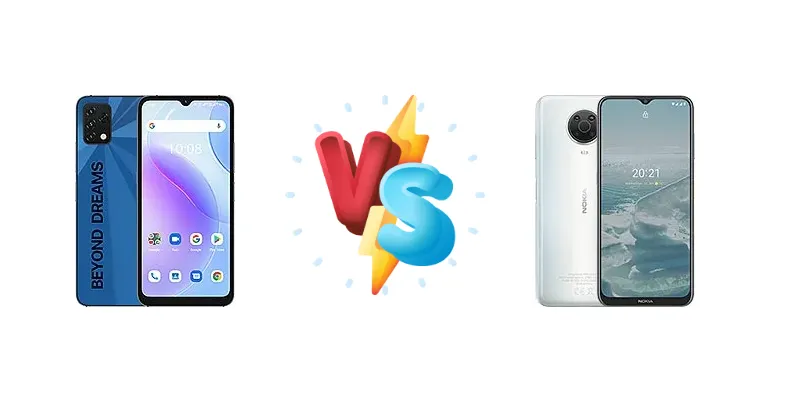
The Umidigi A11S and Nokia G20 represent the fiercely competitive sub-$150 Android smartphone market. Both aim to deliver essential functionality at an accessible price, but they take different approaches to achieving this. The A11S leverages Unisoc’s Tiger T310, while the G20 opts for MediaTek’s Helio G35. This comparison dissects these choices, revealing which phone offers the best balance of performance, efficiency, and usability.
🏆 Quick Verdict
For the average user prioritizing responsiveness in everyday tasks, the Umidigi A11S emerges as the better choice. Its Cortex-A75 core within the Unisoc T310 provides a noticeable performance edge over the all-Cortex-A53 configuration of the Nokia G20, despite the latter having more cores. While both offer similar battery and charging capabilities, the A11S’s CPU architecture translates to a smoother user experience.
| Network |
|---|
| 2G bands | GSM 850 / 900 / 1800 / 1900 | GSM 850 / 900 / 1800 / 1900 |
| 3G bands | HSDPA 800 / 850 / 900 / 1700(AWS) / 1900 / 2100 | HSDPA 850 / 900 / 1900 / 2100 - International |
| 4G bands | 1, 2, 3, 4, 5, 7, 8, 12, 13, 17, 18, 19, 20, 26, 28, 34, 38, 39, 40, 41, 66 | 1, 3, 5, 7, 8, 20, 28, 38, 40, 41 - International |
| Speed | HSPA, LTE | HSPA 42.2/5.76 Mbps, LTE Cat4 150/50 Mbps |
| Technology | GSM / HSPA / LTE | GSM / HSPA / LTE |
| | - | 1, 2, 3, 4, 5, 7, 8, 12, 17, 28, 66 - LATAM |
| Launch |
|---|
| Announced | 2021. Released 2021 | 2021, April 08 |
| Status | Discontinued | Available. Released 2021, May 17 |
| Body |
|---|
| Dimensions | 162.2 x 75 x 9.2 mm (6.39 x 2.95 x 0.36 in) | 164.9 x 76 x 9.2 mm (6.49 x 2.99 x 0.36 in) |
| SIM | Nano-SIM + Nano-SIM | · Nano-SIM· Nano-SIM + Nano-SIM |
| Weight | 225 g (7.94 oz) | 197 g (6.95 oz) |
| | - | Splash protection |
| Display |
|---|
| Resolution | 720 x 1600 pixels, 20:9 ratio (~269 ppi density) | 720 x 1600 pixels, 20:9 ratio (~269 ppi density) |
| Size | 6.53 inches, 102.9 cm2 (~84.6% screen-to-body ratio) | 6.52 inches, 102.6 cm2 (~81.9% screen-to-body ratio) |
| Type | IPS LCD | IPS LCD |
| Platform |
|---|
| CPU | Quad-core (1x2.0 GHz Cortex-A75 & 3x1.8 GHz Cortex-A55) | Octa-core (4x2.3 GHz Cortex-A53 & 4x1.8 GHz Cortex-A53) |
| Chipset | Unisoc Tiger T310 (12nm) | Mediatek MT6765G Helio G35 (12 nm) |
| GPU | PowerVR GE8300 | PowerVR GE8320 |
| OS | Android 11 | Android 11, upgradable to Android 13 |
| Memory |
|---|
| Card slot | microSDXC (dedicated slot) | microSDXC (dedicated slot) |
| Internal | 32GB 4GB RAM, 64GB 4GB RAM | 64GB 4GB RAM, 128GB 4GB RAM |
| Main Camera |
|---|
| Features | Dual-LED flash, HDR, panorama | LED flash, HDR, panorama |
| Quad | - | 48 MP, f/1.8, (wide), PDAF
5 MP, (ultrawide)
2 MP (macro)
Auxiliary lens |
| Single | - | 8 MP, (wide) |
| Triple | 16 MP, f/2.0, (wide), AF
8 MP, 120˚ (ultrawide)
5 MP (macro) | - |
| Video | 1080p@30fps | 1080p@30fps |
| Selfie camera |
|---|
| Single | 8 MP, f/2.2, (wide) | 8 MP, (wide) |
| Video | 1080p@30fps | 1080p@30fps |
| Sound |
|---|
| 3.5mm jack | - | Yes |
| 35mm jack | Yes | Yes |
| Loudspeaker | Yes | Yes |
| Comms |
|---|
| Bluetooth | 5.0, A2DP, LE | 5.0, A2DP, LE |
| NFC | No | Yes (market/region dependent) |
| Positioning | GPS, GLONASS, GALILEO | GPS, GLONASS, BDS |
| Radio | No | FM radio |
| USB | USB Type-C, OTG | USB Type-C 2.0, OTG |
| WLAN | Wi-Fi 802.11 a/b/g/n/ac, dual-band, Wi-Fi Direct | Wi-Fi 802.11 b/g/n |
| Features |
|---|
| Sensors | Accelerometer, proximity, compass | Fingerprint (side-mounted), accelerometer, gyro, proximity |
| Battery |
|---|
| Charging | 10W wired | 10W wired |
| Type | 5150 mAh | Li-Po 5050 mAh |
| Misc |
|---|
| Colors | Mist Blue, Frost Grey | Glacier, Night |
| Models | - | TA-1336, TA-1343, TA-1347, TA-1372, TA-1365 |
| Price | - | About 90 EUR |
| SAR | - | 1.01 W/kg (head) 1.02 W/kg (body) |
| SAR EU | - | 0.49 W/kg (head) 1.13 W/kg (body) |
Umidigi A11S
- More responsive CPU due to Cortex-A75 core
- Potentially better power efficiency
- Likely lower price point
- Less established brand reputation
- Software update support may be limited
Nokia G20
- Stronger brand reputation and software support from Nokia
- Potentially wider carrier compatibility
- Octa-core CPU may appeal to some users
- Slower CPU performance in real-world tasks
- Less efficient CPU architecture
- May be slightly more expensive
Display Comparison
Neither device boasts a standout display. Both likely utilize LCD panels, common in this price bracket. Without specific brightness data, it’s reasonable to assume both offer adequate visibility indoors, but struggle in direct sunlight. The focus here isn’t on visual fidelity, but rather on basic functionality. Bezels are likely to be substantial on both, maximizing screen real estate within a budget-friendly form factor. Color accuracy is unlikely to be a priority, with both likely targeting the sRGB color space with limited coverage.
Camera Comparison
Camera performance is likely to be similar, and largely dependent on software processing. Both phones will likely feature a primary camera alongside basic auxiliary lenses (potentially a depth or macro sensor). Without specific sensor size or aperture information, it’s difficult to make definitive claims. However, the image signal processor (ISP) within the Unisoc T310 and Helio G35 are similarly positioned, suggesting comparable image quality in good lighting conditions. Low-light performance will likely be a weak point for both. The inclusion of a 2MP macro camera on either device is largely a marketing tactic, offering limited practical benefit due to the low resolution and lack of autofocus.
Performance
The core difference lies in the chipset architecture. The Umidigi A11S’s Unisoc Tiger T310 features a quad-core configuration with a single high-performance 2.0 GHz Cortex-A75 core and three efficiency-focused 1.8 GHz Cortex-A55 cores. This 'big.LITTLE' approach allows for bursts of speed when needed, while conserving power during less demanding tasks. Conversely, the Nokia G20’s MediaTek Helio G35 utilizes an octa-core setup comprised entirely of lower-tier 2.3 GHz Cortex-A53 cores. While more numerous, these cores are less individually powerful than the A75. This translates to a more consistent, but ultimately slower, performance profile. The A11S will likely exhibit smoother app launches and faster web browsing. The G35’s higher clock speed doesn’t compensate for the architectural disadvantage.
Battery Life
Both the Umidigi A11S and Nokia G20 feature 10W wired charging, indicating similar charging speeds. A full 0-100% charge will likely take around 2.5 to 3 hours. Battery capacity is not specified, but given the target price point, both likely house batteries in the 4000-5000 mAh range. The Unisoc T310’s efficiency gains, particularly with its Cortex-A55 cores, *could* translate to slightly longer battery life in mixed usage scenarios, but the difference is unlikely to be substantial. Both phones are designed for all-day battery life with moderate use.
Buying Guide
Buy the Umidigi A11S if you need a phone that feels responsive during daily use, such as browsing, social media, and light app multitasking. Its single high-performance core makes a tangible difference. Buy the Nokia G20 if you prioritize a brand with a strong software update commitment and potentially wider carrier compatibility, and are willing to trade some performance for that assurance. The G20’s octa-core setup *appears* more powerful on paper, but its weaker core architecture limits its real-world impact.
Frequently Asked Questions
❓ Will the Unisoc Tiger T310 in the Umidigi A11S struggle with demanding games like PUBG Mobile?
While the T310 isn't a gaming powerhouse, it can handle PUBG Mobile at low to medium settings with acceptable frame rates. Expect some stuttering and frame drops during intense action. The Helio G35 in the Nokia G20 will likely offer a similar, if not slightly worse, gaming experience due to its less powerful CPU architecture.
❓ How reliable is software support for the Umidigi A11S compared to the Nokia G20?
Nokia is known for providing relatively consistent software updates, including security patches, even for its budget devices. Umidigi’s software support is less predictable. While they may offer updates, they are typically less frequent and may not be as comprehensive as Nokia’s. If long-term software support is a priority, the Nokia G20 is the safer bet.
❓ Does the Nokia G20's octa-core processor actually make it faster than the Umidigi A11S?
Not necessarily. While the Nokia G20 has more cores, the Umidigi A11S's single Cortex-A75 core is significantly more powerful than each of the G20's Cortex-A53 cores. This means the A11S will generally feel more responsive in everyday tasks, despite having fewer cores overall.