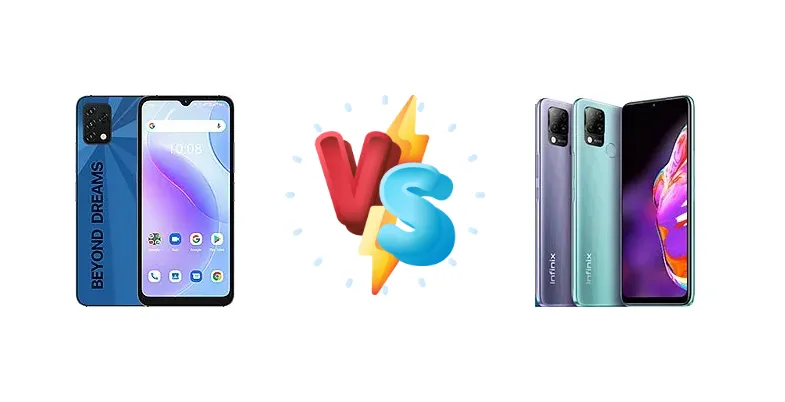
The sub-$200 smartphone market is fiercely competitive, and the Umidigi A11S and Infinix Hot 10s NFC represent compelling options for users prioritizing affordability. While both aim to deliver essential smartphone functionality, they diverge significantly in their core processing power, impacting everything from gaming to multitasking. This comparison dissects these differences to determine which device offers the best value.
🏆 Quick Verdict
For the average user, the Infinix Hot 10s NFC is the stronger choice. Its MediaTek Helio G85 chipset, featuring an octa-core CPU, provides a noticeable performance advantage over the Umidigi A11S’s Unisoc Tiger T310. While both offer similar battery capacities, the Hot 10s NFC’s faster processing makes it more capable for demanding tasks.
| Network |
|---|
| 2G bands | GSM 850 / 900 / 1800 / 1900 | GSM 850 / 900 / 1800 / 1900 |
| 3G bands | HSDPA 800 / 850 / 900 / 1700(AWS) / 1900 / 2100 | HSDPA 850 / 900 / 2100 |
| 4G bands | 1, 2, 3, 4, 5, 7, 8, 12, 13, 17, 18, 19, 20, 26, 28, 34, 38, 39, 40, 41, 66 | 1, 3, 5, 8, 38, 40, 41 |
| Speed | HSPA, LTE | HSPA 42.2/5.76 Mbps, LTE Cat4 150/50 Mbps |
| Technology | GSM / HSPA / LTE | GSM / HSPA / LTE |
| Launch |
|---|
| Announced | 2021. Released 2021 | 2021, April 21 |
| Status | Discontinued | Available. Released 2021, May 12 |
| Body |
|---|
| Build | - | Glass front, plastic back, plastic frame |
| Dimensions | 162.2 x 75 x 9.2 mm (6.39 x 2.95 x 0.36 in) | 171.5 x 77.5 x 9.2 mm (6.75 x 3.05 x 0.36 in) |
| SIM | Nano-SIM + Nano-SIM | Nano-SIM + Nano-SIM |
| Weight | 225 g (7.94 oz) | - |
| Display |
|---|
| Resolution | 720 x 1600 pixels, 20:9 ratio (~269 ppi density) | 720 x 1640 pixels (~263 ppi density) |
| Size | 6.53 inches, 102.9 cm2 (~84.6% screen-to-body ratio) | 6.82 inches, 110.5 cm2 (~83.1% screen-to-body ratio) |
| Type | IPS LCD | IPS LCD, 90Hz |
| Platform |
|---|
| CPU | Quad-core (1x2.0 GHz Cortex-A75 & 3x1.8 GHz Cortex-A55) | Octa-core (2x2.0 GHz Cortex-A75 & 6x1.8 GHz Cortex-A55) |
| Chipset | Unisoc Tiger T310 (12nm) | Mediatek MT6769Z Helio G85 (12 nm) |
| GPU | PowerVR GE8300 | Mali-G52 MC2 |
| OS | Android 11 | Android 11, XOS 7.6 |
| Memory |
|---|
| Card slot | microSDXC (dedicated slot) | microSDXC (dedicated slot) |
| Internal | 32GB 4GB RAM, 64GB 4GB RAM | 64GB 4GB RAM, 128GB 4GB RAM |
| | - | eMMC 5.1 |
| Main Camera |
|---|
| Features | Dual-LED flash, HDR, panorama | Quad-LED flash, HDR, panorama |
| Single | - | 8 MP, (wide) |
| Triple | 16 MP, f/2.0, (wide), AF
8 MP, 120˚ (ultrawide)
5 MP (macro) | 48 MP, f/1.8, (wide), 1/2.0, 0.8µm, PDAF
Auxiliary lenses |
| Video | 1080p@30fps | 1080p@30fps |
| Selfie camera |
|---|
| Features | - | Dual-LED flash |
| Single | 8 MP, f/2.2, (wide) | 8 MP, (wide) |
| Video | 1080p@30fps | 1080p@30fps |
| Sound |
|---|
| 3.5mm jack | - | Yes |
| 35mm jack | Yes | Yes |
| Loudspeaker | Yes | Yes |
| Comms |
|---|
| Bluetooth | 5.0, A2DP, LE | 5.0, A2DP, LE |
| NFC | No | NFC |
| Positioning | GPS, GLONASS, GALILEO | GPS |
| Radio | No | FM radio |
| USB | USB Type-C, OTG | microUSB 2.0, OTG |
| WLAN | Wi-Fi 802.11 a/b/g/n/ac, dual-band, Wi-Fi Direct | Wi-Fi 802.11 a/b/g/n/ac, dual-band, Wi-Fi Direct |
| Features |
|---|
| Sensors | Accelerometer, proximity, compass | Fingerprint (rear-mounted), accelerometer, proximity |
| Battery |
|---|
| Charging | 10W wired | - |
| Type | 5150 mAh | 5000 mAh |
| Misc |
|---|
| Colors | Mist Blue, Frost Grey | Black, Purple, Morandi Green, Heart of Ocean |
| Price | - | About 110 EUR |
Umidigi A11S
- Lowest possible price point
- Functional for basic tasks
- Likely lightweight design
- Significantly weaker processor
- Slow charging speed (10W)
- Limited multitasking capabilities
Infinix Hot 10s NFC
- Superior processing power (Helio G85)
- NFC support for contactless payments
- Potentially faster charging
- Slightly higher price
- May experience more heat under heavy load
- Software updates may be less frequent
Display Comparison
Neither device boasts a standout display. Both likely utilize LCD panels, common in this price bracket. The focus here isn't on visual fidelity, but on functionality. While specific display specs (resolution, brightness) are unavailable, the real differentiator will be viewing angles and color accuracy, areas where neither is expected to excel. Bezels are likely to be substantial on both, maximizing screen real estate within a budget-friendly form factor.
Camera Comparison
Camera performance is likely to be similar, leaning towards adequate for casual snapshots. Both devices will likely feature a primary camera alongside supporting lenses (potentially depth or macro). However, without sensor size or aperture information, it’s difficult to make a definitive judgment. The image processing algorithms will play a crucial role, and Infinix’s experience in the smartphone market may give it a slight edge. The presence of NFC on the Hot 10s NFC doesn't directly impact camera quality, but suggests a more feature-rich overall experience.
Performance
The core difference lies in the chipsets. The Infinix Hot 10s NFC’s MediaTek Helio G85 (12nm) is a significant step up from the Umidigi A11S’s Unisoc Tiger T310 (12nm). The Helio G85’s octa-core configuration (2x2.0 GHz Cortex-A75 & 6x1.8 GHz Cortex-A55) provides more processing power and multi-tasking capability compared to the Tiger T310’s quad-core setup (1x2.0 GHz Cortex-A75 & 3x1.8 GHz Cortex-A55). This translates to faster app loading times, smoother gameplay, and a more responsive user interface on the Infinix. The additional cores on the G85 are particularly beneficial for handling background processes and demanding applications. While both are built on a 12nm process, the architectural advantages of the Helio G85 are clear.
Battery Life
Both phones likely feature batteries in the 5000mAh range, typical for this segment. However, the Infinix Hot 10s NFC’s more efficient chipset and potentially optimized power management could translate to slightly longer real-world battery life. The Umidigi A11S is limited to 10W wired charging, while the Hot 10s NFC’s charging speed is unspecified but likely faster, reducing the time spent tethered to a power outlet. The faster processor in the Hot 10s NFC will draw more power under load, but its efficiency gains may offset this during typical usage.
Buying Guide
Buy the Umidigi A11S if you primarily need a basic smartphone for calls, texts, and light social media use, and prioritize a minimal cost of entry. Buy the Infinix Hot 10s NFC if you enjoy mobile gaming, frequently multitask between apps, or value the convenience of NFC for mobile payments and quick connections – its superior chipset delivers a smoother, more responsive experience.
Frequently Asked Questions
❓ Will the Helio G85 in the Infinix Hot 10s NFC overheat during prolonged gaming sessions?
While the Helio G85 is a capable processor, it's not a flagship chipset. Expect some heat generation during extended gaming. However, the 12nm process and Infinix’s thermal management design should prevent significant throttling, allowing for reasonably sustained performance. The Umidigi A11S, with its less powerful chipset, will likely generate less heat but also offer a less immersive gaming experience.
❓ Is the NFC functionality on the Infinix Hot 10s NFC compatible with all payment systems?
The Infinix Hot 10s NFC supports standard NFC protocols, making it compatible with most contactless payment systems like Google Pay and various banking apps that support NFC transactions. However, compatibility can vary depending on your bank and region. It's best to check with your financial institution to confirm support.
❓ How does the Unisoc Tiger T310 in the Umidigi A11S handle multitasking compared to the Helio G85?
The Unisoc Tiger T310’s quad-core configuration struggles with heavy multitasking. Switching between apps will be noticeably slower, and running multiple demanding applications simultaneously will likely result in lag. The Helio G85’s octa-core design provides significantly better multitasking performance, allowing for smoother transitions and a more responsive experience when juggling multiple apps.