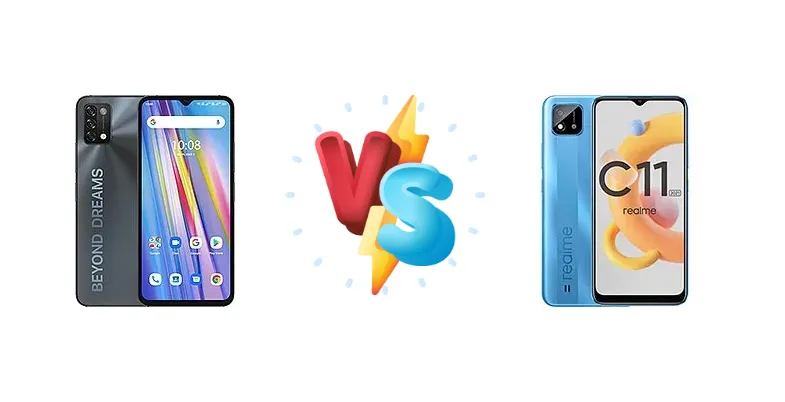
The sub-$150 smartphone market is fiercely competitive. Both the Umidigi A11 and the Realme C11 (2021) aim to deliver essential smartphone functionality at an incredibly accessible price point. However, they take different approaches to achieving this, primarily in their chipset choices. This comparison will dissect those differences and determine which device offers the best value for your money.
🏆 Quick Verdict
For the average user prioritizing responsiveness and future-proofing, the Umidigi A11 is the better choice. Its Mediatek Helio G25, built on a 12nm process, offers a more modern CPU architecture than the Realme C11 (2021)'s older 28nm Unisoc SC9863A, translating to a smoother user experience despite similar core counts.
| Network |
|---|
| 2G bands | GSM 850 / 900 / 1800 / 1900 | GSM 850 / 900 / 1800 / 1900 |
| 3G bands | HSDPA 800 / 850 / 900 / 1700(AWS) / 1900 / 2100 | HSDPA 850 / 900 / 1900 / 2100 |
| 4G bands | 1, 2, 3, 4, 5, 7, 8, 12, 13, 17, 18, 19, 20, 26, 28, 34, 38, 39, 40, 41, 66 | 1, 3, 5, 8, 38, 40, 41 |
| Speed | HSPA, LTE | HSPA, LTE |
| Technology | GSM / HSPA / LTE | GSM / HSPA / LTE |
| Launch |
|---|
| Announced | 2021. Released 2021 | 2021, June 28 |
| Status | Discontinued | Available. Released 2021, June 28 |
| Body |
|---|
| Build | - | Glass front, plastic frame, plastic back |
| Dimensions | 162.2 x 75 x 9.2 mm (6.39 x 2.95 x 0.36 in) | 165.2 x 76.4 x 8.9 mm (6.50 x 3.01 x 0.35 in) |
| SIM | Nano-SIM + Nano-SIM | Nano-SIM + Nano-SIM |
| Weight | 222 g (7.83 oz) | 190 g (6.70 oz) |
| | - | Splash resistant design |
| Display |
|---|
| Resolution | 720 x 1600 pixels, 20:9 ratio (~269 ppi density) | 720 x 1600 pixels, 20:9 ratio (~269 ppi density) |
| Size | 6.53 inches, 102.9 cm2 (~84.6% screen-to-body ratio) | 6.52 inches, 102.6 cm2 (~81.3% screen-to-body ratio) |
| Type | IPS LCD | IPS LCD, 400 nits (typ) |
| Platform |
|---|
| CPU | Octa-core (4x2.0 GHz Cortex-A53 & 4x1.5 GHz Cortex-A53) | Octa-core (4x1.6 GHz Cortex-A55 & 4x1.2 GHz Cortex-A55) |
| Chipset | Mediatek Helio G25 (12 nm) | Unisoc SC9863A (28 nm) |
| GPU | PowerVR GE8320 | IMG8322 |
| OS | Android 11 | Android 11, Realme Go UI |
| Memory |
|---|
| Card slot | microSDXC (dedicated slot) | microSDXC (dedicated slot) |
| Internal | 64GB 3GB RAM, 128GB 4GB RAM | 32GB 2GB RAM, 64GB 4GB RAM |
| | - | eMMC 5.1 |
| Main Camera |
|---|
| Features | Dual-LED flash, HDR, panorama | LED flash, HDR, panorama |
| Single | - | 8 MP, f/2.0, (wide), AF |
| Triple | 16 MP, f/2.0, (wide), AF
8 MP, 120˚ (ultrawide)
5 MP (macro) | - |
| Video | 1080p@30fps | 1080p@30fps |
| Selfie camera |
|---|
| Features | - | HDR, panorama |
| Single | 5 MP, f/2.2, (wide) | 5 MP, f/2.2, (wide) |
| Video | 1080p@30fps | 1080p@30fps |
| Sound |
|---|
| 3.5mm jack | - | Yes |
| 35mm jack | Yes | Yes |
| Loudspeaker | Yes | Yes |
| Comms |
|---|
| Bluetooth | 5.0, A2DP, LE | 4.2, A2DP |
| NFC | No | No |
| Positioning | GPS, GLONASS, GALILEO | GPS, GLONASS, GALILEO, BDS |
| Radio | No | Unspecified |
| USB | USB Type-C, OTG | microUSB 2.0, OTG |
| WLAN | Wi-Fi 802.11 a/b/g/n/ac, dual-band, Wi-Fi Direct | Wi-Fi 802.11 b/g/n |
| Features |
|---|
| Sensors | Fingerprint (side-mounted), accelerometer, proximity, compass, thermometer (skin temperature) | Accelerometer, gyro, proximity, compass |
| Battery |
|---|
| Charging | 10W wired | 10W wired
Reverse wired |
| Type | 5150 mAh | 5000 mAh |
| Misc |
|---|
| Colors | Mist Blue, Frost Grey | Cool Blue, Cool Grey |
| Models | - | RMX3231 |
| Price | - | About 80 EUR |
Umidigi A11
- More modern CPU architecture (Helio G25)
- More efficient chipset (12nm process)
- Potentially longer battery life
- Lacks reverse wired charging
- Basic camera system
Realme C11 (2021)
- Reverse wired charging for accessories
- Slightly more refined software experience (Realme UI)
- Potentially lower price
- Less efficient chipset (28nm process)
- Older CPU architecture (Unisoc SC9863A)
- Potentially shorter battery life
Display Comparison
Neither device boasts a standout display. Both likely feature basic LCD panels with resolutions around 720p+, typical for this price bracket. However, specifics like peak brightness and color gamut coverage are unavailable. The Realme C11 (2021) doesn't offer any display features beyond the basics, while Umidigi doesn't specify any enhancements either. The display is unlikely to be a deciding factor for most buyers in this segment.
Camera Comparison
Camera performance is likely to be similar on both devices, with both likely featuring a primary sensor around 13MP. Details regarding sensor size and aperture are unavailable, but given the price point, expectations should be tempered. The Realme C11 (2021) includes a depth sensor, which may offer slightly improved portrait mode effects, but the impact will be minimal. Both devices likely include basic image processing algorithms, prioritizing scene detection over advanced computational photography. The 2MP macro cameras found on both are largely marketing filler and offer limited practical utility.
Performance
The core difference lies in the chipsets. The Umidigi A11’s Mediatek Helio G25, fabricated on a 12nm process, features an octa-core CPU with a split configuration of 4x2.0 GHz Cortex-A53 and 4x1.5 GHz Cortex-A53 cores. This is a more modern architecture than the Realme C11 (2021)’s Unisoc SC9863A, which uses older Cortex-A55 cores clocked at 4x1.6 GHz and 4x1.2 GHz, and is built on a less efficient 28nm process. While both have eight cores, the A55 architecture is generally more efficient *per clock* than the A53, but the G25's higher clock speeds and smaller node give it an overall advantage. This translates to snappier app launches and smoother multitasking on the Umidigi A11. The Unisoc chip's larger process node suggests potentially higher power consumption for similar tasks.
Battery Life
Both phones feature 10W wired charging, indicating similar charging speeds – expect around 2.5-3 hours for a full charge. The Realme C11 (2021) adds reverse wired charging, a useful feature for topping up accessories like wireless earbuds or smartwatches. While battery capacity isn't specified, the Unisoc SC9863A's less efficient process node may result in slightly shorter battery life on the Realme C11 (2021) despite a potentially similar capacity. The Umidigi A11’s more efficient chipset should provide a longer runtime for comparable usage.
Buying Guide
Buy the Umidigi A11 if you need a phone that feels more responsive for everyday tasks like browsing and social media, and if you anticipate keeping the device for more than a year. Buy the Realme C11 (2021) if you prioritize reverse wired charging for topping up accessories, and if your usage is extremely light, consisting primarily of calls and basic messaging.
Frequently Asked Questions
❓ Will the Unisoc SC9863A in the Realme C11 (2021) struggle with multitasking?
Yes, the Unisoc SC9863A, being an older and less powerful chipset, will likely exhibit noticeable slowdowns when running multiple apps simultaneously. While it can handle basic tasks, demanding multitasking will likely result in lag and app reloading. The Umidigi A11's Helio G25 is better equipped for this.
❓ Is the reverse wired charging on the Realme C11 (2021) useful for more than just earbuds?
While primarily useful for accessories like earbuds and smartwatches, the Realme C11 (2021)'s reverse wired charging can provide a small emergency charge to another smartphone, though the 10W output will be very slow. It's more of a convenience feature than a primary charging solution.
❓ How much of a real-world performance difference will I notice between the Helio G25 and the Unisoc SC9863A?
You'll notice a difference in app launch speeds and overall system responsiveness. The Umidigi A11 with the Helio G25 will feel snappier when opening apps, switching between them, and navigating the user interface. The Realme C11 (2021) will feel more sluggish, especially over time as the system becomes cluttered.