
Umidigi A11 vs Nokia G20: A Deep Dive into Budget Smartphone Performance
| Phones Images | |||||
|---|---|---|---|---|---|
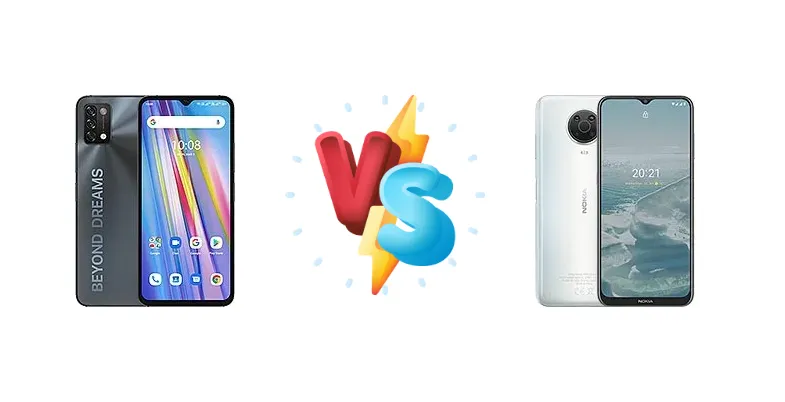
|
🏆 Quick Verdict
For the average user prioritizing slightly smoother performance and responsiveness, the Nokia G20 emerges as the better choice. Its Helio G35 chipset, with higher clocked Cortex-A53 cores, provides a noticeable edge in everyday tasks and light gaming, despite both phones sharing the same 10W charging and similar overall feature sets.
| PHONES | ||
|---|---|---|
| Phone Names | Umidigi A11 | Nokia G20 |
| Network | ||
|---|---|---|
| 2G bands | GSM 850 / 900 / 1800 / 1900 | GSM 850 / 900 / 1800 / 1900 |
| 3G bands | HSDPA 800 / 850 / 900 / 1700(AWS) / 1900 / 2100 | HSDPA 850 / 900 / 1900 / 2100 - International |
| 4G bands | 1, 2, 3, 4, 5, 7, 8, 12, 13, 17, 18, 19, 20, 26, 28, 34, 38, 39, 40, 41, 66 | 1, 3, 5, 7, 8, 20, 28, 38, 40, 41 - International |
| Speed | HSPA, LTE | HSPA 42.2/5.76 Mbps, LTE Cat4 150/50 Mbps |
| Technology | GSM / HSPA / LTE | GSM / HSPA / LTE |
| - | 1, 2, 3, 4, 5, 7, 8, 12, 17, 28, 66 - LATAM | |
| Launch | ||
|---|---|---|
| Announced | 2021. Released 2021 | 2021, April 08 |
| Status | Discontinued | Available. Released 2021, May 17 |
| Body | ||
|---|---|---|
| Dimensions | 162.2 x 75 x 9.2 mm (6.39 x 2.95 x 0.36 in) | 164.9 x 76 x 9.2 mm (6.49 x 2.99 x 0.36 in) |
| SIM | Nano-SIM + Nano-SIM | · Nano-SIM· Nano-SIM + Nano-SIM |
| Weight | 222 g (7.83 oz) | 197 g (6.95 oz) |
| - | Splash protection | |
| Display | ||
|---|---|---|
| Resolution | 720 x 1600 pixels, 20:9 ratio (~269 ppi density) | 720 x 1600 pixels, 20:9 ratio (~269 ppi density) |
| Size | 6.53 inches, 102.9 cm2 (~84.6% screen-to-body ratio) | 6.52 inches, 102.6 cm2 (~81.9% screen-to-body ratio) |
| Type | IPS LCD | IPS LCD |
| Platform | ||
|---|---|---|
| CPU | Octa-core (4x2.0 GHz Cortex-A53 & 4x1.5 GHz Cortex-A53) | Octa-core (4x2.3 GHz Cortex-A53 & 4x1.8 GHz Cortex-A53) |
| Chipset | Mediatek Helio G25 (12 nm) | Mediatek MT6765G Helio G35 (12 nm) |
| GPU | PowerVR GE8320 | PowerVR GE8320 |
| OS | Android 11 | Android 11, upgradable to Android 13 |
| Memory | ||
|---|---|---|
| Card slot | microSDXC (dedicated slot) | microSDXC (dedicated slot) |
| Internal | 64GB 3GB RAM, 128GB 4GB RAM | 64GB 4GB RAM, 128GB 4GB RAM |
| Main Camera | ||
|---|---|---|
| Features | Dual-LED flash, HDR, panorama | LED flash, HDR, panorama |
| Quad | - | 48 MP, f/1.8, (wide), PDAF 5 MP, (ultrawide) 2 MP (macro) Auxiliary lens |
| Single | - | 8 MP, (wide) |
| Triple | 16 MP, f/2.0, (wide), AF 8 MP, 120˚ (ultrawide) 5 MP (macro) | - |
| Video | 1080p@30fps | 1080p@30fps |
| Selfie camera | ||
|---|---|---|
| Single | 5 MP, f/2.2, (wide) | 8 MP, (wide) |
| Video | 1080p@30fps | 1080p@30fps |
| Sound | ||
|---|---|---|
| 3.5mm jack | - | Yes |
| 35mm jack | Yes | Yes |
| Loudspeaker | Yes | Yes |
| Comms | ||
|---|---|---|
| Bluetooth | 5.0, A2DP, LE | 5.0, A2DP, LE |
| NFC | No | Yes (market/region dependent) |
| Positioning | GPS, GLONASS, GALILEO | GPS, GLONASS, BDS |
| Radio | No | FM radio |
| USB | USB Type-C, OTG | USB Type-C 2.0, OTG |
| WLAN | Wi-Fi 802.11 a/b/g/n/ac, dual-band, Wi-Fi Direct | Wi-Fi 802.11 b/g/n |
| Features | ||
|---|---|---|
| Sensors | Fingerprint (side-mounted), accelerometer, proximity, compass, thermometer (skin temperature) | Fingerprint (side-mounted), accelerometer, gyro, proximity |
| Battery | ||
|---|---|---|
| Charging | 10W wired | 10W wired |
| Type | 5150 mAh | Li-Po 5050 mAh |
| Misc | ||
|---|---|---|
| Colors | Mist Blue, Frost Grey | Glacier, Night |
| Models | - | TA-1336, TA-1343, TA-1347, TA-1372, TA-1365 |
| Price | - | About 90 EUR |
| SAR | - | 1.01 W/kg (head) 1.02 W/kg (body) |
| SAR EU | - | 0.49 W/kg (head) 1.13 W/kg (body) |
Umidigi A11
- Extremely affordable price point
- Functional for basic smartphone tasks
- Likely long battery life due to efficient chipset
- Slower performance compared to the Nokia G20
- Limited multitasking capabilities
- Potentially lower camera quality
Nokia G20
- Slightly faster processor for smoother performance
- More responsive user experience
- Potentially better camera image processing
- Still limited by the budget chipset
- 10W charging is slow
- May be slightly more expensive than the Umidigi A11
Display Comparison
Neither Umidigi nor Nokia provide display specifications beyond resolution in their marketing materials. Given the price point, both likely utilize IPS LCD panels. The absence of details like peak brightness or color gamut coverage suggests a focus on cost reduction. Bezels are expected to be substantial on both devices, impacting the overall screen-to-body ratio. Color accuracy is likely to be standard for this segment, prioritizing power efficiency over vibrant visuals.
Camera Comparison
Detailed camera specifications are scarce for both devices. Both are expected to feature a primary camera and multiple secondary sensors, likely including a depth sensor and potentially a macro lens. However, the quality of these secondary sensors is often minimal. Without knowing sensor sizes or apertures, it’s difficult to definitively assess camera performance. Image processing will likely be basic on both phones, prioritizing speed over advanced features. The Nokia G20 may benefit from slightly better image signal processing capabilities due to the more powerful chipset, potentially resulting in marginally improved image quality.
Performance
The core difference lies in the chipsets. The Nokia G20’s Mediatek Helio G35 features a CPU clocked up to 2.3 GHz, utilizing 4x Cortex-A53 cores at this speed and 4x at 1.8 GHz. The Umidigi A11’s Helio G25, conversely, peaks at 2.0 GHz (4x cores) and 1.5 GHz (4x cores). While both are based on the 12nm process, the higher clock speeds of the G35 translate to faster single-core and multi-core performance. This difference will be most noticeable when launching apps, multitasking, and navigating the user interface. Both phones likely feature similar RAM configurations (2GB-4GB), further emphasizing the chipset as the primary performance differentiator. Thermal management is unlikely to be a significant concern given the low-power nature of these chipsets.
Battery Life
Both the Umidigi A11 and Nokia G20 utilize 10W wired charging, indicating a similar charging experience – expect approximately 2.5 to 3.5 hours for a full charge. Battery capacity is not specified in the provided data, but given the target market, both are likely to house batteries in the 4000-5000 mAh range. The slightly more efficient Helio G35 in the Nokia G20 *could* translate to marginally longer battery life, but the difference is unlikely to be substantial in real-world usage. Both phones prioritize longevity over fast charging.
Buying Guide
Buy the Umidigi A11 if you need a functional, extremely affordable smartphone for basic communication and light tasks, and are willing to accept slightly slower performance. Buy the Nokia G20 if you prefer a more responsive experience for everyday use, including social media browsing and casual gaming, and value the slightly improved processing power offered by the Helio G35 chipset.