
Umidigi A11 vs. Motorola Moto G Power (2021): A Deep Dive into Budget Smartphone Performance
| Phones Images | |||||
|---|---|---|---|---|---|
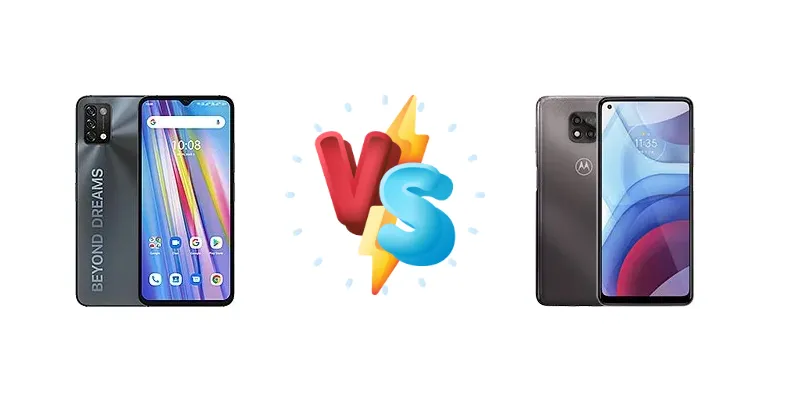
|
🏆 Quick Verdict
For the average user prioritizing consistent performance and slightly faster charging, the Motorola Moto G Power (2021) is the better choice. Its Snapdragon 662 chipset, built on an 11nm process, provides a noticeable advantage in application responsiveness and multitasking compared to the Umidigi A11’s Helio G25.
| PHONES | ||
|---|---|---|
| Phone Names | Umidigi A11 | Motorola Moto G Power (2021) |
| Network | ||
|---|---|---|
| 2G bands | GSM 850 / 900 / 1800 / 1900 | GSM 850 / 900 / 1800 / 1900 |
| 3G bands | HSDPA 800 / 850 / 900 / 1700(AWS) / 1900 / 2100 | HSDPA 850 / 900 / 1700(AWS) / 1900 / 2100 |
| 4G bands | 1, 2, 3, 4, 5, 7, 8, 12, 13, 17, 18, 19, 20, 26, 28, 34, 38, 39, 40, 41, 66 | 1, 2, 3, 4, 5, 7, 8, 12, 13, 14, 17, 25, 26, 29, 30, 38, 41, 66, 71 |
| Speed | HSPA, LTE | HSPA, LTE |
| Technology | GSM / HSPA / LTE | GSM / CDMA / HSPA / EVDO / LTE |
| - | CDMA2000 1xEV-DO | |
| Launch | ||
|---|---|---|
| Announced | 2021. Released 2021 | 2021, January 08 |
| Status | Discontinued | Available. Released 2021, January 14 |
| Body | ||
|---|---|---|
| Build | - | Glass front, plastic back, plastic frame |
| Dimensions | 162.2 x 75 x 9.2 mm (6.39 x 2.95 x 0.36 in) | 165.3 x 75.9 x 9.5 mm (6.51 x 2.99 x 0.37 in) |
| SIM | Nano-SIM + Nano-SIM | Nano-SIM |
| Weight | 222 g (7.83 oz) | 206.5 g (7.30 oz) |
| - | Water-repellent coating | |
| Display | ||
|---|---|---|
| Resolution | 720 x 1600 pixels, 20:9 ratio (~269 ppi density) | 720 x 1600 pixels, 20:9 ratio (~266 ppi density) |
| Size | 6.53 inches, 102.9 cm2 (~84.6% screen-to-body ratio) | 6.6 inches, 105.2 cm2 (~83.8% screen-to-body ratio) |
| Type | IPS LCD | IPS LCD |
| Platform | ||
|---|---|---|
| CPU | Octa-core (4x2.0 GHz Cortex-A53 & 4x1.5 GHz Cortex-A53) | Octa-core (4x2.0 GHz Kryo 260 Gold & 4x1.8 GHz Kryo 260 Silver) |
| Chipset | Mediatek Helio G25 (12 nm) | Qualcomm SM6115 Snapdragon 662 (11 nm) |
| GPU | PowerVR GE8320 | Adreno 610 |
| OS | Android 11 | Android 10 |
| Memory | ||
|---|---|---|
| Card slot | microSDXC (dedicated slot) | microSDXC (dedicated slot) |
| Internal | 64GB 3GB RAM, 128GB 4GB RAM | 32GB 3GB RAM, 64GB 4GB RAM |
| - | eMMC 5.1 | |
| Main Camera | ||
|---|---|---|
| Features | Dual-LED flash, HDR, panorama | LED flash, HDR, panorama |
| Triple | 16 MP, f/2.0, (wide), AF 8 MP, 120˚ (ultrawide) 5 MP (macro) | 48 MP, f/1.7, (wide), 1/2.0", 0.8µm, PDAF 2 MP (macro) Auxiliary lens |
| Video | 1080p@30fps | 1080p@30/60fps, gyro-EIS |
| Selfie camera | ||
|---|---|---|
| Features | - | HDR |
| Single | 5 MP, f/2.2, (wide) | 8 MP, f/2.0, 1.12µm |
| Video | 1080p@30fps | 1080p@30fps, gyro-EIS |
| Sound | ||
|---|---|---|
| 3.5mm jack | - | Yes |
| 35mm jack | Yes | Yes |
| Loudspeaker | Yes | Yes |
| Comms | ||
|---|---|---|
| Bluetooth | 5.0, A2DP, LE | 5.0, A2DP, LE |
| NFC | No | No |
| Positioning | GPS, GLONASS, GALILEO | GPS, GLONASS, GALILEO |
| Radio | No | FM radio |
| USB | USB Type-C, OTG | USB Type-C 2.0 |
| WLAN | Wi-Fi 802.11 a/b/g/n/ac, dual-band, Wi-Fi Direct | Wi-Fi 802.11 a/b/g/n/ac, dual-band, Wi-Fi Direct |
| Features | ||
|---|---|---|
| Sensors | Fingerprint (side-mounted), accelerometer, proximity, compass, thermometer (skin temperature) | Fingerprint (side-mounted), accelerometer, gyro, proximity, compass, barometer |
| Battery | ||
|---|---|---|
| Charging | 10W wired | 15W wired |
| Type | 5150 mAh | Li-Po 5000 mAh |
| Misc | ||
|---|---|---|
| Colors | Mist Blue, Frost Grey | Flash Gray, Polar Silver |
| Price | - | About 60 EUR |
Umidigi A11
- Potentially lower price point
- Acceptable for basic tasks
- May offer expandable storage (market dependent)
- Less powerful Helio G25 chipset
- Slower 10W charging
- Likely less refined software experience
Motorola Moto G Power (2021)
- More powerful Snapdragon 662 chipset
- Faster 15W charging
- Better optimized software experience
- Generally slightly higher price
- May have limited storage options
- Potentially larger physical size
Display Comparison
Neither device boasts a standout display. Both likely utilize LCD panels, a common cost-saving measure in this segment. However, the lack of detailed display specs necessitates focusing on performance. The real difference lies in how the chipsets handle UI rendering, impacting perceived smoothness. We can assume both have similar resolutions, likely 720p+, given the price point.
Camera Comparison
Without detailed camera sensor information, a direct comparison is difficult. However, it’s safe to assume both phones feature basic camera setups geared towards casual photography. The Motorola, benefiting from Qualcomm’s image signal processor (ISP) within the Snapdragon 662, likely offers slightly better image processing and dynamic range. The Umidigi A11’s Helio G25 ISP is less sophisticated, potentially resulting in less refined images, particularly in challenging lighting conditions. We can expect both to include a primary camera and potentially depth or macro sensors of limited utility.
Performance
The core difference lies in the chipsets. The Motorola Moto G Power (2021) features the Qualcomm Snapdragon 662 (11nm), while the Umidigi A11 uses the MediaTek Helio G25 (12nm). While both are octa-core CPUs, the Snapdragon 662’s Kryo 260 Gold cores, clocked at 2.0 GHz, offer a performance edge over the A11’s Cortex-A53 cores at the same clock speed. The 11nm process node of the Snapdragon 662 is also more efficient, potentially leading to better sustained performance and thermal management. This translates to snappier app launches and smoother multitasking for the Motorola.
Battery Life
The Motorola Moto G Power (2021) supports 15W wired charging, while the Umidigi A11 is limited to 10W. While battery capacity isn’t specified, Motorola’s ‘Power’ branding suggests a larger battery, likely around 5000mAh. The faster charging speed of the Motorola will result in quicker top-ups, even if the battery capacity is similar. The Snapdragon 662’s improved efficiency also contributes to potentially longer battery life during typical usage.
Buying Guide
Buy the Umidigi A11 if you need a very basic smartphone for essential tasks like calls, texts, and light social media, and are extremely budget-constrained. Buy the Motorola Moto G Power (2021) if you prefer a more responsive user experience, slightly better gaming capabilities, and the peace of mind that comes with Qualcomm’s generally more refined software support and optimization.