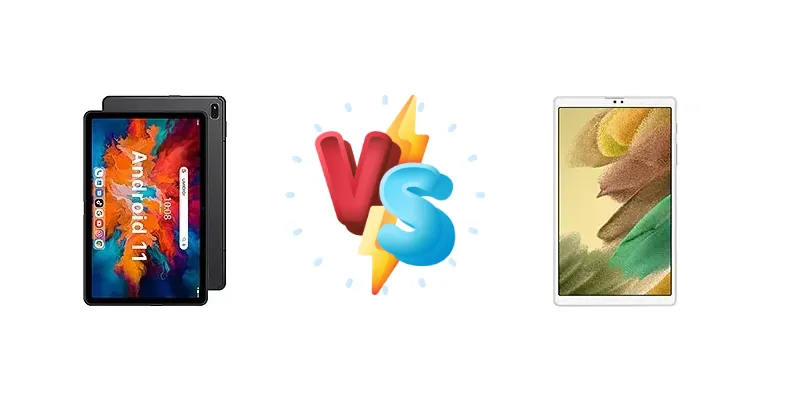
The budget tablet market is fiercely competitive, and the Umidigi A11 Tab and Samsung Galaxy Tab A7 Lite represent compelling options for users seeking affordable Android experiences. Both tablets aim to deliver essential functionality without breaking the bank, but subtle differences in their hardware and software can significantly impact performance and usability. This comparison dives deep into the specifications to determine which tablet offers the best value.
🏆 Quick Verdict
For most users, the Samsung Galaxy Tab A7 Lite emerges as the slightly better choice. While both utilize the Mediatek Helio P22 chipset family, the A7 Lite’s faster CPU clock speeds and 15W charging provide a noticeable edge in responsiveness and convenience. However, the Umidigi A11 Tab remains a viable option for those prioritizing absolute cost savings.
| Network |
|---|
| 2G bands | N/A | GSM 850 / 900 / 1800 / 1900 |
| 3G bands | - | HSDPA 850 / 900 / 1700(AWS) / 1900 / 2100 |
| 4G bands | N/A | 1, 2, 3, 4, 5, 7, 8, 12, 17, 20, 28, 38, 40, 66 |
| EDGE | N/A | - |
| GPRS | N/A | - |
| Speed | - | HSPA, LTE - cellular model only |
| Technology | No cellular connectivity | GSM / HSPA / LTE |
| Launch |
|---|
| Announced | 2021. Released 2021 | 2021, May 27 |
| Status | Discontinued | Available. Released 2021, June 18 |
| Body |
|---|
| Build | - | Glass front, aluminum back, aluminum frame, plastic ends |
| Dimensions | 247.2 x 157 x 8 mm (9.73 x 6.18 x 0.31 in) | 212.5 x 124.7 x 8 mm (8.37 x 4.91 x 0.31 in) |
| SIM | No | Nano-SIM (cellular model only) |
| Weight | 527 g (1.16 lb) | 366 g (Wi-Fi), 371 g (LTE) (12.91 oz) |
| Display |
|---|
| Resolution | 1200 x 2000 pixels, 5:3 ratio (~224 ppi density) | 800 x 1340 pixels, 5:3 ratio (~179 ppi density) |
| Size | 10.4 inches, 307.9 cm2 (~79.3% screen-to-body ratio) | 8.7 inches, 214.9 cm2 (~81.1% screen-to-body ratio) |
| Type | TFT | TFT LCD |
| Platform |
|---|
| CPU | Octa-core (4x2.0 GHz Cortex-A53 & 4x1.5 GHz Cortex-A53) | Octa-core (4x2.3 GHz Cortex-A53 & 4x1.8 GHz Cortex-A53) |
| Chipset | Mediatek Helio P22 (12 nm) | Mediatek MT8768T Helio P22T (12 nm) |
| GPU | PowerVR GE8320 | PowerVR GE8320 |
| OS | Android 11 | Android 11, upgradable to Android 14, One UI 6.1 |
| Memory |
|---|
| Card slot | microSDXC | microSDXC (dedicated slot) |
| Internal | 128GB 4GB RAM | 32GB 2GB RAM, 32GB 3GB RAM, 64GB 4GB RAM |
| | - | eMMC 5.1 |
| Main Camera |
|---|
| Features | LED flash | - |
| Single | 16 MP, f/2.0, (wide) | 8 MP, AF |
| Video | 1080p@30fps | 1080p@30fps |
| Selfie camera |
|---|
| Single | 8 MP, f/2.2, (wide) | 2 MP |
| Video | 1080p@30fps | - |
| Sound |
|---|
| 3.5mm jack | - | Yes |
| 35mm jack | No | Yes |
| Loudspeaker | Yes, with stereo speakers (4 speakers) | Yes, with stereo speakers |
| Comms |
|---|
| Bluetooth | 5.0, A2DP, LE | 5.0, A2DP, LE |
| NFC | No | No |
| Positioning | GPS, GALILEO, GLONASS, BDS | GPS, GLONASS, BDS, GALILEO - cellular model only |
| Radio | FM radio | No |
| USB | USB Type-C 2.0, OTG | USB Type-C 2.0 |
| WLAN | Wi-Fi 802.11 a/b/g/n/ac, dual-band | Wi-Fi 802.11 a/b/g/n/ac, dual-band, Wi-Fi Direct |
| Features |
|---|
| Sensors | Fingerprint (side-mounted), accelerometer, gyro, proximity, compass | Accelerometer, compass |
| Battery |
|---|
| Charging | 10W wired | 15W wired |
| Type | 8000 mAh | Li-Po 5100 mAh |
| Misc |
|---|
| Colors | Black | Gray, Silver |
| Models | - | SM-T225, SM-T220, SM-T225N, SM-T227U |
| Price | - | About 140 EUR |
| SAR | - | 0.68 W/kg (body) |
| SAR EU | - | 0.64 W/kg (head) 0.99 W/kg (body) |
Umidigi A11 Tab
- Potentially lower price point
- Functional for basic tasks
- Acceptable for light media consumption
- Slower CPU clock speeds
- Slower 10W charging
- Likely less software support
Samsung Galaxy Tab A7 Lite
- Faster CPU clock speeds for improved performance
- Faster 15W charging
- Samsung brand reputation and software support
- Higher price compared to Umidigi A11 Tab
- Still limited by the Helio P22 chipset
- May not be a significant upgrade for very basic users
Display Comparison
Neither Umidigi nor Samsung provide detailed display specifications beyond the panel type. Both likely utilize IPS LCDs, common in this price bracket. The key difference lies in the processing power available to drive the display. While resolution is likely similar, the A7 Lite’s slightly more powerful chipset may translate to smoother scrolling and animations. Bezels are expected to be substantial on both devices, reflecting their budget positioning. Color accuracy is unlikely to be a strong point on either tablet, geared towards general consumption rather than professional color work.
Camera Comparison
Camera performance is unlikely to be a deciding factor for buyers in this segment. Both tablets will likely feature basic camera setups, and image quality will be adequate for casual snapshots. Detailed specifications are unavailable, but it’s safe to assume both will include a primary rear camera and a front-facing camera for video calls. Focusing on megapixel counts would be misleading; image processing and sensor size are far more important, and neither manufacturer provides this information. The cameras are best suited for quick documentation rather than serious photography.
Performance
Both tablets are powered by Mediatek Helio P22 chips built on a 12nm process, but the Samsung Galaxy Tab A7 Lite features the Helio P22T variant. This seemingly minor distinction is crucial: the A7 Lite’s CPU boasts clock speeds of up to 2.3 GHz (4x Cortex-A53), compared to the A11 Tab’s 2.0 GHz (4x Cortex-A53). This 15% increase in peak CPU frequency will result in snappier app launches and improved multitasking. The GPU performance is also likely slightly higher on the A7 Lite. While neither tablet is designed for demanding gaming, the A7 Lite will handle casual titles more smoothly. RAM configurations are not specified, but both will likely offer options around 3-4GB, sufficient for basic Android operation.
Battery Life
Battery capacity is not specified for either device. However, the Samsung Galaxy Tab A7 Lite’s 15W wired charging is a significant advantage over the Umidigi A11 Tab’s 10W charging. This faster charging speed will reduce downtime and allow users to quickly top up their battery when needed. While a larger battery capacity on the A11 Tab could partially offset this difference, the faster charging of the A7 Lite provides a more convenient user experience. Expect both tablets to offer all-day battery life with moderate usage, primarily consisting of web browsing, video streaming, and reading.
Buying Guide
Buy the Umidigi A11 Tab if you need a tablet for extremely basic tasks like reading ebooks, light web browsing, and occasional video playback, and your budget is the absolute primary concern. Buy the Samsung Galaxy Tab A7 Lite if you prefer a more responsive user experience, faster charging, and the brand recognition and software support that Samsung provides, even if it means spending a bit more.
Frequently Asked Questions
❓ Will the Helio P22 chipset struggle with multitasking on the Samsung Galaxy Tab A7 Lite?
While the Helio P22 isn't a powerhouse, the A7 Lite's faster CPU clock speeds and optimized software will allow for smoother multitasking than the Umidigi A11 Tab. Expect to be able to switch between a few apps without significant slowdown, but avoid running too many demanding applications simultaneously.
❓ Is the 10W charging on the Umidigi A11 Tab noticeably slow?
Yes, 10W charging is relatively slow by modern standards. Expect a significantly longer charging time compared to the Samsung Galaxy Tab A7 Lite’s 15W charging. A full charge could take several hours, making it less convenient for users who need to quickly top up their battery.
❓ Can either of these tablets handle popular mobile games like PUBG or Call of Duty?
Both tablets will struggle with graphically intensive games like PUBG or Call of Duty. You may be able to run them at the lowest settings with reduced frame rates, but the experience won't be optimal. These tablets are better suited for casual gaming and less demanding titles.
❓ What Android version do these tablets ship with, and will they receive updates?
The Samsung Galaxy Tab A7 Lite typically ships with a more recent version of Android and benefits from Samsung's software update policy, offering at least one major OS upgrade. The Umidigi A11 Tab's software support is less certain, and updates may be infrequent or unavailable.