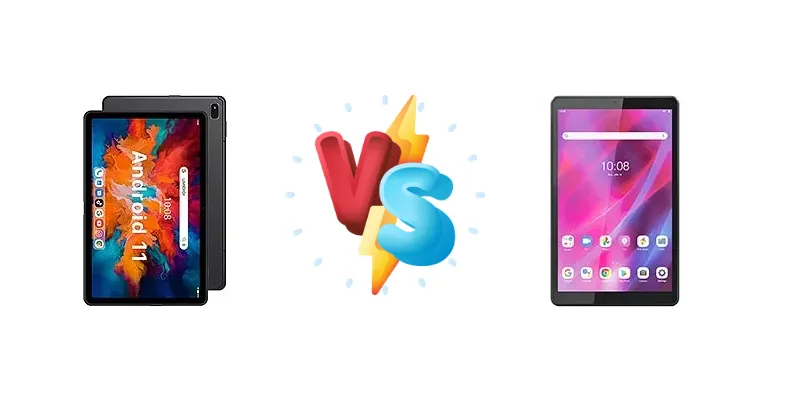
The sub-$150 tablet market is fiercely competitive. Both the Umidigi A11 Tab and the Lenovo Tab M8 (3rd Gen) aim to deliver a functional Android experience without breaking the bank. While both utilize MediaTek Helio P22 series chipsets, subtle differences in CPU clock speeds and overall system optimization create distinct performance profiles. This comparison dives deep into these nuances to determine which tablet offers the best value.
🏆 Quick Verdict
For the average user prioritizing slightly smoother multitasking and responsiveness, the Lenovo Tab M8 (3rd Gen) is the better choice. Its marginally faster CPU clock speeds translate to a more fluid experience, despite both tablets sharing the same Helio P22 base. However, the Umidigi A11 Tab remains a viable option for basic tasks and media consumption.
| Network |
|---|
| 2G bands | N/A | GSM 850 / 900 / 1800 / 1900 |
| 3G bands | - | HSDPA 850 / 900 / 1700(AWS) / 1900 / 2100 - International |
| 4G bands | N/A | 1, 2, 3, 4, 5, 19, 7, 8, 20, 26, 28, 38, 40, 41 - International |
| EDGE | N/A | - |
| GPRS | N/A | - |
| Speed | - | HSPA, LTE - cellular model only |
| Technology | No cellular connectivity | GSM / CDMA / HSPA / LTE |
| | - | 1, 3, 5, 7, 8, 34, 38, 39, 40, 41 - China |
| Launch |
|---|
| Announced | 2021. Released 2021 | 2021, June 28 |
| Status | Discontinued | Available. Released 2022, February |
| Body |
|---|
| Build | - | Glass front, aluminum back, aluminum frame |
| Dimensions | 247.2 x 157 x 8 mm (9.73 x 6.18 x 0.31 in) | 199.1 x 121.8 x 8.2 mm (7.84 x 4.80 x 0.32 in) |
| SIM | No | Nano-SIM (cellular model only) |
| Weight | 527 g (1.16 lb) | 305 g (10.76 oz) |
| Display |
|---|
| Resolution | 1200 x 2000 pixels, 5:3 ratio (~224 ppi density) | 800 x 1280 pixels, 16:10 ratio (~189 ppi density) |
| Size | 10.4 inches, 307.9 cm2 (~79.3% screen-to-body ratio) | 8.0 inches, 185.6 cm2 (~76.5% screen-to-body ratio) |
| Type | TFT | TDDI IPS LCD, 350 nits (typ) |
| Platform |
|---|
| CPU | Octa-core (4x2.0 GHz Cortex-A53 & 4x1.5 GHz Cortex-A53) | Octa-core (4x2.3 GHz Cortex-A53 & 4x1.8 GHz Cortex-A53) |
| Chipset | Mediatek Helio P22 (12 nm) | Mediatek MT8768T Helio P22T (12 nm) |
| GPU | PowerVR GE8320 | PowerVR GE8320 |
| OS | Android 11 | Android 11 (Go edition) - 2 GB RAM versionAndroid 11 - 3 GB RAM version |
| Memory |
|---|
| Card slot | microSDXC | microSDXC (dedicated slot) |
| Internal | 128GB 4GB RAM | 32GB 2GB RAM, 32GB 3GB RAM |
| | - | eMMC 5.1 |
| Main Camera |
|---|
| Features | LED flash | - |
| Single | 16 MP, f/2.0, (wide) | 5 MP, AF |
| Video | 1080p@30fps | 1080p |
| Selfie camera |
|---|
| Single | 8 MP, f/2.2, (wide) | 2 MP |
| Video | 1080p@30fps | 720p |
| Sound |
|---|
| 3.5mm jack | - | Yes |
| 35mm jack | No | Yes |
| Loudspeaker | Yes, with stereo speakers (4 speakers) | Yes |
| Comms |
|---|
| Bluetooth | 5.0, A2DP, LE | 5.0, A2DP, LE |
| NFC | No | No |
| Positioning | GPS, GALILEO, GLONASS, BDS | GPS, GLONASS, BDS - cellular model only |
| Radio | FM radio | FM radio |
| USB | USB Type-C 2.0, OTG | USB Type-C 2.0, OTG |
| WLAN | Wi-Fi 802.11 a/b/g/n/ac, dual-band | Wi-Fi 802.11 a/b/g/n, dual-band, Wi-Fi Direct |
| Features |
|---|
| Sensors | Fingerprint (side-mounted), accelerometer, gyro, proximity, compass | Accelerometer, proximity |
| Battery |
|---|
| Charging | 10W wired | - |
| Type | 8000 mAh | Li-Po 5100 mAh |
| Misc |
|---|
| Colors | Black | Iron Grey, Platinum Grey |
Umidigi A11 Tab
- Potentially lower price point
- Functional for basic tasks
- MediaTek Helio P22 chipset provides adequate performance for light use
- Slower CPU clock speeds compared to Lenovo
- Likely less responsive multitasking
- 10W charging is slow
Lenovo Tab M8 (3rd Gen)
- Faster CPU clock speeds for improved responsiveness
- Slightly smoother multitasking experience
- MediaTek Helio P22T chipset offers a marginal performance boost
- May be slightly more expensive
- 10W charging is slow
- Similar battery life to Umidigi (assuming similar capacity)
Display Comparison
Neither Umidigi nor Lenovo provide detailed display specifications beyond the panel size. Given the price point, both likely utilize IPS LCD panels. The absence of information regarding brightness (nits) suggests neither tablet will excel in direct sunlight. Bezels are expected to be substantial on both devices, reflecting their budget nature. Color accuracy is also likely to be standard, prioritizing cost over fidelity. Without further data, a clear winner cannot be determined; display quality will likely be similar.
Camera Comparison
Camera performance is unlikely to be a deciding factor for either tablet. Both are expected to feature basic camera setups geared towards casual snapshots. Without specific sensor details, it’s safe to assume image quality will be adequate for social media sharing but lacking in detail and dynamic range. The focus should be on the primary camera, as any secondary sensors (often 2MP macro lenses) will offer limited utility. The Lenovo Tab M8 (3rd Gen) may have a slight advantage due to potential software optimizations, but the core hardware is comparable.
Performance
Both tablets are powered by the MediaTek Helio P22 (12nm), but the Lenovo Tab M8 (3rd Gen) features the Helio P22T variant with a CPU clock speed of 4x2.3 GHz Cortex-A53 & 4x1.8 GHz Cortex-A53, compared to the Umidigi A11 Tab’s 4x2.0 GHz Cortex-A53 & 4x1.5 GHz Cortex-A53. This 0.3 GHz and 0.3 GHz difference in core speeds, while seemingly small, can result in a noticeable improvement in application launch times and multitasking responsiveness on the Lenovo. Both utilize an Octa-core configuration, but the higher clock speeds on the Lenovo Tab M8 (3rd Gen) provide a performance edge. The shared 12nm process node suggests similar thermal characteristics, meaning neither tablet is likely to sustain peak performance for extended periods under heavy load.
Battery Life
Battery capacity is not specified for either device. However, both tablets feature 10W wired charging. This slow charging speed suggests neither tablet is designed for rapid replenishment. Real-world battery life will depend heavily on usage patterns, but given the power-efficient Helio P22 chipset, both should provide several hours of light use (web browsing, video playback). The lack of fast charging support means a full charge will take a considerable amount of time, making overnight charging the preferred method.
Buying Guide
Buy the Umidigi A11 Tab if you need a purely functional tablet for static tasks like reading ebooks, displaying digital photos, or very light web browsing, and your budget is extremely tight. Buy the Lenovo Tab M8 (3rd Gen) if you prefer a slightly more responsive experience for everyday tasks like social media, streaming video, and light gaming, and are willing to spend a little more for that added performance.
Frequently Asked Questions
❓ Will the Lenovo Tab M8 (3rd Gen) handle basic games like Candy Crush or Angry Birds smoothly?
Yes, the Lenovo Tab M8 (3rd Gen)'s Helio P22T chipset and slightly faster CPU clock speeds should provide a smooth experience for casual games like Candy Crush and Angry Birds. However, don't expect to run graphically demanding titles at high settings.
❓ Is the 10W charging speed a significant drawback for either tablet?
Yes, 10W charging is relatively slow. Expect a full charge to take several hours. It's best to charge these tablets overnight to ensure they're ready for use the next day. Neither tablet supports fast charging technologies.
❓ Can either tablet be used for video conferencing effectively?
Both tablets can handle basic video conferencing via apps like Zoom or Google Meet. However, the camera quality is likely to be limited, and the built-in microphones may not provide the clearest audio. Using an external headset is recommended for optimal video conferencing performance.
❓ What type of storage does each tablet use, and is it expandable?
Storage type is not specified in the provided data. However, budget tablets typically use eMMC storage. Expandability via microSD card is common in this segment, but it's crucial to verify if each model supports it before purchase.