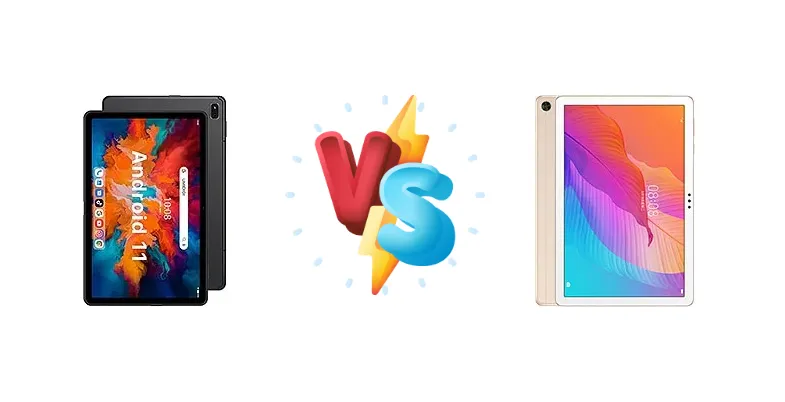
The sub-$200 tablet market is fiercely competitive, and the Umidigi A11 Tab and Huawei MatePad T 10s represent two compelling options. Both aim to deliver a functional tablet experience without breaking the bank, but they achieve this with different approaches to chipset design and processing power. This comparison dives deep into the specifications to determine which tablet offers the best value for your money.
🏆 Quick Verdict
For the average user prioritizing everyday tasks like web browsing, video streaming, and light gaming, the Huawei MatePad T 10s edges out the Umidigi A11 Tab. The Kirin 710A chipset, built on a 14nm process, provides a noticeable performance advantage over the A11 Tab’s Helio P22, translating to smoother multitasking and a more responsive user experience.
| Network |
|---|
| 2G bands | N/A | GSM 850 / 900 / 1800 / 1900 |
| 3G bands | - | HSDPA 850 / 900 / 1700(AWS) / 1900 / 2100 |
| 4G bands | N/A | 1, 3, 5, 7, 8, 18, 19, 20, 26, 28, 38, 40, 41 |
| EDGE | N/A | - |
| GPRS | N/A | - |
| Speed | - | HSPA, LTE - cellular model only |
| Technology | No cellular connectivity | GSM / HSPA / LTE |
| Launch |
|---|
| Announced | 2021. Released 2021 | 2020, September 09. Released 2020, September 09 |
| Status | Discontinued | Discontinued |
| Body |
|---|
| Dimensions | 247.2 x 157 x 8 mm (9.73 x 6.18 x 0.31 in) | 240.2 x 159 x 7.9 mm (9.46 x 6.26 x 0.31 in) |
| SIM | No | Nano-SIM (cellular model only) |
| Weight | 527 g (1.16 lb) | 450 g (0.99 lb) |
| | - | Stylus support |
| Display |
|---|
| Resolution | 1200 x 2000 pixels, 5:3 ratio (~224 ppi density) | 1200 x 1920 pixels, 16:10 ratio (~224 ppi density) |
| Size | 10.4 inches, 307.9 cm2 (~79.3% screen-to-body ratio) | 10.1 inches, 295.8 cm2 (~77.4% screen-to-body ratio) |
| Type | TFT | IPS LCD |
| Platform |
|---|
| CPU | Octa-core (4x2.0 GHz Cortex-A53 & 4x1.5 GHz Cortex-A53) | Octa-core (4x2.0 GHz Cortex-A73 & 4x1.7 GHz Cortex-A53) |
| Chipset | Mediatek Helio P22 (12 nm) | Kirin 710A (14 nm) |
| GPU | PowerVR GE8320 | Mali-G51 MP4 |
| OS | Android 11 | Android 10, EMUI 10.1, no Google Play Services |
| Memory |
|---|
| Card slot | microSDXC | microSDXC |
| Internal | 128GB 4GB RAM | 16GB 2GB RAM, 32GB 2GB RAM, 64GB 3GB RAM, 64GB 4GB RAM, 128GB 4GB RAM |
| | - | eMMC 5.1 |
| Main Camera |
|---|
| Features | LED flash | HDR, panorama |
| Single | 16 MP, f/2.0, (wide) | 5 MP, f/2.2, PDAF |
| Video | 1080p@30fps | 1080p@30fps |
| Selfie camera |
|---|
| Single | 8 MP, f/2.2, (wide) | 2 MP, f/2.4 |
| Video | 1080p@30fps | - |
| Sound |
|---|
| 3.5mm jack | - | Yes |
| 35mm jack | No | Yes |
| Loudspeaker | Yes, with stereo speakers (4 speakers) | Yes, with stereo speakers |
| | - | Tuned by Harman Kardon |
| Comms |
|---|
| Bluetooth | 5.0, A2DP, LE | 5.0, A2DP, LE |
| NFC | No | No |
| Positioning | GPS, GALILEO, GLONASS, BDS | GPS, GLONASS, BDS - cellular model only |
| Radio | FM radio | No |
| USB | USB Type-C 2.0, OTG | USB Type-C 2.0, OTG |
| WLAN | Wi-Fi 802.11 a/b/g/n/ac, dual-band | Wi-Fi 802.11 a/b/g/n/ac, dual-band, Wi-Fi Direct |
| Features |
|---|
| Sensors | Fingerprint (side-mounted), accelerometer, gyro, proximity, compass | Accelerometer, proximity |
| Battery |
|---|
| Charging | 10W wired | 10W wired |
| Type | 8000 mAh | Li-Po 5100 mAh |
| Misc |
|---|
| Colors | Black | Gold, Deepsea Blue |
| Models | - | AGS3-L09, AGS3-W09, AGS3K-W09 |
| Price | - | About 200 EUR |
Umidigi A11 Tab
- Potentially lower price point
- Lightweight and portable
- Suitable for basic tasks
- Less powerful processor
- Slower app loading times
- May struggle with multitasking
Huawei MatePad T 10s
- More powerful Kirin 710A chipset
- Smoother multitasking experience
- Potentially better power efficiency
- Slightly higher price
- May have larger bezels
- 10W charging is slow
Display Comparison
Neither Umidigi nor Huawei provide detailed display specifications beyond the basic resolution. However, the core difference lies in the processing power driving the display. The Kirin 710A’s image signal processor (ISP) likely offers better image processing capabilities, potentially resulting in slightly more vibrant colors and improved contrast on the MatePad T 10s. Both tablets likely utilize IPS LCD panels, common in this price bracket, and lack features like high refresh rates or HDR support. Bezels are expected to be substantial on both devices, reflecting their budget positioning.
Camera Comparison
Given the price point, camera performance isn’t a primary focus for either tablet. Detailed camera specs are unavailable, but it’s safe to assume both feature basic rear and front-facing cameras suitable for video calls and casual snapshots. The Kirin 710A’s ISP may provide slightly better image processing, but the overall image quality will be limited by the sensor quality, which is likely similar on both devices. Expect limited low-light performance and a lack of advanced features like optical image stabilization (OIS).
Performance
The core of the performance difference lies in the chipsets. The Huawei MatePad T 10s utilizes the Kirin 710A, fabricated on a 14nm process, featuring four Cortex-A73 cores clocked at 2.0 GHz alongside four Cortex-A53 cores at 1.7 GHz. This architecture prioritizes performance with the A73 cores. Conversely, the Umidigi A11 Tab employs the Mediatek Helio P22, a 12nm chip with eight Cortex-A53 cores, all clocked at either 2.0 GHz or 1.5 GHz. While both are octa-core, the A73 cores in the Kirin 710A offer significantly higher single-core performance, crucial for app responsiveness. The 14nm process of the Kirin 710A, while older, may offer a better balance of performance and power efficiency compared to the Helio P22’s 12nm node, given the architectural differences.
Battery Life
Both tablets feature 10W wired charging, indicating a similar charging experience. Battery capacity isn’t specified, but given the similar size and target market, they likely fall within the 5000-6000 mAh range. The Kirin 710A’s potentially better power efficiency could translate to slightly longer battery life during typical usage on the MatePad T 10s, despite any minor capacity differences. The 10W charging speed will result in relatively slow charging times for both devices – expect several hours to reach a full charge.
Buying Guide
Buy the Umidigi A11 Tab if you need a highly portable tablet for basic consumption – reading ebooks, casual browsing, and occasional video playback – and are on an extremely tight budget. Buy the Huawei MatePad T 10s if you prefer a more responsive experience for multitasking, slightly more demanding apps, and appreciate the potential for a smoother overall user interface, even if it comes at a small price premium.
Frequently Asked Questions
❓ Will the Umidigi A11 Tab struggle with demanding games like PUBG Mobile?
Yes, the Helio P22 chipset in the Umidigi A11 Tab is not designed for graphically intensive games. While you might be able to run PUBG Mobile at the lowest settings, expect significant frame rate drops and a generally poor gaming experience. The Huawei MatePad T 10s, with its Kirin 710A, will offer a slightly better experience, but still won't be ideal for high-end gaming.
❓ Does the Huawei MatePad T 10s support Google Mobile Services (GMS)?
This is a crucial consideration. Huawei has faced restrictions on using GMS. The MatePad T 10s typically ships with Huawei’s AppGallery and Huawei Mobile Services (HMS). This means you won’t have direct access to the Google Play Store and apps reliant on GMS may require workarounds or won’t function at all. Check the specific retailer and model to confirm GMS availability.
❓ How long will it take to fully charge either tablet?
With both tablets utilizing 10W charging, expect a full charge to take approximately 3-4 hours from 0%. This is a relatively slow charging speed compared to modern tablets with fast charging capabilities. Neither device prioritizes quick charging.