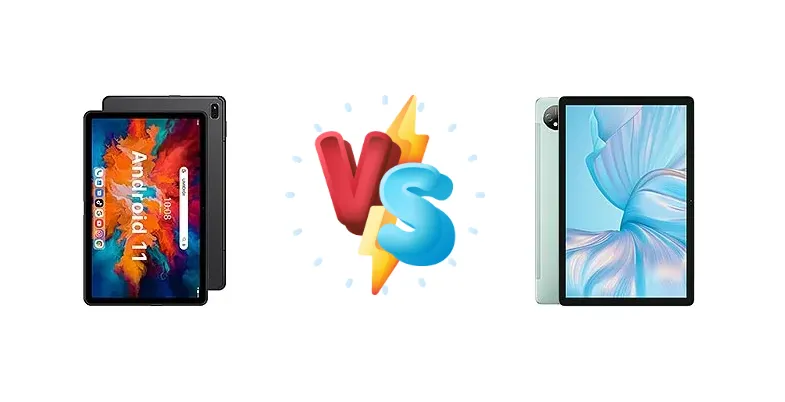
The sub-$150 tablet market is fiercely competitive, and the Umidigi A11 Tab and Blackview Tab 80 represent two compelling options. Both aim to deliver a functional tablet experience without breaking the bank, but they achieve this with different chipsets and architectural approaches. This comparison will dissect those differences to help you determine which tablet best suits your needs.
🏆 Quick Verdict
For most users, the Blackview Tab 80 emerges as the better choice. Its Unisoc T606 chipset, featuring Cortex-A75 cores, provides a noticeable performance uplift over the Umidigi A11 Tab’s Helio P22, translating to smoother multitasking and a more responsive user experience. While both charge at the same speed, the performance advantage justifies the potential slight price difference.
| Network |
|---|
| 2G bands | N/A | GSM 850 / 900 / 1800 / 1900 |
| 3G bands | - | HSDPA 900 / 2100 |
| 4G bands | N/A | 1, 3, 7, 8, 20, 40 |
| EDGE | N/A | - |
| GPRS | N/A | - |
| Speed | - | HSPA, LTE |
| Technology | No cellular connectivity | GSM / HSPA / LTE |
| Launch |
|---|
| Announced | 2021. Released 2021 | 2023, September |
| Status | Discontinued | Available. Released 2023, September |
| Body |
|---|
| Dimensions | 247.2 x 157 x 8 mm (9.73 x 6.18 x 0.31 in) | 241 x 156 x 7.5 mm (9.49 x 6.14 x 0.30 in) |
| SIM | No | Nano-SIM + Nano-SIM |
| Weight | 527 g (1.16 lb) | 484 g (1.07 lb) |
| Display |
|---|
| Resolution | 1200 x 2000 pixels, 5:3 ratio (~224 ppi density) | 800 x 1280 pixels, 16:10 ratio (~149 ppi density) |
| Size | 10.4 inches, 307.9 cm2 (~79.3% screen-to-body ratio) | 10.1 inches, 295.8 cm2 (~78.7% screen-to-body ratio) |
| Type | TFT | IPS LCD |
| Platform |
|---|
| CPU | Octa-core (4x2.0 GHz Cortex-A53 & 4x1.5 GHz Cortex-A53) | Octa-core (2x1.6 GHz Cortex-A75 & 6x1.6 GHz Cortex-A55) |
| Chipset | Mediatek Helio P22 (12 nm) | Unisoc T606 (12 nm) |
| GPU | PowerVR GE8320 | Mali-G57 MP1 |
| OS | Android 11 | Android 13, Doke OS_P 3.0 |
| Memory |
|---|
| Card slot | microSDXC | microSDXC (uses shared SIM slot) |
| Internal | 128GB 4GB RAM | 64GB 4GB RAM, 128GB 4GB RAM, 128GB 8GB RAM |
| Main Camera |
|---|
| Dual | - | 13 MP
secondary unspecified camera |
| Features | LED flash | LED flash |
| Single | 16 MP, f/2.0, (wide) | - |
| Video | 1080p@30fps | 1080p@30fps |
| Selfie camera |
|---|
| Single | 8 MP, f/2.2, (wide) | 8 MP |
| Video | 1080p@30fps | 1080p@30fps |
| Sound |
|---|
| 35mm jack | No | Yes |
| Loudspeaker | Yes, with stereo speakers (4 speakers) | Yes, with stereo speakers |
| Comms |
|---|
| Bluetooth | 5.0, A2DP, LE | 5.0, A2DP |
| NFC | No | No |
| Positioning | GPS, GALILEO, GLONASS, BDS | GPS, GLONASS, GALILEO, BDS |
| Radio | FM radio | FM Radio |
| USB | USB Type-C 2.0, OTG | USB Type-C, OTG |
| WLAN | Wi-Fi 802.11 a/b/g/n/ac, dual-band | Wi-Fi 802.11 a/b/g/n/ac, dual-band |
| Features |
|---|
| Sensors | Fingerprint (side-mounted), accelerometer, gyro, proximity, compass | Accelerometer |
| Battery |
|---|
| Charging | 10W wired | 10W wired |
| Type | 8000 mAh | 7680 mAh |
| Misc |
|---|
| Colors | Black | Grey, Blue, Green |
Umidigi A11 Tab
- Potentially lower price point
- Simple and straightforward user experience
- Adequate for basic tasks like reading
- Older Helio P22 chipset limits performance
- Less responsive multitasking
- May struggle with demanding apps
Blackview Tab 80
- More powerful Unisoc T606 chipset
- Smoother multitasking and app performance
- Better suited for streaming and light gaming
- May be slightly more expensive
- 10W charging is relatively slow
- Camera performance likely similar to Umidigi
Display Comparison
Neither Umidigi nor Blackview provide detailed display specifications beyond the tablet size. Assuming both utilize IPS LCD panels – common in this price bracket – the display experience will likely be similar in terms of color reproduction and viewing angles. The absence of information regarding peak brightness or resolution means we can’t definitively declare a winner. However, the overall user experience will be more impacted by the processor's ability to render the UI smoothly than by subtle display differences.
Camera Comparison
Given the price point, camera performance isn’t a primary focus. Both tablets likely feature basic camera setups. Without specific sensor details, it’s difficult to make a meaningful comparison. It’s safe to assume image quality will be adequate for casual snapshots but not competitive with smartphones. Focusing on the chipset’s image signal processor (ISP) capabilities, the Unisoc T606 likely offers slightly better image processing due to its newer architecture, but the difference will be minimal in real-world usage.
Performance
The core difference lies in the chipsets. The Umidigi A11 Tab’s MediaTek Helio P22 (12nm) utilizes four Cortex-A53 cores clocked at 2.0 GHz and another four at 1.5 GHz. This is an older architecture focused on power efficiency. The Blackview Tab 80, however, employs the Unisoc T606 (12nm) with a more modern configuration: two Cortex-A75 cores at 1.6 GHz and six Cortex-A55 cores, also at 1.6 GHz. The Cortex-A75 cores represent a significant architectural improvement, offering substantially higher single-core performance, crucial for responsive app launching and UI navigation. This translates to a more fluid experience on the Blackview Tab 80, especially when multitasking. While both are 12nm, the architectural advantage of the T606 is clear.
Battery Life
Both tablets feature 10W wired charging, indicating similar charging speeds – expect around 3-4 hours for a full charge. Without knowing the battery capacity of either device, it’s difficult to assess battery life definitively. However, the more efficient architecture of the Unisoc T606 in the Blackview Tab 80 may contribute to slightly longer runtimes, even with a similar battery capacity, as it requires less power to perform the same tasks.
Buying Guide
Buy the Umidigi A11 Tab if you prioritize absolute affordability and your tablet usage is limited to very basic tasks like reading ebooks or light web browsing. Buy the Blackview Tab 80 if you anticipate more demanding use cases, such as streaming video, light gaming, or running multiple apps simultaneously, and are willing to spend a little more for a significantly smoother experience.
Frequently Asked Questions
❓ Will the Blackview Tab 80 handle popular streaming apps like Netflix and YouTube smoothly?
Yes, the Unisoc T606 chipset in the Blackview Tab 80 is significantly better equipped to handle streaming apps compared to the Helio P22 in the Umidigi A11 Tab. The Cortex-A75 cores provide the necessary processing power for smooth video playback and navigation within these apps, even at higher resolutions.
❓ Is the performance difference between the Helio P22 and Unisoc T606 noticeable for everyday tasks like browsing and email?
Absolutely. While both tablets can handle basic tasks, the Blackview Tab 80 with the Unisoc T606 will feel noticeably more responsive. App launch times will be faster, web pages will load quicker, and multitasking will be smoother. The Helio P22 in the Umidigi A11 Tab may exhibit occasional lag or stuttering during these tasks.
❓ Can either of these tablets be used for light gaming?
The Blackview Tab 80 is the better option for light gaming. The Unisoc T606 offers a more capable GPU, allowing for playable frame rates in less demanding titles. The Umidigi A11 Tab’s Helio P22 will struggle with even basic games, resulting in a poor gaming experience.
❓ What type of storage do these tablets use, and is it expandable?
Unfortunately, the context data doesn't specify the storage type (eMMC or UFS) or whether either tablet supports microSD card expansion. However, given the price point, it's likely both utilize eMMC storage, and microSD expansion is a common feature in this segment. Check the product listings for confirmation.