
Umidigi A11 Pro Max vs. Nokia X20: Which Budget 5G Phone Wins?
| Phones Images | |||||
|---|---|---|---|---|---|
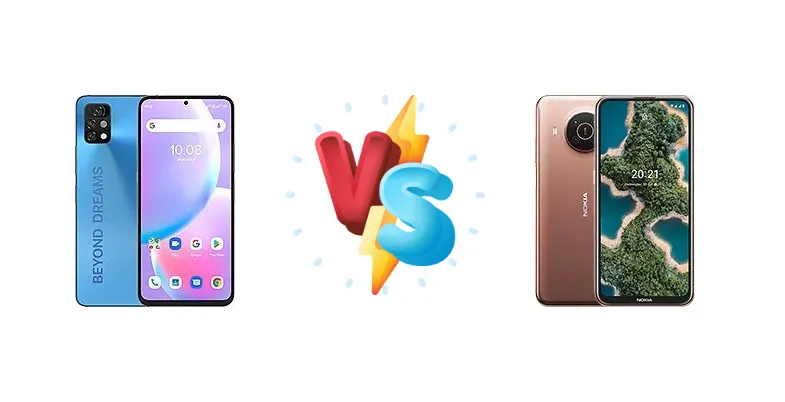
|
🏆 Quick Verdict
For the average user prioritizing future-proofing and efficient performance, the Nokia X20 emerges as the better choice. Its Qualcomm Snapdragon 480, built on an 8nm process, offers superior power efficiency and 5G connectivity compared to the Umidigi A11 Pro Max’s Mediatek Helio G80. While the Umidigi boasts a lower price, the Nokia’s long-term usability and smoother experience justify the slight premium.
| PHONES | ||
|---|---|---|
| Phone Names | Umidigi A11 Pro Max | Nokia X20 |
| Network | ||
|---|---|---|
| 2G bands | GSM 850 / 900 / 1800 / 1900 | GSM 850 / 900 / 1800 / 1900 |
| 3G bands | HSDPA 800 / 850 / 900 / 1700(AWS) / 1900 / 2100 | HSDPA 850 / 900 / 1700(AWS) / 1900 / 2100 |
| 4G bands | 1, 2, 3, 4, 5, 7, 8, 12, 13, 17, 18, 19, 20, 25, 26, 28, 34, 38, 39, 40, 41, 66 | 1, 2, 3, 4, 5, 7, 8, 12, 20, 28, 66, 38, 39, 40, 41 |
| 5G bands | - | 1, 2, 3, 5, 7, 28, 38, 41, 66, 78 SA/NSA/Sub6 |
| Speed | HSPA, LTE | HSPA, LTE, 5G |
| Technology | GSM / CDMA / HSPA / CDMA2000 / LTE | GSM / HSPA / LTE / 5G |
| Launch | ||
|---|---|---|
| Announced | 2021. Released 2021 | 2021, April 08 |
| Status | Discontinued | Available. Released 2021, May 12 |
| Body | ||
|---|---|---|
| Build | Aluminum frame | - |
| Dimensions | 167.8 x 75.6 x 8.6 mm (6.61 x 2.98 x 0.34 in) | 168.9 x 79.7 x 9.1 mm (6.65 x 3.14 x 0.36 in) |
| SIM | Nano-SIM + Nano-SIM | · Nano-SIM· Nano-SIM + Nano-SIM |
| Weight | 225 g (7.94 oz) | 220 g (7.76 oz) |
| Display | ||
|---|---|---|
| Protection | - | Corning Gorilla Glass 5 |
| Resolution | 1080 x 2460 pixels (~395 ppi density) | 1080 x 2400 pixels, 20:9 ratio (~395 ppi density) |
| Size | 6.8 inches, 109.8 cm2 (~86.6% screen-to-body ratio) | 6.67 inches, 107.4 cm2 (~79.8% screen-to-body ratio) |
| Type | IPS LCD | IPS LCD, 450 nits (typ) |
| Platform | ||
|---|---|---|
| CPU | Octa-core (2x2.0 GHz Cortex-A75 & 6x1.8 GHz Cortex-A55) | Octa-core (2x2.0 GHz Kryo 460 & 6x1.8 GHz Kryo 460) |
| Chipset | Mediatek Helio G80 (12 nm) | Qualcomm SM4350 Snapdragon 480 5G (8 nm) |
| GPU | Mali-G52 MC2 | Adreno 619 |
| OS | Android 11 | Android 11, upgradable to Android 14 |
| Memory | ||
|---|---|---|
| Card slot | microSDXC (dedicated slot) | microSDXC (uses shared SIM slot) |
| Internal | 128GB 4GB RAM, 128GB 8GB RAM | 128GB 6GB RAM, 128GB 8GB RAM |
| Main Camera | ||
|---|---|---|
| Features | Dual-LED flash, HDR, panorama | Zeiss optics, LED flash, HDR, panorama |
| Quad | - | 64 MP, (wide), PDAF 5 MP, (ultrawide) 2 MP (macro) Auxiliary lens |
| Single | - | 32 MP, (wide) |
| Triple | 48 MP, f/1.8, (wide), 1/2.0", AF 16 MP, f/2.2, 120˚ (ultrawide) 2 MP (macro) | - |
| Video | 1080p@30fps | 1080p@30/60fps |
| Selfie camera | ||
|---|---|---|
| Single | 24 MP, f/1.8, (wide) | 32 MP, (wide) |
| Video | 1080p@30fps | 1080p@30fps |
| Sound | ||
|---|---|---|
| 3.5mm jack | - | Yes |
| 35mm jack | Yes | Yes |
| Loudspeaker | Yes | Yes |
| Comms | ||
|---|---|---|
| Bluetooth | 5.0, A2DP, LE | 5.0, A2DP, LE, aptX HD |
| NFC | No | Yes |
| Positioning | GPS, GLONASS, GALILEO | GPS, GLONASS, GALILEO |
| Radio | No | FM radio |
| USB | USB Type-C, OTG | USB Type-C 2.0, OTG |
| WLAN | Wi-Fi 802.11 a/b/g/n/ac, dual-band, Wi-Fi Direct | Wi-Fi 802.11 a/b/g/n/ac, dual-band, Wi-Fi Direct |
| Features | ||
|---|---|---|
| Sensors | Fingerprint (side-mounted), accelerometer, proximity, compass, thermometer (skin temperature) | Fingerprint (side-mounted), accelerometer, gyro, proximity |
| Battery | ||
|---|---|---|
| Charging | 10W wired | 18W wired |
| Type | 5150 mAh | Li-Po 4470 mAh |
| Misc | ||
|---|---|---|
| Colors | Mist Blue, Frost Grey | Midnight Sun, Nordic Blue |
| Models | - | TA-1341, TA-1344 |
| Price | - | About 130 EUR |
| SAR | - | 1.04 W/kg (head) 0.62 W/kg (body) |
| SAR EU | - | 0.51 W/kg (head) 1.29 W/kg (body) |
Umidigi A11 Pro Max
- Potentially lower price point
- Likely larger display size
- Aggressive feature set for the price
- Less efficient Mediatek Helio G80 chipset
- Slower 10W charging
- Potentially less refined software experience
Nokia X20
- More efficient Qualcomm Snapdragon 480 chipset
- Faster 18W charging
- Cleaner Android software experience
- 5G connectivity
- Potentially higher price
- May have a smaller display
- Performance is still entry-level
Display Comparison
Neither device boasts a standout display. Both likely utilize IPS LCD panels, a common choice in this price bracket. However, the lack of detailed display specs (resolution, brightness) makes a direct comparison difficult. The Umidigi’s larger size *may* offer a more immersive viewing experience, but without knowing the Nokia X20’s screen size, it’s speculative. Color accuracy and viewing angles are likely similar, leaning towards acceptable but not exceptional.
Camera Comparison
Without detailed camera specs beyond the chipsets, a precise comparison is challenging. However, the Nokia X20 likely benefits from Qualcomm’s image signal processor (ISP), which generally delivers better image processing and noise reduction than Mediatek’s equivalent. The absence of information regarding sensor sizes is critical; a larger sensor generally captures more light and produces better images, especially in low-light conditions. It’s safe to assume both phones include basic camera setups, and any 2MP macro or depth sensors are unlikely to significantly impact image quality.
Performance
The core difference lies in the chipsets. The Nokia X20’s Qualcomm Snapdragon 480 (8nm) significantly outperforms the Umidigi A11 Pro Max’s Mediatek Helio G80 (12nm) in both CPU and GPU performance, and crucially, power efficiency. The 8nm process allows the Snapdragon 480 to maintain performance under sustained loads with less thermal throttling. While both CPUs feature a 2x2.0 GHz core configuration alongside six efficiency cores, the Kryo 460 cores in the Snapdragon 480 are architecturally more advanced than the Cortex-A75/A55 combination in the Helio G80. This translates to snappier app launches, smoother multitasking, and a more responsive user interface on the Nokia X20.
Battery Life
The Umidigi A11 Pro Max’s battery capacity is unknown, but the Nokia X20’s efficiency advantage with the Snapdragon 480 will likely result in comparable or even better real-world battery life despite potentially having a smaller battery. The Nokia X20 also supports 18W wired charging, a significant improvement over the Umidigi’s 10W charging. This faster charging speed will reduce the time spent tethered to a wall outlet, offering a more convenient user experience.
Buying Guide
Buy the Umidigi A11 Pro Max if you need maximum value for your money and are comfortable with a less refined software experience. It’s ideal for users who prioritize a large display and don't heavily rely on 5G connectivity. Buy the Nokia X20 if you prefer a cleaner Android experience, value long-term software support, and want a more efficient processor for everyday tasks and occasional 5G use. It’s the better choice for users who prioritize reliability and future-proofing.